




 Some of the links on this site may be affiliate links. ICOBench may receive advertising commissions when users visit recommended platforms via our affiliate links, at no additional cost to you. All recommendations are based on a comprehensive review process.
Senate Republicans introduced another revised version of the 635-page CLARITY Act on September 14, 2026, ahead of Tuesday’s procedural vote, adding an ethics framework backed by President Donald Trump that would restrict public officials and their spouses from issuing or sponsoring digital assets.
The immediate question is whether the last-minute changes are enough to secure the Democratic support Republicans need to clear the Senate’s 60-vote cloture threshold.
JUST IN: 🇺🇸 US Senators officially release final draft of the Crypto Clarity Act for voting on Tuesday.
— Watcher.Guru (@WatcherGuru) September 14, 2026
You’re Still Early: 10 AI Agent Coins That Could Win Big Next Bullrun
Senate Republicans Revise the CLARITY Act Ahead of the September 15 Vote
The new text requires officials to sell substantial crypto-related holdings or place them in a blind trust, and it splits enforcement authority between the Department of Justice and state attorneys general. That dual-enforcement structure directly answers a Democratic objection to an earlier version that left the DOJ as the sole enforcer of the ethics provisions.
The bill has already passed the House and cleared the Senate Banking Committee, but full Senate passage still hinges on Democratic votes. Background on how those procedural mechanics work, and why cloture is not the same as final passage, is covered in ICOBench’s earlier look at the CLARITY Act’s September 15 cloture vote.
After a year of intense daily bipartisan negotiations, this bill is ready. Here is the final text. President Trump voluntarily agreed to new ethics provisions holding every federally elected official, judge, and their spouses to some of the toughest ethics restrictions in U.S.…
— Senator Cynthia Lummis (@SenLummis) September 14, 2026
Don’t Miss: ETF Experts Predict The Next Crypto to Explode in 2026
What the New Text Would Change
Beyond the ethics compromise, the revised Blockchain Regulatory Certainty Act provisions now apply only to the Bank Secrecy Act and civil enforcement matters. Language that would have extended those protections to criminal proceedings, including cases brought under Section 1960, has been stripped out, while miners and validators are newly brought under the narrower shield.
The stablecoin-yield section now carries a circuit-breaker mechanism, first proposed by Senator Thom Tillis in July, that lets federal regulators intervene if stablecoin activity triggers significant withdrawals from community banks.
The draft also tightens limits on vertical integration and affiliate trading across digital commodity exchanges, brokers, and dealers, while confirming that state consumer-protection laws stay in force and that developer protections cannot override derivatives rules or prediction-market regulations.
Markets currently price a 37% chance the Clarity Act becomes law before Jan 2027, 48% before Apr 2027, and 69% before Jul 2027. Odds have risen sharply since August.
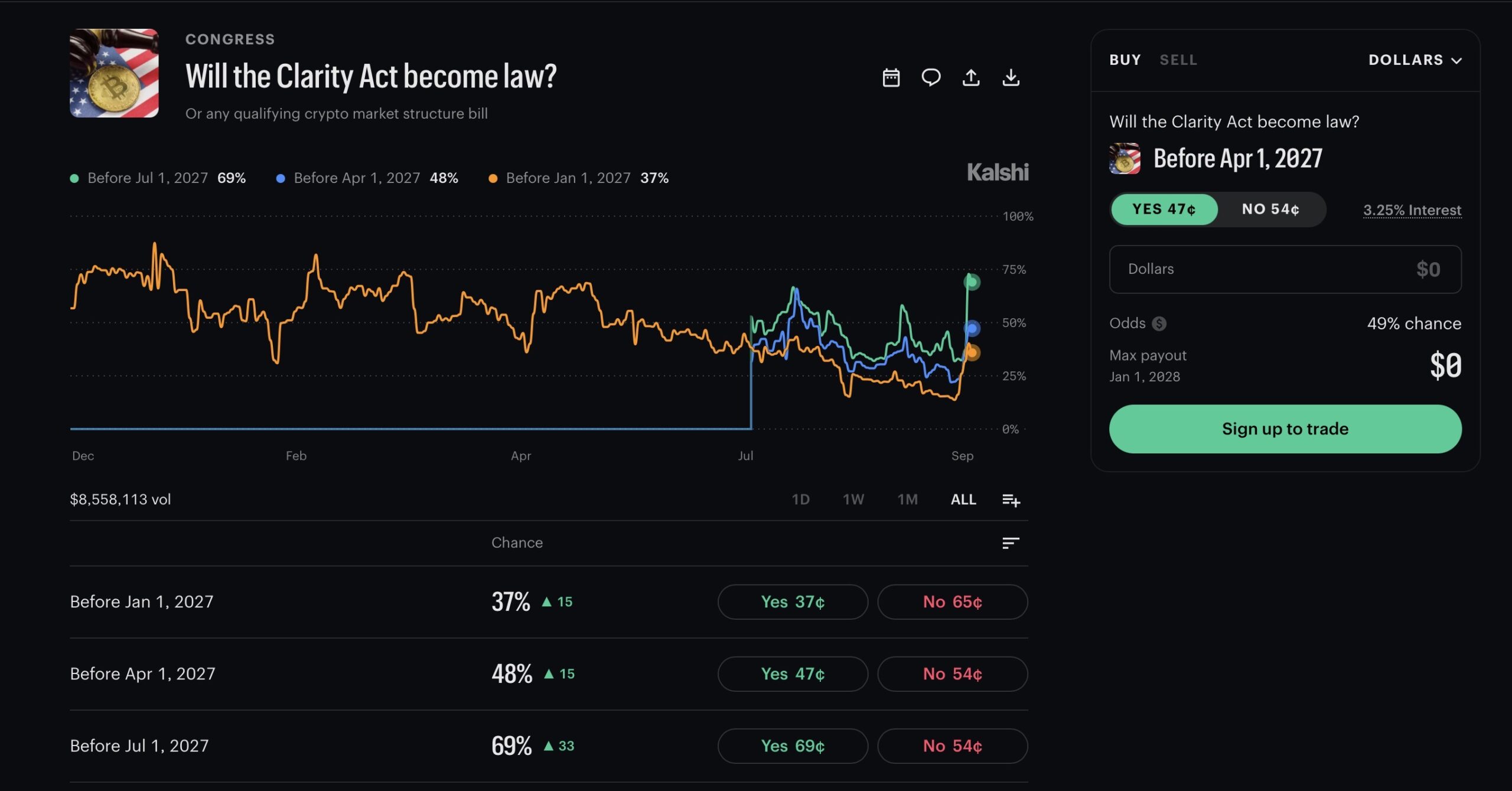
Whether the ethics concessions and new enforcement powers are enough to flip the necessary Democratic votes remains unresolved heading into the vote. The bill’s fate now rests on whether Republicans have finally closed the gap Democrats have held open since negotiations began.
You’re Still Early: 10 AI Agent Coins That Could Win Big Next Bullrun