




 Some of the links on this site may be affiliate links. ICOBench may receive advertising commissions when users visit recommended platforms via our affiliate links, at no additional cost to you. All recommendations are based on a comprehensive review process.
H.R. 3633, the House-passed Digital Asset Market Clarity Act, has a Senate cloture motion on the motion to proceed scheduled to ripen at 2:15 p.m. on Tuesday, Sept. 15, 2026, according to a Senate Democrats floor schedule notice. The scheduled action concerns whether to invoke cloture on the motion to proceed to the measure, while the bill’s broader legislative outcome remains unresolved.
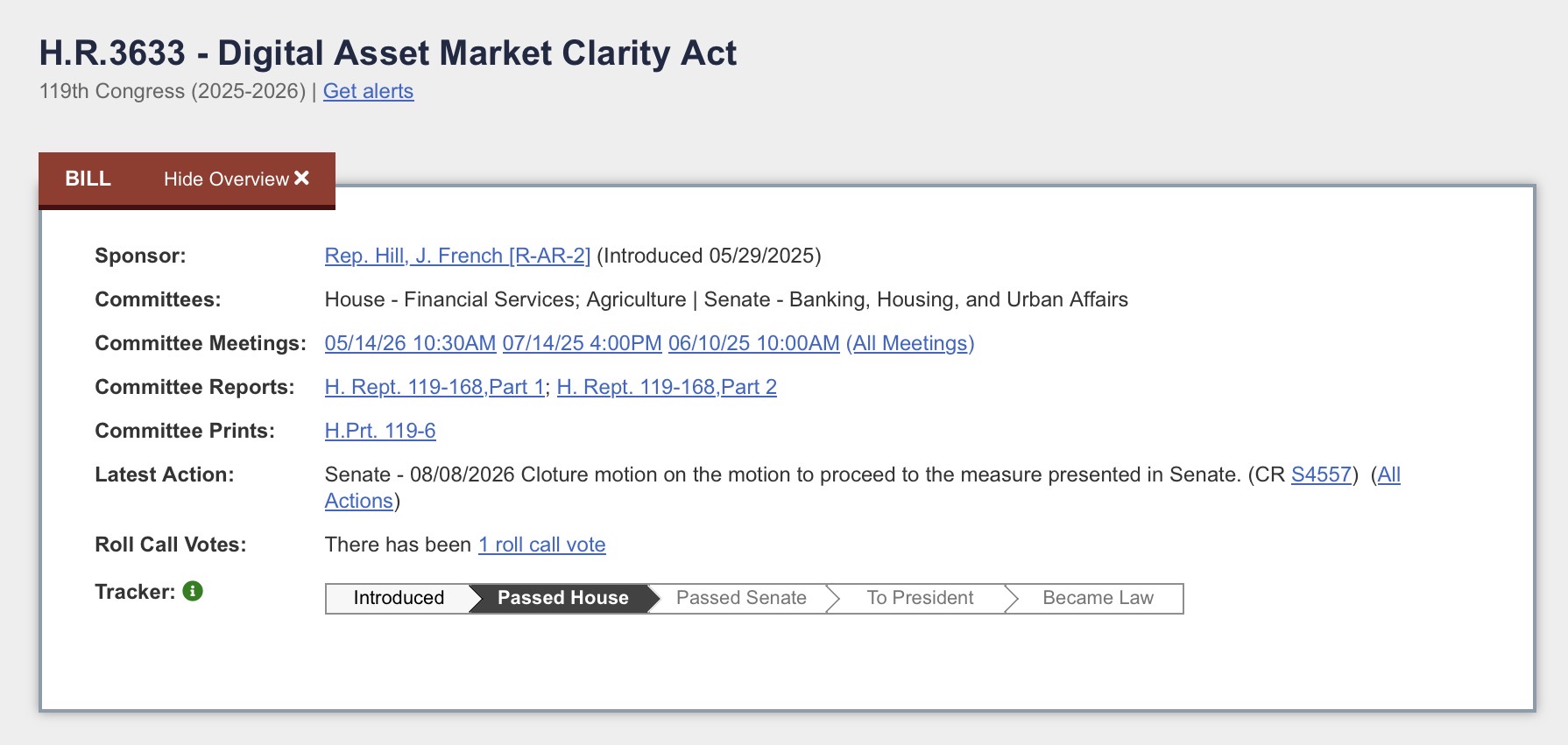
Congress.gov identifies H.R. 3633 as the Digital Asset Market Clarity Act of 2025. Rep. J. French Hill introduced the bill on May 29, 2025. The House passed it on July 17, 2025, by a 294-134 vote, and Congress.gov lists the Senate Banking, Housing, and Urban Affairs Committee among the measure’s committees. The official record lists the latest action as the presentation of a cloture motion on the motion to proceed in the Senate on Aug. 8, 2026.
You’re Still Early: 10 AI Agent Coins That Could Win Big Next Bullrun
Clarity Act: Senate Cloture Motion for H.R. 3633
The Senate Democrats’ schedule states that, after adjourning on Sept. 10, the Senate will next convene at 3 p.m. on Monday, Sept. 14, 2026. The notice says the cloture motion with respect to Calendar No. 423, H.R. 3633, will ripen on Tuesday, Sept. 15, at 2:15 p.m. It also identifies the filing as a cloture on the motion to proceed to the CLARITY Act.
That schedule provides a specific procedural milestone for the bill, but it does not establish final Senate passage. Congress.gov continues to show H.R. 3633 with a Passed House status, while its listed Senate action is the cloture motion on the motion to proceed. The Sept. 15 action is therefore a defined point in the Senate’s consideration of the measure rather than a record of the bill becoming law.
JUST IN: Rep. French Hill says there may be enough votes to PASS the CLARITY Act. 🚨
Huge statement coming directly from the House Financial Services Chair. 🏛️ pic.twitter.com/8HsjzjMoLK
— Bitcoin Archive (@BitcoinArchive) September 4, 2026
Don’t Miss: New Binance Listings That Could Erupt This Year
What the Senate Vote Means for Crypto Regulation
According to the Congressional Research Service summary on Congress.gov, the CLARITY Act would establish a regulatory framework for digital commodities, which the bill defines as digital assets that rely upon a blockchain for their value. The summary says the Commodity Futures Trading Commission would generally regulate digital-commodity transactions, including transactions involving digital commodity exchanges, brokers and dealers.

The bill sets conditions for digital commodities to trade on exchanges, requiring either a mature or decentralized blockchain (as defined) or specific issuer reporting. It covers trade monitoring, recordkeeping, and customer asset segregation.
Digital commodities on mature blockchains, or expected to mature within set timeframes, would be exempt from SEC registration if annual sales stay below a threshold and other conditions are met. The SEC would gain jurisdiction over certain digital-commodity activities involving specified brokers, dealers, and trading platforms.
Exchanges, brokers, and dealers would fall under Bank Secrecy Act anti-money-laundering rules, with added requirements for alternative trading systems and provisional registration.
The next scheduled Senate action is a concrete date to monitor. Its result would not alter the official tracker’s current Passed House status on its own, and Congress.gov does not list H.R. 3633 as having passed the Senate, reached the president, or become law.
Discover: Trade Crypto On MEXC


