Some of the links on this site may be affiliate links. ICOBench may receive advertising commissions when users visit recommended platforms via our affiliate links, at no additional cost to you. All recommendations are based on a comprehensive review process.
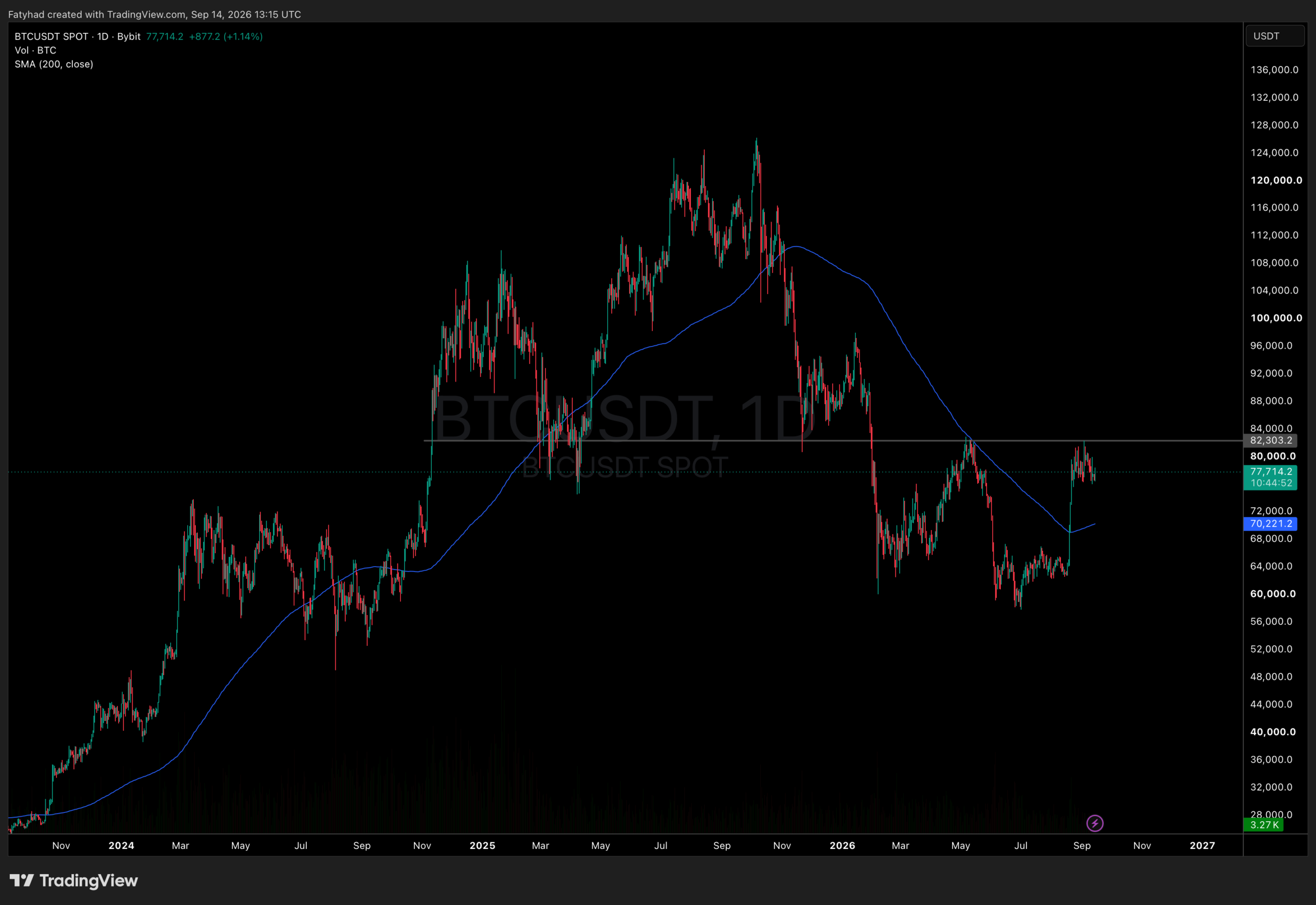
Bitcoin (BTC USD) sits near $77,714, up 1.14% on the day. The line that separates a confirmed bull market from another failed attempt is $81,700. That’s roughly $4,000 away. And the question is whether demand shows up before whales finish selling.
CryptoQuant defines its bull-market confirmation level as the average closing price of the past year, currently set at $81,700. Bitcoin has approached that threshold this month without delivering the weekly close required to trigger it. The September push stalled at $82,303 before sellers took it back.
At $77,714, the gap is thin: but thin gaps have failed before.
Don’t Miss: New Binance Listings That Could Erupt This Year
Bitcoin Faces a $77,100-$80,200 Supply Wall
The nearest resistance is between $77,100 and $80,200: directly in the path of any move toward confirmation. Long-term holders released as much as 539,000 BTC within that band during 2026, meaning the exact zone Bitcoin must clear is also where patient holders have chosen to exit.
Crypto analyst Moreno described the dynamic plainly:
The upper band marks where trader profit-taking has historically emerged.
Clear that zone with sustained demand and the next ceilings sit at $83,600 and $88,700. Fail, and the rejection risk compounds with every retest.
If the rally stalls and price retreats, support sits near $70,000 and again between $62,000 and $65,000, where holders accumulated roughly 476,000 BTC during 2026.
Someone just opened a $70,100,000 $BTC short with 40x leverage.
Liquidation Price: $80,103 pic.twitter.com/4sza7avcWn
— Ted (@TedPillows) September 14, 2026
Whale Transfers and Weak U.S. Spot Demand
JUST IN: BlackRock ETF clients sell $19.23 million worth of $BTC. pic.twitter.com/V3lrv1o16L
— Whale Insider (@WhaleInsider) September 14, 2026
CryptoQuant’s Exchange Whale Ratio hit 0.93 in a one-hour reading, a level the firm flags as an alert. It tracks how much exchange-bound Bitcoin originates from the largest wallets, since exchanges are where coins get sold. The reading covers a single hour, not a confirmed trend, but it lands at an inconvenient moment.
Retail sentiment, meanwhile, leans the other way. The Fear and Greed Index reads 66, inside greed territory, and a taker buy/sell ratio of 1.12 shows traders paying up for leveraged long exposure. U.S. institutions haven’t matched that enthusiasm. A negative Coinbase Premium means Bitcoin trades cheaper on the main American exchange than offshore, a signal that domestic funds haven’t fully joined the rally. Recent Bitcoin ETF outflows and the broader question of how much exposure flows through vehicles like BlackRock’s IBIT underscore the same gap: large-wallet selling plus tepid U.S. spot appetite is a supply overhang, not a confirmed breakdown.
If Bitcoin manages the required weekly close above $81,700 and demand absorbs the $77,100-$80,200 zone, $83,600 and $88,700 become the next objectives. Stronger Bitcoin ETF inflows would help make that case.
But per the primary reporting, the harder question is who actually buys a breakout when long-term holders and exchange-bound whales are both selling into the same zone U.S. funds are sitting out.
Don’t Miss: The Hottest Low-Cap Crypto Gems of 2026