

 Some of the links on this site may be affiliate links. ICOBench may receive advertising commissions when users visit recommended platforms via our affiliate links, at no additional cost to you. All recommendations are based on a comprehensive review process.
 If you have ever used cryptocurrencies beyond Bitcoin, chances are you have interacted with ERC-20 tokens. From stablecoins like USDT and USDC to DeFi and governance tokens, ERC-20 is one of the most widely used standards in the crypto ecosystem.
But what exactly are ERC-20 tokens, how do they work, and why are they so important?
In this guide, we’ll break down everything you need to know about ERC-20 tokens in simple terms, even if you’re completely new to crypto.
What Does “ERC-20” Mean?
ERC-20 stands for Ethereum Request for Comment 20.
It is a technical standard used for creating and issuing fungible tokens on the Ethereum blockchain. This standard defines a common set of rules that all ERC-20 tokens must follow so they can work seamlessly with wallets, exchanges, and decentralized applications (dApps).
Key Points:
- ERC = Ethereum Request for Comment
- 20 = Proposal ID number
- Introduced in 2015 and widely adopted by 2017
In simple terms, ERC-20 is like a universal blueprint that developers use to create Ethereum-based tokens that are compatible across the ecosystem.
How ERC-20 Tokens Work
ERC-20 tokens are powered by smart contracts running on the Ethereum blockchain.
A smart contract is a self-executing program that automatically handles token rules such as transfers, balances, and approvals without the need for intermediaries.
☆ Core ERC-20 Functions
Every ERC-20 token follows a standardized set of functions, including:
- Total Supply – Defines how many tokens exist
- Balance Of – Shows how many tokens an address holds
- Transfer – Sends tokens from one address to another
- Approve – Grants permission to spend tokens
- Transfer From – Allows approved third parties to transfer tokens
Because every ERC-20 token follows these same rules, wallets and exchanges can support thousands of tokens without custom integrations.
☆ Fungibility Explained
ERC-20 tokens are fungible, meaning:
- Each token is identical in value and function
- One ERC-20 token can be exchanged for another of the same type
This is different from NFTs (ERC-721), which are unique and non-interchangeable.
Why Are ERC-20 Tokens Important?
ERC-20 tokens play a crucial role in the growth and adoption of blockchain technology.
- Standardization
Before ERC-20, token creation was inconsistent. ERC-20 introduced a unified standard, making tokens easier to create and use.
- Interoperability
ERC-20 tokens work smoothly with:
- Crypto wallets (like MetaMask)
- Centralized and decentralized exchanges
- DeFi platforms and dApps
- Faster Development
Developers don’t need to build token logic from scratch, reducing errors and speeding up innovation.
- Foundation of DeFi
Most DeFi protocols, liquidity pools, yield farming platforms, and DAOs rely on ERC-20 tokens. Without ERC-20, Ethereum’s ecosystem would be fragmented and far less efficient.
Common Use Cases of ERC-20 Tokens
ERC-20 tokens are used across many sectors of the crypto industry:
🔹 Stablecoins
Tokens pegged to fiat currencies, such as:
- USDT (Tether)
- USDC (USD Coin)
🔹 DeFi Tokens
Used for lending, borrowing, staking, and liquidity provision.
🔹 Governance Tokens
Allow holders to vote on protocol upgrades and decisions in DAOs.
🔹 Utility Tokens
Provide access to services, platforms, or products within a blockchain ecosystem.
🔹 ICO & Token Launches
Most Initial Coin Offerings (ICOs) and token sales are built using the ERC-20 standard.
ERC-20 vs BEP-20
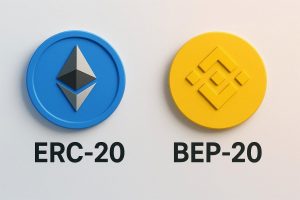
ERC-20 is often compared with BEP-20, the token standard used on Binance Smart Chain (BSC).
| Feature | ERC-20 | BEP-20 |
| Blockchain | Ethereum | Binance Smart Chain |
| Fees | Higher (gas fees) | Lower |
| Ecosystem | Largest & most secure | Faster & cheaper |
| Decentralization | Very high | Moderate |
Key Difference:
- ERC-20 prioritizes security and decentralization
- BEP-20 focuses on speed and low transaction costs
Both standards are widely used, but ERC-20 remains the most established and trusted.
Risks & Limitations of ERC-20 Tokens
While ERC-20 tokens are powerful, they come with some drawbacks:
⚠️ High Gas Fees
Ethereum network congestion can lead to expensive transaction fees.
⚠️ Smart Contract Risks
Poorly written contracts can contain vulnerabilities or bugs.
⚠️ Irreversible Transactions
Once tokens are sent to the wrong address, they cannot be recovered.
⚠️ Scam Tokens
Anyone can create an ERC-20 token, making scams and fake projects a risk for beginners.
Always verify token contracts and use reputable platforms.
Conclusion
ERC-20 tokens are the backbone of Ethereum’s ecosystem and one of the most important innovations in blockchain history.
By introducing a standardized, interoperable, and developer-friendly framework, ERC-20 made it possible for:
- Thousands of cryptocurrencies to exist
- DeFi to flourish
- Ethereum to become the leading smart contract platform
Whether you are an investor, developer, or beginner, understanding ERC-20 tokens is essential for navigating the crypto world confidently.
Visit the ICObench Academy to learn more about crypto.