

 Some of the links on this site may be affiliate links. ICOBench may receive advertising commissions when users visit recommended platforms via our affiliate links, at no additional cost to you. All recommendations are based on a comprehensive review process.
XRP news today centers on Privy, which announced a partnership with Ripple on October 13 to bring its programmable wallet infrastructure to the XRP Ledger (XRPL). The integration gives developers tools to build payment and agentic-commerce applications with XRP, RLUSD, and other XRPL assets.
This partnership is extending the network into embedded stablecoin payments and AI-agent payments. The market has not reacted yet: XRP trades at $1.3656 on Binance, +1% in the last 24 hours but still down 6.3% over seven days.
That gap is the real question. Access to new infrastructure does not by itself establish lasting demand for XRP or RLUSD, so the news matters only if developers build applications that people actually use. The sections below look at what the integration enables and whether XRP can hold $1.31 while that adoption story develops.
Don’t Miss Out on Binance’s Latest Trading PairsBroadening access to XRPL, from everyday payments to agentic commerce.
We’re partnering with @privy_io, a Stripe company, to bring embedded wallets to the XRP Ledger. Developers will be able to build payment experiences with XRP, RLUSD and other digital assets on XRPL directly… https://t.co/eJXsm5bHIZ pic.twitter.com/rIu4HiN6tc
— Ripple (@Ripple) October 13, 2026
XRP News Today: What Does Privy’s XRPL Wallet Integration Enable?
Developers will be able to create and manage XRPL wallets through Privy. They can also sign transactions with its wallet infrastructure. The tools are built for products that use XRP, Ripple’s RLUSD stablecoin, and other ledger assets. Fintechs and payment companies can use them to build blockchain payments into their apps.
Embedded wallets mean users no longer have to manage keys directly. Server-side wallets let software agents hold funds and make transactions. That includes x402 payments, a capability aimed at machine-to-machine commerce and not conventional checkout. Users can still export their private keys and seed phrases, so access does not depend on a single application.
Privy describes the XRPL as a decentralized Layer 1 blockchain. It offers fast settlement, low costs and support for stablecoins and tokenized real-world assets. The company says the network has more than 8 million funded accounts. It also says the network has moved $1 trillion in value over more than 14 years. These are company figures and not independent adoption measures.
XRPL’s PermissionDelegation amendment points in the same direction. It covers delegated transaction permissions, which suit managed payment workflows.
Privy’s announcement itself focuses on wallet creation, signing, and portability.
You’re Still Early: 10 AI Agent Coins That Could Win Big Next Bullrun
Can XRP Price Hold $1.31 as the Wallet Infrastructure Arrives?
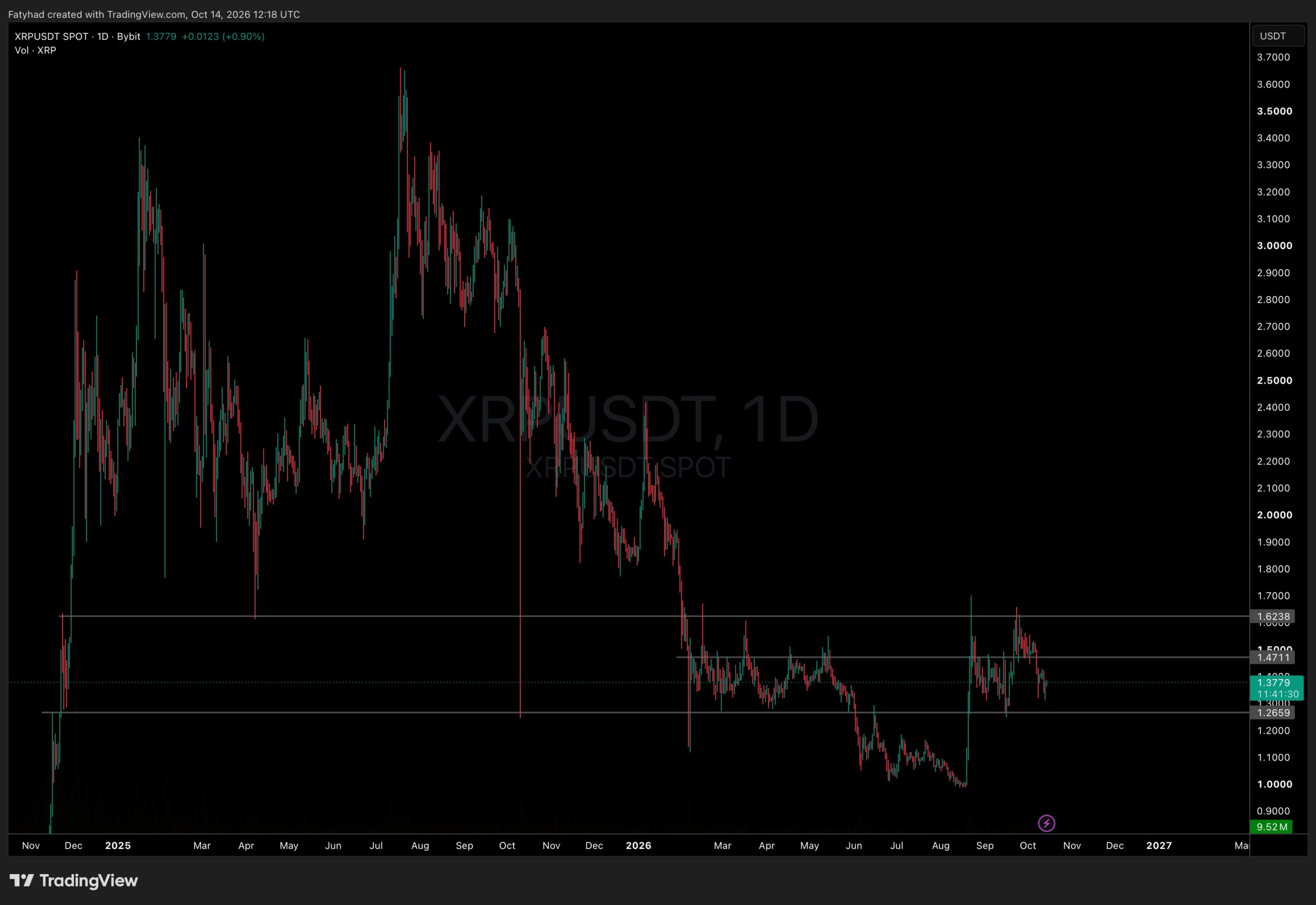
XRP news today has not moved the chart much. The token is up 1% in the last 24 hours and down 6.3% over seven days and 9.9% over 14 days. It slid from near $1.50 in early October and dipped to about $1.31 before recovering. Daily volume is $1.72 billion, about 2% of its $86.04 billion market cap, which is steady trading and not a surge of new demand after the announcement.
Lasting demand for XRP or RLUSD depends on whether developers ship applications that people use, so the price levels matter more in the short term.
Support is positioned at $1.27, while $1.31 marks the recent low. Resistance lies between $1.45 and $1.47, near the 50-day and 200-day exponential moving averages around $1.40, and $1.62 represents the yearly ceiling.
Don’t Miss: ICOBench Experts Call the Next 1000x Crypto Coins for 2027