


 Some of the links on this site may be affiliate links. ICOBench may receive advertising commissions when users visit recommended platforms via our affiliate links, at no additional cost to you. All recommendations are based on a comprehensive review process.
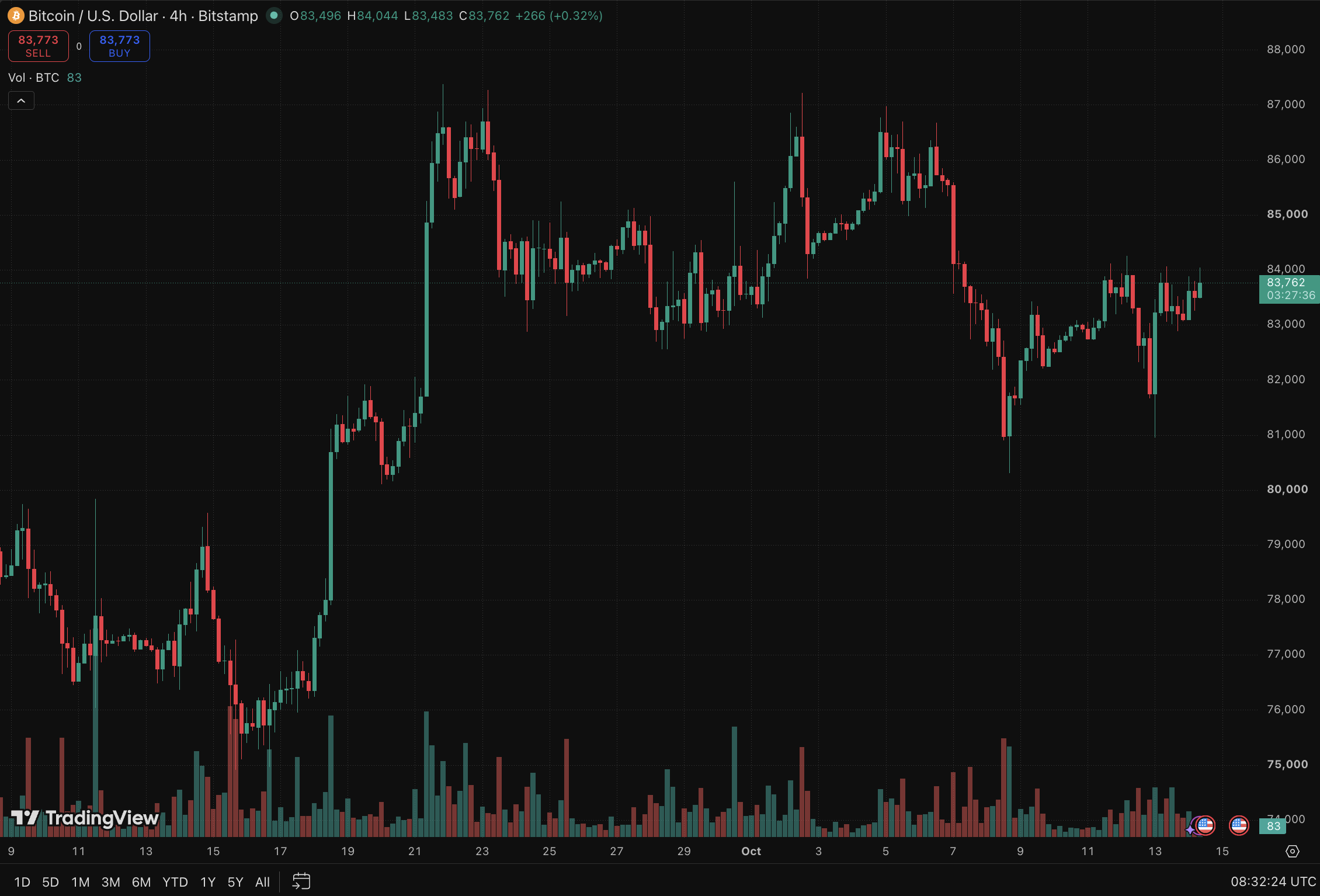
In today’s Bitcoin news, BTC recovered to above $83,000 yesterday after dipping just under $81,000 at midnight, according to CoinGecko data.
The rebound came as South Korea’s KOSPI fell more than 6% and Nasdaq futures declined, offering an early sign of crypto-specific resilience, but only across one trading session, not proof of a durable Bitcoin decoupling from risk markets.
As of this morning’s trading session, BTC USD is currently trading at $83,700, essentially flat over the past 24 hours, with daily trading volume sitting at $27.3Bn.
Bitcoin Recovered as Korean Stocks and Nasdaq Futures Slid
The price sequence makes the divergence measurable: bitcoin initially weakened alongside Asian equities, then reclaimed $83,000 while pressure on Korean shares and US technology futures persisted.
The KOSPI fell below 6,000 intraday, reaching its lowest level since late July; Samsung Electronics and SK Hynix each lost roughly 8% in the primary report’s market snapshot.
Nasdaq futures were down 0.6% after the Nasdaq Composite fell -0.78% on Monday, while Hong Kong’s Hang Seng slipped 0.4%.
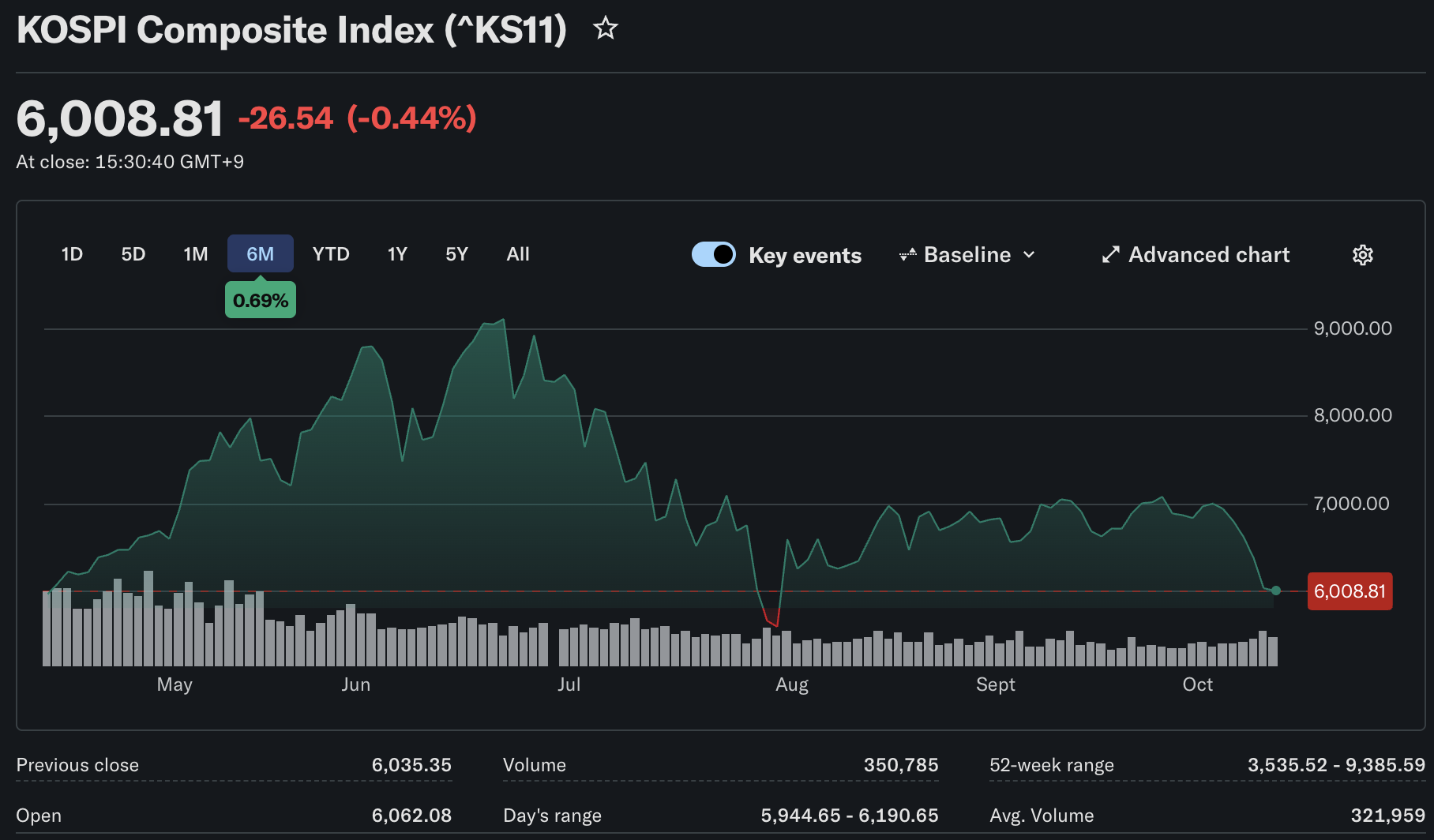
Those moves put bitcoin’s recovery against a clear risk-off backdrop, but a single-session price divergence does not show capital rotating from Korean shares into BTC or a structural change in the relationship.
That distinction matters for short-term positioning. A rebound after a sharp dip can reflect market-clearing leveraged exposure as well as fresh demand, so price alone does not confirm sustained spot buying.
Oil and the Dollar Keep Macro Pressure in Play
THE REAL PRICE OF OIL IS MUCH HIGHER THAN YOU THINK.
Physical Brent crude surged above $154 per barrel, its highest level since records began in 1991.
The gap between physical oil prices and Brent futures has widened to a record $50+ per barrel.
Buyers are paying huge premiums… pic.twitter.com/Mt5W0yT9uB
— Bull Theory (@BullTheoryio) October 12, 2026
Bitcoin’s short-term strength is unfolding alongside macro conditions that can still weigh on risk assets. WTI crude traded near $92.67, and Brent hovered around $106 as fresh attacks in Saudi Arabia and continued threats to shipping through the Strait of Hormuz kept energy supply uncertainty elevated, according to the primary report.
Higher oil prices can feed inflation concerns and strengthen the case for Federal Reserve rate increases, a potential headwind for cryptocurrencies.
The Dollar Index held near 102.50, its highest level since April 2025; a firm dollar and rising yields would complicate the case that BTC can remain insulated from broader financial conditions.
This is why Treasury yields and inflation conditions remain relevant to Bitcoin price analysis, even during an apparent equity-market divergence.
These are the crypto macro signals that keep the rebound provisional: elevated oil, a strong dollar, and the risk that inflation expectations push policy rates higher.
Bitcoin’s move is notable because it recovered while equity futures remained weak, but it does not erase the macro channels through which tighter financial conditions can affect demand for volatile assets.
Thursday’s US CPI Data Drop Is the Next Test of Bitcoin’s Resilience
🚨 REMINDER: 🇺🇸 U.S. CPI DATA DROPS TODAY AT 8:30 AM ET!
Previous: 3.4% • Forecast: 3.6%
IF INFLATION > 3.6% → MARKETS CRASH HARD
IF INFLATION < 3.6% → MARKETS RALLY HARD
IF INFLATION = 3.6% → EXPECT A MIXED REACTION pic.twitter.com/G8Ckx0lZjV
— Crypto Rover (@cryptorover) October 14, 2026
The upcoming U.S. CPI report is the next major catalyst identified in the source coverage. A hotter reading could lift Treasury yields and the dollar, restoring pressure across risk assets; softer inflation could ease that pressure and support Bitcoin’s relative strength.
The recovery above $83,000 therefore marks an early stress-test success, not a declaration of permanent decoupling. Derivatives deleveraging may also have helped the rebound, leaving follow-through, not one isolated session, as the key confirmation.
The immediate scoreboard is clear: Bitcoin recovered from below $81,000, while the KOSPI remained more than 6% lower intraday, and tomorrow’s U.S. inflation reading awaited.
Don’t Miss Out on Binance’s Latest Trading Pairs