


 Some of the links on this site may be affiliate links. ICOBench may receive advertising commissions when users visit recommended platforms via our affiliate links, at no additional cost to you. All recommendations are based on a comprehensive review process.
Ethereum researchers reported that a segmented broadcasting design under draft proposal EIP-8411 cut the simulated median propagation time for a 1 MiB execution payload from roughly five seconds to about 0.75 seconds, according to a write-up on Ethereum Research.
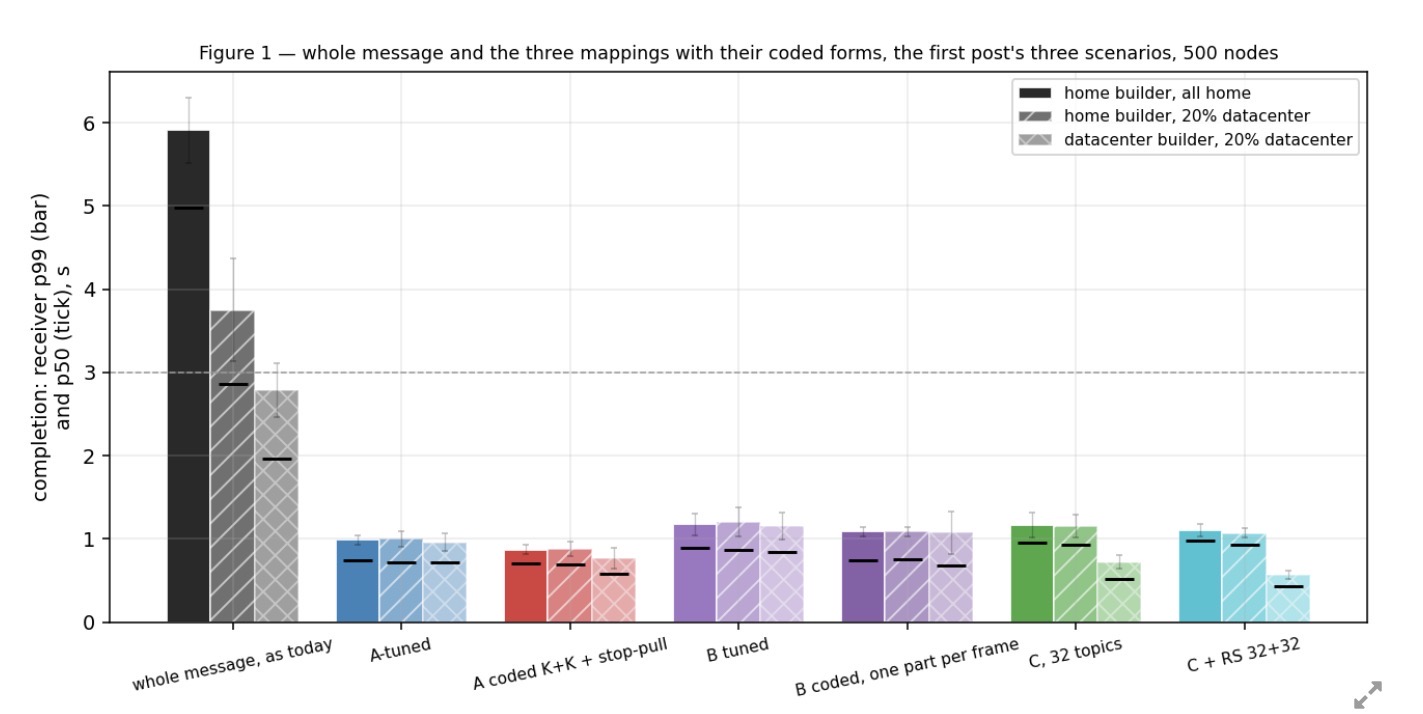
The test modeled 500 nodes with geographic latency, 50 Mbps upload and 100 Mbps download capacity. The payload was sent from a home builder rather than a high-bandwidth data-center node. Researchers ran real Prysm and go-libp2p-pubsub code on a simulated network and virtual clock. They repeated each measurement across ten randomized configurations so the results would not depend on a single lucky topology.
Sending the full payload as one gossipsub message reached half the network in about five seconds, and the slowest nodes received it near six. The tuned segmented variant cut those figures to roughly 0.75 seconds and one second.
Don’t Miss: ETF Experts Predict The Next Crypto to Explode in 2026
EIP-8411 Replaces Whole-Payload Waiting With Segmented Broadcasts
EIP-8411 replaces the single execution_payload gossip topic from EIP-7732 with a new execution_payload_chunks topic. Nodes no longer need to wait for the complete payload before passing it on. Instead, they can verify and forward independently authenticated segments as they arrive, checking each one against a Merkle root carried in the builder’s execution bid.
The proposal was opened Sept. 4, 2026, and remains an unapproved Draft networking EIP. It also depends on EIP-7732, Ethereum’s enshrined proposer-builder separation design. For more on how draft upgrades move through the design process, see this Ethereum account abstraction explainer.
The results come from a controlled simulation using prototype client code, not from measurements on Ethereum mainnet, so any real-world gains would still need to be confirmed. The researchers described their branch as “a harness, not a proposal.”
Sign Up With MergeX And Trade CryptoEthereum researchers just exposed the hidden dependency behind fast block propagation:
datacenters.Then they removed them.
1 MiB payload.
500 nodes.
Home-grade bandwidth.
No high-bandwidth datacenter nodes.GossipSub: ~5s median
Segmented propagation: ~0.75sBut the more… https://t.co/7k0tjOGEQR pic.twitter.com/cytAvwJtwr
— slymnogunc (@slymnogunc) September 17, 2026
This Is How the Design Trades Speed for Network Overhead
Ethereum’s current gossip model can cause a store-and-forward delay. A node must receive and validate an entire large message before relaying it. The basic Tier 1 design uses 16 KiB segments plus batch publishing. It cut the 1 MiB median from five seconds to under one second. Tail latency also fell, from roughly six seconds to just over one. The tradeoff is about one-third more received bytes than today’s whole-message approach.
More advanced variants target that duplicate-byte overhead directly. One approach, disciplined pulls, has a node request a missing segment from one peer. If that peer times out, the node falls back to another. This cut received traffic to around 1.5 payload copies per node. However, tail latency rose when peers withheld segments they had advertised.
A third tier adds Reed-Solomon erasure coding on top. It produced the lowest tail latency in testing and kept working under withholding. The cost is higher bandwidth demand at the source. That tradeoff matters for Ethereum’s post-Glamsterdam scaling roadmap. Larger gas limits and execution payloads are expected to strain node bandwidth further.
The researchers also flagged several open questions. These include control-message traffic and CPU cost from processing many smaller messages. Queue management, timer tuning and client coordination also remain unresolved.
ACDC Weighs EIP-8411 for Ethereum Hegotá
After a month of community outreach, @ethlabs_org is shipping a major piece on a faster Ethereum with faster L1 blocks, collecting perspectives from all corners of the ecosystem.
Ethereum core developers are in the final stretches of deciding what to include in Hegotá, the… https://t.co/s30H0Zi5cw
— Barnabé Monnot | barnabé.eth (@barnabemonnot) September 17, 2026
Ethereum developers requested Proposed for Inclusion status for EIP-8411 in Hegotá, the network upgrade expected after Glamsterdam, with the request arriving after the normal Hegotá PFI deadline. The ACDC #187 agenda scheduled a PFI discussion for Sept. 17 at 14:00 UTC, but at the time of the primary report that call had not yet taken place and no inclusion decision had been recorded.
Prototype implementations for Prysm and go-libp2p-pubsub are already published, but the researchers caution that advanced erasure-coding configurations remain experimental test-environment features rather than confirmed parts of the minimum EIP-8411 specification. Whether EIP-8411 becomes a core piece of Ethereum scaling infrastructure now hinges on a core-developer decision still to come.
You’re Still Early: 10 AI Agent Coins That Could Win Big Next Bullrun


