


 Some of the links on this site may be affiliate links. ICOBench may receive advertising commissions when users visit recommended platforms via our affiliate links, at no additional cost to you. All recommendations are based on a comprehensive review process.
Ethereum and Base developers have abandoned efforts to agree on a common account-abstraction standard after failing to reconcile EIP-8141 and EIP-8130. Ethlabs developer Derek Chiang said the authors stopped pursuing a shared specification once it became clear that every available technical option would force one side to compromise on core requirements.
The split reflects diverging priorities: Ethereum developers are focused on censorship resistance, privacy, and security, while Base emphasizes scale, customization, and compliance. Both proposals aim to simplify smart wallet interactions, enabling transactions without users holding ETH for gas, and supporting authentication methods like phone passkeys, but neither could accommodate the other’s goals.
The practical cost falls on wallet developers. If both proposals reach production, wallets may need to support two native transaction formats.
Ethereum and Base have failed to agree on a shared account abstraction standard.
The two networks will now pursue separate approaches, with Ethereum backing EIP-8141 and Base pushing EIP-8130.
Both are designed to make Ethereum wallets easier to use, including features like… pic.twitter.com/uM6Af7jxl4
— That Martini Guy ₿ (@MartiniGuyYT) September 15, 2026
You’re Still Early: 10 AI Agent Coins That Could Win Big Next Bullrun
Two Standards, One Experience? Chiang Downplays Fragmentation Fears
Chiang did not frame the split as inevitably worsening the user experience. Wallets could still deliver a consistent experience across networks despite the technical differences, he said, depending on how developers implement support for each standard.
I'm sad to report that the AA collab between 8130 and 8141 (Frames) broke down last week, and Base and Ethereum are now going separate ways to implement different AA standards.
I want to share some reflections on this collab and on the future of the EVM.
For a long time, the…
— Derek Chiang | Ethlabs (@decentrek) September 14, 2026
That outcome hinges on wallet developers abstracting away the differences. The proposals share account-abstraction goals but rest on distinct transaction and validation structures. A unified experience remains possible, at the cost of cross-wallet ecosystem work.
- EIP-8130 uses an onchain keystore where accounts register approved actors and authenticator contracts. Transactions specify which authenticator they use, allowing the network to determine the required validation process before executing wallet code. The proposal adds a new transaction type alongside this account-configuration system.
- EIP-8141 instead structures transactions as programmable contract calls called frames, which can handle validation, gas approval, and execution within a single transaction. The design targets sponsored gas payments, batching, alternative signature systems, and key rotation. Efforts to merge the two approaches into one standard have now been abandoned.
Diverging Paths: Ethereum Hegotá vs. Base
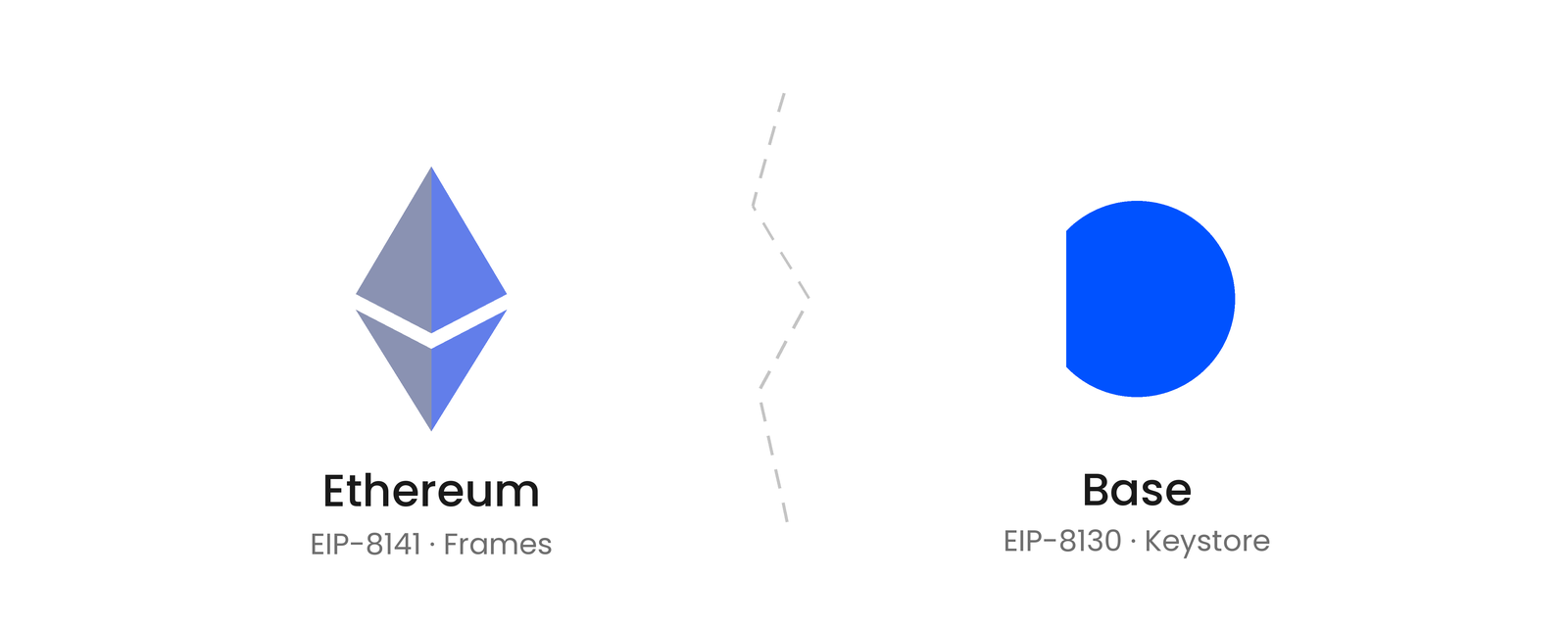
Ethereum is advancing EIP-8141 (Frame Transactions) in its planned 2027 Hegotá upgrade. The Ethereum Foundation Protocol cluster marked it must-ship this month, and core developers moved it to Scheduled for Inclusion on the Aug. 27 All Core Developers Execution call, despite its draft specification. Under the design, apps could cover user fees or accept alternative assets, while validators still receive ETH, with accounts represented by a code address.
Base is pursuing EIP-8130 independently, pairing a new transaction type with an on-chain keystore. Accounts register actors with authenticator contracts, making validation requirements explicit before wallet code runs.
The next question is whether either or both designs reach production and whether wallet developers can bridge the resulting fragmentation. Their shared objective of improving wallet interaction remains, but the route to that objective is now being developed through separate standards.
Don’t Miss: ETF Experts Predict The Next Crypto to Explode in 2026


