


 Some of the links on this site may be affiliate links. ICOBench may receive advertising commissions when users visit recommended platforms via our affiliate links, at no additional cost to you. All recommendations are based on a comprehensive review process.
Smart money has started to rotate into high-beta names even after Bitcoin failed to recapture $80,000 over the last few days, and that split is why the search for the best altcoins has intensified this week. Injective has climbed about 11% in the last 24 hours to pass $6.30, taking its market cap to $629.6 million, and Pieverse has posted a 12.4% move, changing hands near $1.21 with a $361 million valuation as traders piled into its on-chain payment and invoice rails. Polkadot has also joined the run, with DOT up 11% to $1.08, lifting its market cap to $1.85 billion after the token found a floor at $0.73 in mid-August.
Looking at the bigger picture, those coins’ impressive gains stand out even further. The total crypto market cap is $2.69 trillion, down 0.35% on the day; Bitcoin has fallen 0.71% to $78,730; and ETH is little changed near $2,490. Markets are assigning a 60.4% chance of an FOMC interest rate increase next week, while an Altcoin Season reading of 46 shows Bitcoin still absorbing most of the latest flows.
Presales have kept attracting capital throughout this grind, and serious investors have taken the success of INJ, Pieverse, and DOT as a signal to buy into other advanced Web3 infrastructure projects. This is why BNB (BNB), LiquidChain (LIQUID), and Bitcoin Hyper (HYPER) have become the best altcoins to buy right now. BNB is the native token of the Binance ecosystem, and has already added 10% in a week; LiquidChain is funding a Layer 3 that ties Bitcoin, Ethereum, and Solana together; and Bitcoin Hyper is building a new BTC Layer 2 while raising more than $33 million through its native token presale.
BNB (BNB)
BNB (BNB) was first launched in 2017 as a fee-discount asset on Binance, and became the base currency of BNB Chain after its 2019 mainnet launch. The coin is used to pay for block space on BNB Smart Chain, the opBNB Layer 2, and BNB Greenfield. Holders can also vote on chain upgrades, and a programmed Auto-Burn trims supply over time toward a 100 million target.
Binance’s native cryptocurrency is now trading at $756, up 1.8% over 24 hours and 10.2% over seven days. That move has pushed BNB’s market cap to $100.74 billion, making the token the fourth-largest crypto by market cap, with $1.1 billion in trading volume over the past day.
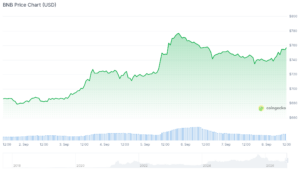
BNB’s all-time high of $1,370.55, set last October, still sits far above the coin’s current price, which leaves more than enough upside room if the latest bid continues. BNB’s combination of fee demand, supply reduction, and a 10% weekly gain offers a chance to add to those advances through the rest of Q3.
LiquidChain (LIQUID)
LiquidChain (LIQUID) is a Layer 3 network built to run Bitcoin’s capital, Ethereum’s decentralized applications, and Solana-speed execution in one place. The design will use a high-performance virtual machine and trust-minimized proofs to verify Bitcoin UTXOs, Ethereum states, and Solana accounts, so a transaction can settle atomically across those chains.
Assets from the three networks will be represented in shared liquidity pools without wrapping, so developers can ship a dApp, prediction market, or other smart contract just once and reach users on all three main chains.
A little of this chain. A little of that chain.
Then things get interesting. 👁️ pic.twitter.com/ybu9a1L0o0
— LiquidChain (@getliquidchain) September 7, 2026
The LIQUID token is required for users to pay for network use, staking, and access to Layer 3 features. Total supply is 11.8 billion tokens, with 35% reserved for development, 32.5% for LiquidLabs growth work, 15% for AquaVault’s community and business programs, 10% for rewards, and 7.5% for exchange listings and expansion.
The live LIQUID presale has raised more than $960,000. LIQUID is priced at $0.014953 in the current stage, and buyers can stake from the moment of purchase at a 1,183% APY. A cheap entry into a chain that will merge the Web3 industry’s three deepest liquidity pools, and provides an outsized staking rate even during its token presale, gives LiquidChain a strong case for a run-up into its first listings.
Bitcoin Hyper (HYPER)
Bitcoin Hyper (HYPER) is a Bitcoin Layer 2 that will pair Layer 1 settlement with the Solana Virtual Machine to power high-throughput smart contracts. Users will send BTC to a canonical bridge so a relay program can check block headers and proofs, then mint an equivalent balance on the Layer 2. Transfers on that layer will finalize almost immediately and can feed staking, swaps, and other on-chain apps.
Batched transactions will be compressed, verified with zero-knowledge proofs, and written back to Bitcoin’s Layer 1, so that the L2 state remains tied to the base chain.
Follow the bolts. Find Hyper Speed. ⚡️https://t.co/VNG0P4GuDo pic.twitter.com/eLagJv5Lmf
— Bitcoin Hyper (@BTC_Hyper2) September 7, 2026
HYPER is the gas, staking, and governance token for the new L2. Supply is capped at 21 billion, a nod to Bitcoin’s own limit, split 30% to development, 25% to treasury, 20% to promotion, 15% to rewards, and 10% to listings. Coinsult and SpyWolf have completed audits, and mainnet and exchange listings are targeted later in 2026.
The HYPER presale has brought in $33.11 million, and HYPER is currently selling for $0.0136859 per token. Buyers can stake their HYPER for a dynamic 35% APY. As the new Layer 2 will allow BTC to move quickly and earn yield, and is being funded with more than $33 million, Bitcoin Hyper is one of the best altcoins to buy as an early-stage bet with high upside potential this year.