

 Some of the links on this site may be affiliate links. ICOBench may receive advertising commissions when users visit recommended platforms via our affiliate links, at no additional cost to you. All recommendations are based on a comprehensive review process.
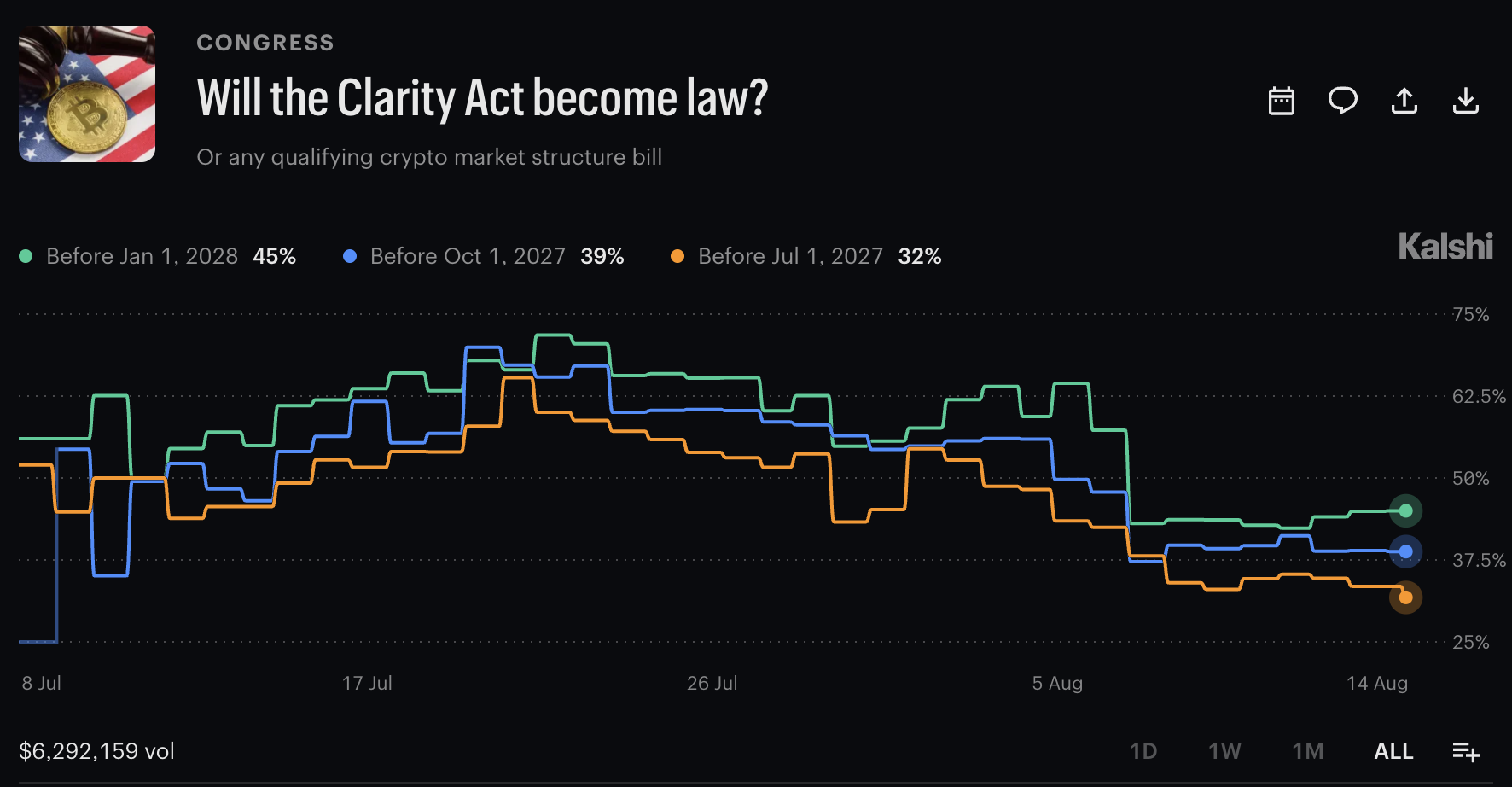
In SEC regulation news today, the Senate adjourned on Aug. 8 without holding a final vote on the Digital Asset Market Clarity Act of 2025, also known as the CLARITY Act. The Senate is in recess until Sept. 14, according to the ABA Banking Journal.
Congress.gov lists the latest action on H.R. 3633 as a Senate cloture motion on the motion to proceed to the measure, presented on Aug. 8, 2026. Its bill tracker lists the measure as having passed the House.
The congressional record identifies the measure as H.R. 3633, the Digital Asset Market Clarity Act of 2025.
It was introduced on May 29, 2025, by Rep. J. French Hill, and the House passed it on July 17, 2025, by a 294-134 vote. The Senate Banking, Housing, and Urban Affairs Committee reported the bill on June 1, 2026, with an amendment in the nature of a substitute.
Where the CLARITY Act Stands
The reported Senate text describes the legislation as a measure to provide for regulation of the offer and sale of digital commodities by the Securities and Exchange Commission and the Commodity Futures Trading Commission. It also includes provisions amending the Federal Reserve Act and provisions concerning central bank digital currency.
The Aug. 8 Senate action did not produce a final vote on the bill. The ABA Banking Journal reported that further action was pushed until at least September. Congress.gov continues to show the Senate cloture motion on the motion to proceed as the latest listed action.
The bill has moved through several stages since its introduction. The House vote occurred in July 2025, after which the measure was received in the Senate and referred to the Banking, Housing, and Urban Affairs Committee. The committee later reported a version containing a substitute amendment. Congress.gov lists five text versions, including the House-engrossed text and the version reported to the Senate.
DISCOVER: Best Crypto Presales to Watch Right Now
What Is in the Senate-Reported Text
The Senate-reported version is organized around definitions, rulemaking, and registration provisions for digital-asset activity. Its table of contents includes definitions under the Securities Act of 1933, the Securities Exchange Act of 1934, and the Commodity Exchange Act, as well as provisions for the expedited registration of digital commodity exchanges, brokers, and dealers.
The legislation also includes a title addressing offers and sales of digital commodities. Other titles address registration with the SEC regulation for intermediaries and with the CFTC for digital commodity intermediaries.
The text includes provisions on investment contract assets, digital commodity exchanges, qualified digital asset custodians, brokers, dealers and associated persons.
Additional sections listed in the bill concern anti-fraud authority over permitted payment stablecoins and certain digital commodity transactions, recordkeeping modernization, dual-registered entities, DeFi activities and custody activities by banking institutions. The bill also contains sections labeled “effective-date” and “implementation provisions.”
A separate title covers innovation and technology improvements, including provisions related to the SEC’s Strategic Hub for Innovation and Financial Technology, LabCFTC, decentralized finance, non-fungible tokens, financial literacy, payments and illicit use of digital assets.
The final title is the Anti-CBDC Surveillance State Act, with provisions concerning products or services offered by Federal Reserve banks and central bank digital currency.
SEC’s Tokenization Push Stalls As CLARITY Act Negotiations Take Priority
The SEC’s tokenization innovation exemption has reportedly been delayed again.
Crypto reporter Eleanor Terrett says details are unlikely to be released soon.
Sources cited by Terrett linked the delay to… pic.twitter.com/1tbrQCqsbN
— BSCN (@BSCNews) August 14, 2026
SEC Regulation: Issues Raised During the Senate Delay
The ABA Banking Journal described the CLARITY Act as a proposed regulatory framework for cryptocurrencies and other digital assets.
It reported that the American Bankers Association and others have urged senators to use the legislation to address what they describe as a loophole allowing digital-asset service providers to avoid an existing prohibition on stablecoin interest and yield.
The same report said Democrats have pressed for language intended to prevent federal officials from profiting from businesses engaged in digital currencies.
It also reported that senators from both parties have raised concerns about the bill’s potential effects on local lending if the stablecoin-interest-and-yield issue is not addressed.
Those matters are part of the policy context surrounding the measure as senators prepare to return from recess.
The congressional record documents the Senate committee’s substitute amendment, while the ABA report identifies the stablecoin-interest and yield question, federal-officials language and local-lending concerns as issues raised around the delayed action.