


 Some of the links on this site may be affiliate links. ICOBench may receive advertising commissions when users visit recommended platforms via our affiliate links, at no additional cost to you. All recommendations are based on a comprehensive review process.
Bitcoin has become an extraordinarily successful asset to own – making that same capital productive is increasingly a part of crypto’s next argument.
Coinbase Institute describes on-chain lending as one of blockchain’s most compelling financial applications, allowing assets to serve as collateral in markets governed by smart contracts rather than conventional intermediaries. That wider shift – from storing digital wealth to actually doing something with it – has already played out much further on Ethereum and Solana than on Bitcoin. Bitcoin still accounts for around 58.7% of the entire crypto market, according to CoinMarketCap, while its application economy remains comparatively sparse.
BTC is trading at $63,519.51, down 1.10% over 24 hours and 0.54% across the week. Ethereum is also slightly lower, at $1,858.44. Very modest moves.
The more interesting long-term question is whether some of the immense value accumulated in Bitcoin can begin circulating through payments, trading, and decentralized applications without redesigning the base chain.
Bitcoin Hyper (HYPER) is being built for precisely that possibility: HYPER costs $0.01368, its presale has raised $33 million, and staking currently pays 35% APY.
How Bitcoin Hyper Gives BTC Somewhere to Work
Bitcoin Hyper is a Layer 2 intended to create a faster, programmable economy around Bitcoin while leaving Bitcoin itself focused on settlement.
That division of labor is important – Bitcoin does not need to become Solana to gain some of Solana’s usability. What Bitcoin Hyper does instead is use the Solana Virtual Machine as its execution environment, giving developers a high-throughput system where they can build payment tools, decentralized exchanges, staking products, and other applications centered on BTC. The project says users will be able to send and receive Bitcoin on the Layer 2 with near-instant finality.
Did somebody say…
Hyper!? ⚡️🔥https://t.co/VNG0P4GuDo pic.twitter.com/QGp9WFfcpZ
— Bitcoin Hyper (@BTC_Hyper2) August 11, 2026
The change for a Bitcoin holder is more interesting than the machinery underneath it: BTC that would otherwise remain largely passive can enter an environment where it can move rapidly between users or interact with financial applications. The base asset remains Bitcoin, and the Layer 2 creates more places to use it.
Behind that experience, Bitcoin Hyper batches and compresses Layer 2 transactions and uses zero-knowledge proofs to verify their validity. Its state is periodically committed to Bitcoin Layer 1. In effect, the project enables frequent activity to happen faster while retaining Bitcoin as the underlying network.
HYPER provides the working token inside this economy, used for network transactions, while holders can stake it and are intended to gain governance rights as the ecosystem develops. So HYPER is what allows someone to participate once Bitcoin starts doing more than sitting inside the Layer 2.
Coinsult has also published an audit record for the HYPER token contract, suggesting the launch is coming soon.
Could HYPER Become One of the Best Crypto Presales?
Bitcoin Hyper is going after a market that does not need to be invented. Bitcoin already has holders, liquidity, and more than $1 trillion in market value at current prices.
What it lacks is the breadth of activity that grew around newer smart-contract networks. CoinMarketCap currently puts Bitcoin dominance near 59%, while Ethereum accounts for only about 10.5% of the crypto market. The irony is that the smaller network by market value built the much larger programmable-finance culture.
That leaves a considerable prize for Bitcoin Layer 2 developers, and payments are the obvious starting point – Bitcoin was introduced as peer-to-peer electronic cash, after all.
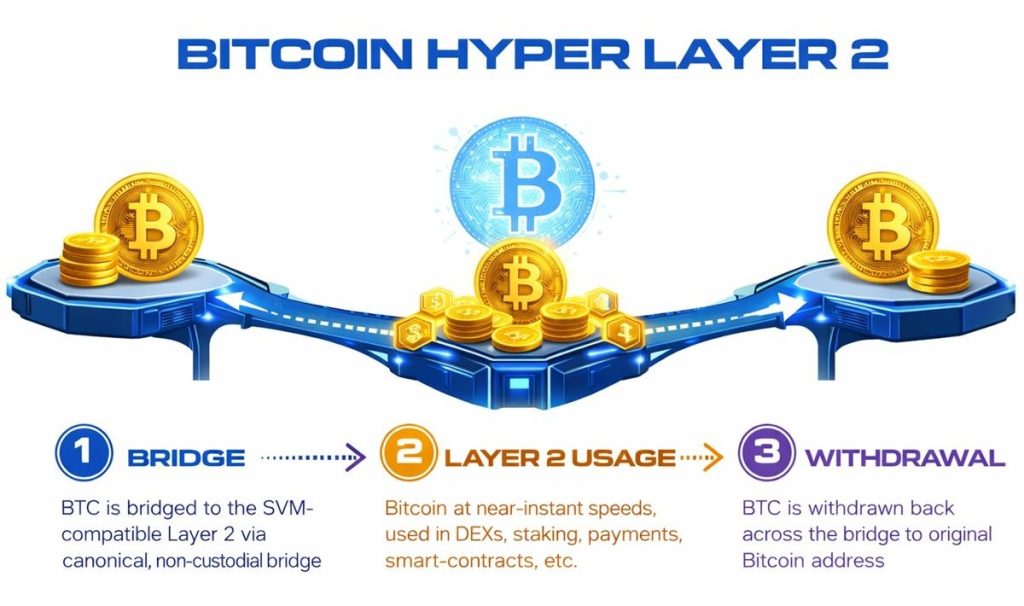
So a faster execution layer can bring that original purpose back into view without asking Bitcoin to sacrifice the characteristics that made people comfortable storing wealth there.
The opportunity gets larger once payments are only one application among many. A Bitcoin holder who can trade through a decentralized exchange, use BTC inside financial products, or interact with entirely new applications has a different relationship with the asset – ownership becomes the beginning of the experience rather than the end of it.
That is also where the Solana Virtual Machine choice becomes important – developers are not being handed a stripped-down Bitcoin scripting environment and asked to invent around its limitations. Bitcoin Hyper is giving them a much more expressive execution layer while BTC remains the economic force.
The $33 million presale raise indicates that buyers have responded to the proposal before the network has had a chance to prove itself at scale.
HYPER will ultimately be judged by whether its faster environment contains tools people repeatedly want to use. That is a harder test than fundraising. It is also where the upside lies.
Bitcoin Already Has the Capital
Crypto spent years trying to persuade the world that Bitcoin was worth holding. That argument became successful enough to change financial markets.
The next era does not require abandoning digital gold, but it asks whether an asset can be both valuable to keep and useful when its owner decides to move it.
Bitcoin Hyper is building that solution – Bitcoin supplies an enormous existing capital base and HYPER is trying to give some of it somewhere productive to go. For Bitcoin, that could be less a reinvention than the completion of an old idea.