


 Some of the links on this site may be affiliate links. ICOBench may receive advertising commissions when users visit recommended platforms via our affiliate links, at no additional cost to you. All recommendations are based on a comprehensive review process.
Bitcoin was introduced as electronic cash and, seventeen years later, it has become something larger and, in one important respect, narrower.
BTC proved that digitally scarce money could survive without a central issuer, attract institutions, and become an asset people were willing to hold for years. What never developed on the same scale was the everyday economy around it. CoinMarketCap estimates Bitcoin’s base layer at roughly seven transactions per second. That is enough for settlement, but a difficult foundation for busy payment networks and applications.
The $33 million raised by Bitcoin Hyper (HYPER) suggests investors see room for another attempt to solve that problem. HYPER is priced at $0.01368, with staking currently paying 35% APY. Rather than competing with Bitcoin, the project is building a faster Layer 2 around it: somewhere BTC can move, trade, and interact with applications without asking the base chain to process every action itself.
How Bitcoin Hyper Gives BTC a Working Economy
Bitcoin Hyper starts from an increasingly familiar idea in blockchain design: not every transaction needs to happen on the most valuable layer.
Bitcoin can remain the settlement foundation while a faster network above it handles the constant activity. Payments can complete quickly, decentralized exchanges can operate without waiting on Bitcoin block times, and developers gain an environment capable of running smart contracts.
The unusual part is the execution engine: Bitcoin Hyper uses the Solana Virtual Machine, bringing the high-speed programming environment associated with Solana into a Bitcoin-focused Layer 2. Its whitepaper describes an execution layer built for low-latency transactions before activity is ultimately settled back toward Bitcoin.
Hyper is the future. 🔥⚡️
33M Raised!https://t.co/VNG0P4GuDo pic.twitter.com/lOKtlYvAlq
— Bitcoin Hyper (@BTC_Hyper2) August 6, 2026
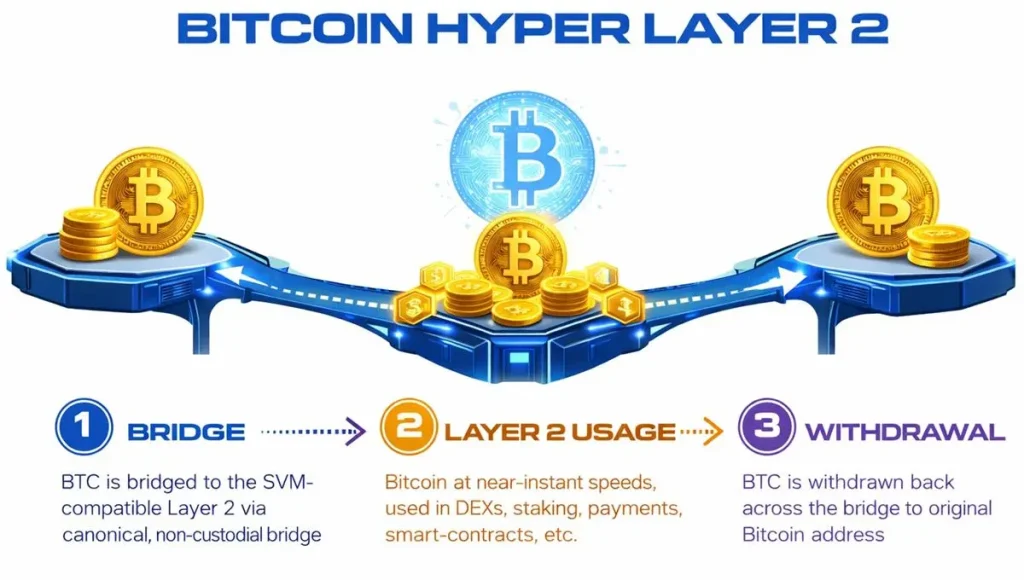
For a BTC holder, the architecture is less important than the experience it is intended to create. Bitcoin moved into the HYPER environment can be sent rapidly or put to work in applications, including decentralized trading and staking products. When users want native BTC again, the protocol provides the route back to the base chain. The bridge, relay, and proof systems make those movements possible – they are infrastructure beneath the product rather than the reason to use it.
Bitcoin Hyper will batch and compress Layer 2 activity, use zero-knowledge proofs to establish transaction validity, and periodically commit its Layer 2 state to Bitcoin. The aim is to let the faster network do far more work without turning Bitcoin itself into a high-throughput smart-contract chain.
HYPER gives users access to that economy, intended to pay network fees, while holders can stake tokens for rewards and eventually participate in governance. Coinsult and SpyWolf have also audited the token contracts used by the project.
Why Bitcoin Payments Still Have an Enormous Audience
There is something slightly strange about Bitcoin’s evolution. Satoshi Nakamoto titled the original paper Bitcoin: A Peer-to-Peer Electronic Cash System. Its opening argument was about sending online payments directly between people without passing through a financial institution.)
Bitcoin became successful enough that another use came to dominate: people wanted to keep it.
Layer 2 networks make it possible for the two ideas not to compete. The base chain can continue to prioritize security and settlement, while another layer handles smaller payments and programmable activity. Even Bitcoin Core contributors argued years ago that Bitcoin could reach greater scale through additional layers built above the protocol.
Ethereum and Solana already demonstrate what happens when a blockchain asset gains a busy application layer. Their ecosystems contain exchanges, lending markets, payments, games, and other financial products. Bitcoin starts from a different position. It already has an enormous holder base, while its programmable application economy remains comparatively immature.
That leaves open territory.
HYPER does not need to invent enthusiasm for Bitcoin or persuade people to acquire an unfamiliar base asset. Its challenge is converting some existing BTC ownership into activity. A holder who previously had little reason to move Bitcoin can use it for payments, decentralized trading, or other applications without leaving a Bitcoin-centered ecosystem.
The $33 million presale raise is notable in that context – buyers are backing the infrastructure before the Layer 2 has had the chance to prove itself at scale. It is an early vote for the proposition.
There is competition, including the Lightning Network and other Bitcoin scaling projects. Bitcoin Hyper’s opportunity is broader than making one payment travel faster. By using an SVM execution environment, it creates an application layer where developers can build around BTC as programmable capital.
Bitcoin Does Not Need to Start Again
Most new cryptocurrencies begin with the same problem: first, find people who care.
Bitcoin Hyper gets to begin somewhere else. Bitcoin already has users, capital, and history. What remains comparatively underdeveloped is the space where that capital can actually move.
The $33 million behind HYPER indicates there is an appetite for completing that story. Bitcoin proved digital money could be valuable – the next challenge is making more of that value usable.