Some of the links on this site may be affiliate links. ICOBench may receive advertising commissions when users visit recommended platforms via our affiliate links, at no additional cost to you. All recommendations are based on a comprehensive review process.
Tokenization is moving beyond pilot schemes, with institutions moving in. Take Schroders, which has secured approval from the Central Bank of Ireland for a tokenized share class in a US dollar money-market fund, supported by JPMorgan’s Kinexys platform. Investors will be able to use smart contracts when transacting in the fund – an example of another large asset manager putting conventional finance onto blockchain rails.
The money may be going on-chain, but it is not entering one open, connected system. New funds, deposits, and securities can end up spread across different ledgers – just as native crypto liquidity is already divided between Bitcoin, Ethereum, and Solana.
Today, Bitcoin is up 0.96% at $64,740.23, while Ethereum has gained 1.92% to $1,908.10. Those prices move every hour – but the fractured infrastructure underneath them has proved rather more stubborn.
That is where LiquidChain (LIQUID) enters the discussion, developing a Layer 3 where applications can reach capital and users across BTC, ETH, and SOL, without treating each network as a separate destination. LIQUID costs $0.0148, with a presale that has raised $931,000 so far, and early staking currently paying 1,214% APY.
How LiquidChain Makes Separate Networks Easier to Use
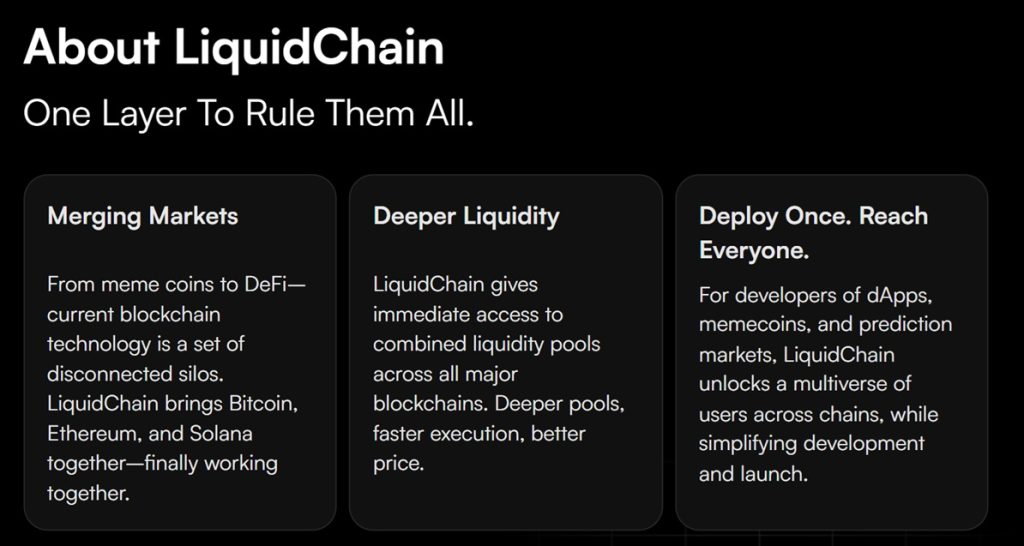
LiquidChain is not another base blockchain asking users to move over and start again, but rather a shared execution layer for existing markets.
Today, a trader moving among Bitcoin, Ethereum, and Solana has to switch wallets, use a bridge, and find a new liquidity pool at each stop. A developer hoping to serve all three audiences can end up maintaining three products. LiquidChain aims to move everything into one place.
It means a decentralized exchange can use liquidity across several chains rather than confining every trade to a single pool. For instance, a lending protocol can bring together collateral and borrowers who currently sit in different ecosystems. Developers get a build-once route into all three markets, and users get one service.
The candle lights the way.
The L3 does the rest. 👁⟁https://t.co/vqvBcdSQYC pic.twitter.com/Pi9tcnrjTP
— LiquidChain (@getliquidchain) August 4, 2026
LiquidChain’s focus is on checking the state of Bitcoin, Ethereum, and Solana in real-time before allowing an application to act on that information. Cross-chain operations are designed to settle atomically: every linked part completes, or none of it does. Funds will not travel halfway through a transaction and become stranded when the final step fails.
The project’s whitepaper describes shared liquidity pools, cross-chain trading and lending, and software tools that enable existing applications to connect through the Layer 3, with fewer manual transfers for traders and less duplicated development work.
LiquidChain’s token and presale contracts have been reviewed by CertiK and SpyWolf, with a launch expected later in 2026.
Could LIQUID Be the Next Crypto to Explode?
Tokenization increases the number of assets that can interact with blockchain software. It can also create another round of isolated pools unless the industry improves how different systems communicate.
LIQUID initially focuses on public crypto rather than, say, Schroders’ fund or JPMorgan’s institutional platform. As more value becomes programmable, infrastructure that helps capital cross technical boundaries becomes harder to dismiss as a niche concern. LIQUID’s market grows when each chain keeps attracting activity, and users grow less tolerant of the work required to move between them.
LIQUID is used to support transaction fees and network participation, with liquidity providers earning proportional rewards from the unified pools. Post-launch plans include cross-chain applications, combined BTC, ETH, and SOL yield strategies, and access routes for institutional capital.
Decentralized trading is planned before mainnet, while centralized exchange listings are targeted for the third quarter of 2026.
The 1,214% staking rate is an early incentive, not a long-term rate – it should drop as more tokens enter the pool. Over time, demand comes from applications people use, and liquidity deep enough to make LiquidChain better than bridge-hopping.
The presale remains small compared to projects that have raised tens of millions, but it also means the market has not yet priced LIQUID as established cross-chain infrastructure.
Tokenization Needs Somewhere to Meet
Putting thousands of funds, currencies, and crypto assets onto disconnected systems leaves the larger job of crypto unfinished.
LiquidChain is working on that less glamorous part: making separate pools of value usable through the same application. Finance is becoming more tokenized without automatically becoming more connected, and LIQUID is built to make that whole journey much easier.