


 Some of the links on this site may be affiliate links. ICOBench may receive advertising commissions when users visit recommended platforms via our affiliate links, at no additional cost to you. All recommendations are based on a comprehensive review process.
Crypto has spent years building faster blockchains, but moving between them still feels oddly primitive. A trader may hold Bitcoin, use an Ethereum lending market, and buy tokens on Solana, but moving capital between them requires another wallet, a bridge, or a wrapped version of the same asset. The networks work – but the joins between them do not.
Can that be fixed? On a day when Bitcoin is up 0.35% to $64,340.21, and Ethereum is almost unchanged at $1,872.55, the market is seeking the next innovation to push it forward.
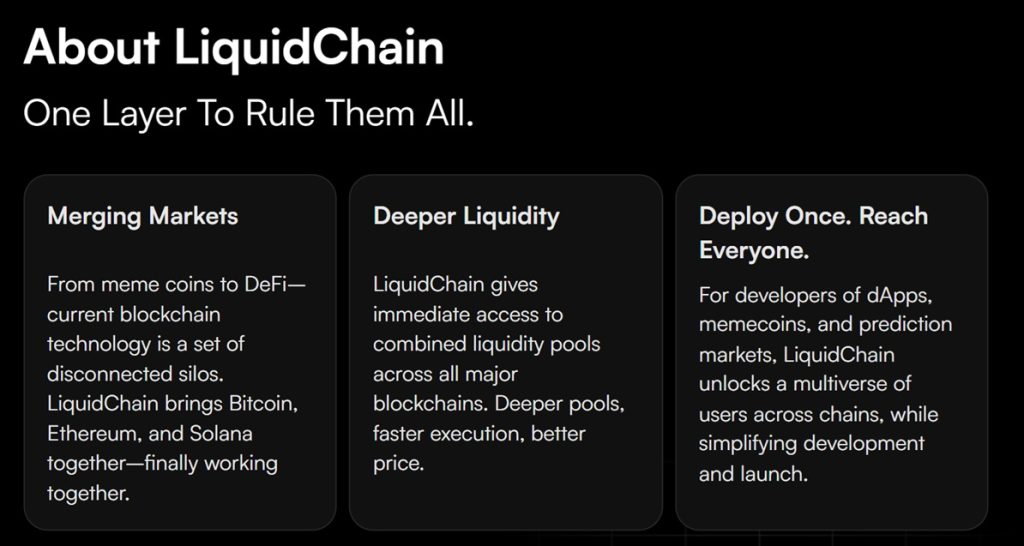
LiquidChain (LIQUID) is perhaps the best example right now, as a Layer 3 intended to give applications access to activity and liquidity across Bitcoin, Ethereum, and Solana through a single shared environment.
LIQUID costs $0.0148 in the presale, which has so far raised $930,000, while early staking currently returns an early bird rate of 1,214% APY.
How LiquidChain Changes the Cross-Chain Experience
Layer 1s such as Bitcoin, Ethereum, and Solana run their own ledgers, and Layer 2s normally help those networks handle more activity. LiquidChain goes beyond that arrangement and asks whether several large blockchain economies can be used simultaneously.
For users, the proposed change is quite direct: instead of manually bridging funds before entering a new market, traders and holders can use a single layer that recognizes verified assets and activity across all three chains and lets them use their assets accordingly.
As an example, a decentralized exchange could draw on liquidity associated with BTC, ETH, and SOL rather than sending each trader towards a separate pool. A lending platform can match collateral on one network with demand coming from another. LiquidChain says assets will be represented inside unified markets without the usual wrapping process.
The candle lights the way.
The L3 does the rest. 👁⟁https://t.co/vqvBcdSQYC pic.twitter.com/Pi9tcnrjTP
— LiquidChain (@getliquidchain) August 4, 2026
The network also aims to make cross-chain transactions complete in one piece – every connected action succeeds, or the whole operation is canceled. That avoids an unpleasant outcome in which funds move successfully at the start of a transaction but become stuck when a later step fails.
Developers get a simpler proposition too – they can build one application for LiquidChain rather than maintaining different products for Bitcoin, Ethereum, and Solana. The network verifies the relevant information from the underlying chains, and users should not need to know which proof or messaging system enabled the transaction.
This is where Layer 3 starts to earn its name: it is not simply another faster blockchain but turns several separate markets into a single usable surface.
Could LIQUID Become the Next 100X Crypto?
LiquidChain is aimed at a problem that grows with crypto itself. More users, applications, and assets do not automatically produce a more connected market – they can leave even more capital divided between chains.
Bitcoin brings the deepest monetary pool, while Ethereum has the most established DeFi economy. Solana, meanwhile, has pushed high-speed trading and consumer applications further than most rivals. LiquidChain benefits if all three remain important and does not need to crown a single winner.
That gives LIQUID a broad role, with the token itself used for staking, governance, network participation, and access to features within the Layer 3. If a trader uses a cross-chain application, a developer launches a product, or a liquidity provider supplies one of the shared pools, that activity takes place using LIQUID.
The presale remains early at $930,000, and its 1,214% staking rate is partly a result of that early participation and will fall as more tokens are committed. The yield is useful for attracting initial holders, but likely not the long-term reason the network succeeds.
A 100x return is a much larger proposition – at the current $0.0148 price, it would put LIQUID near $1.48 and a market cap of around $100 million. For that, LiquidChain needs a functioning infrastructure, serious liquidity, and applications that people choose over existing bridges. But it is a relatively modest early milestone, if the project attracts even a small number of users from the three major chains.
Luckily, LiquidChain does not have to invent demand for Bitcoin, Ethereum, or Solana – simply make the demand already scattered across them easier to serve.
The Valuable Part May Be Between the Chains
Crypto once assumed that a single blockchain would eventually absorb everything, but that future seems less likely now. Different networks have acquired distinct strengths, user bases, and cultures, and are not disappearing.
The next step may be less dramatic: stop making people notice the borders. While LiquidChain has a long way to go before that promise becomes normal infrastructure, the project has chosen a worthwhile place to build.
As value continues spreading across multiple chains, the system that makes those chains feel less separate can become valuable in its own right.