


 Some of the links on this site may be affiliate links. ICOBench may receive advertising commissions when users visit recommended platforms via our affiliate links, at no additional cost to you. All recommendations are based on a comprehensive review process.
Bitcoin, Ethereum, and Solana have built three of crypto’s largest economies, yet using them together remains unnecessarily awkward, with liquidity sitting in separate pools and moving assets leading to a journey of changing wallets, wrapping tokens, and trusting bridges.
The need for better cross-chain infrastructure does not depend on whether BTC or ETH is rising this week – crypto’s largest networks continue to attract capital, applications, and specialized communities.
But their growth also makes the divisions between them more expensive – as each ecosystem expands, users face more isolated liquidity, duplicated applications, and technical hurdles when they try to move between markets.
Can it change? LiquidChain (LIQUID) is building a Layer 3 that connects Bitcoin, Ethereum, and Solana through one shared system. LIQUID costs $0.0148, and the presale has raised $926,000 so far. Buyers can also stake their tokens for a dynamic 1,220% APY, although that rate will fall as more holders join the pool.
How LiquidChain Works
Layer 1 blockchains provide the underlying networks, and Layer 2s increase the speed or lower the cost of using one particular chain. LiquidChain proposes another step: the Layer 3, which helps several blockchain economies interact.
The user experience is easier to understand than the architecture: a trader currently seeking liquidity across Bitcoin, Ethereum, and Solana needs to transfer assets between networks and enter several separate markets. LiquidChain aims to bring verified representations of those assets into a shared liquidity pool, giving users access to capital across multiple ecosystems through a single application.
Consider this your invitation.
The age of isolated chains is ending. 👁 pic.twitter.com/Iaeuk01uPI
— LiquidChain (@getliquidchain) July 29, 2026
The network checks activity on the underlying blockchains before making that information available to applications on LiquidChain, and transactions spanning several chains are designed to complete as a single operation: either all required steps succeed, or none is finalized.
Developers get a similar shortcut: instead of creating and maintaining separate products for Bitcoin, Ethereum, and Solana, they can launch once on LiquidChain and reach assets and users originating across all three. The technology stays in the background, where it belongs, and the customer doesn’t need to care about the pipes.
3 Reasons Why LiquidChain Is the Best Crypto to Buy
Here are the reasons LIQUID is a top choice for the next bull run:
Reason 1: Crypto’s Fragmentation Is Getting Worse
Blockchains were created to remove financial borders, but they gradually developed borders of their own. Their differences helped each network find a role, but they also divided users and liquidity between the two systems.
Traditional bridges move assets between those systems, but each additional transfer introduces cost, delay, and another point where something can go wrong. Liquidity also becomes shallower when the same asset is split across multiple versions and trading venues.
This is not a temporary inconvenience that disappears during a bull market – more chains, tokens, and applications make the problem larger, and the industry can continue asking users to become experts in network selection, wallet compatibility, and token standards – or it can hide the machinery inside better infrastructure.
LiquidChain is built for the second outcome, giving it a long runway extending beyond a single market cycle. Its opportunity grows alongside the ecosystems it connects, rather than relying on any one of them and losing relevance.
Reason 2: LiquidChain Offers a Neater Way to Solve the Problem
LiquidChain does not ask users to abandon Bitcoin, Ethereum, or Solana for another isolated Layer 1 – it works above them.
A decentralized exchange built on LiquidChain can access liquidity across several networks, and a lending application can connect borrowers and collateral that currently operate in different ecosystems. Developers can also reach three audiences without rebuilding the same interface and financial logic for each one.
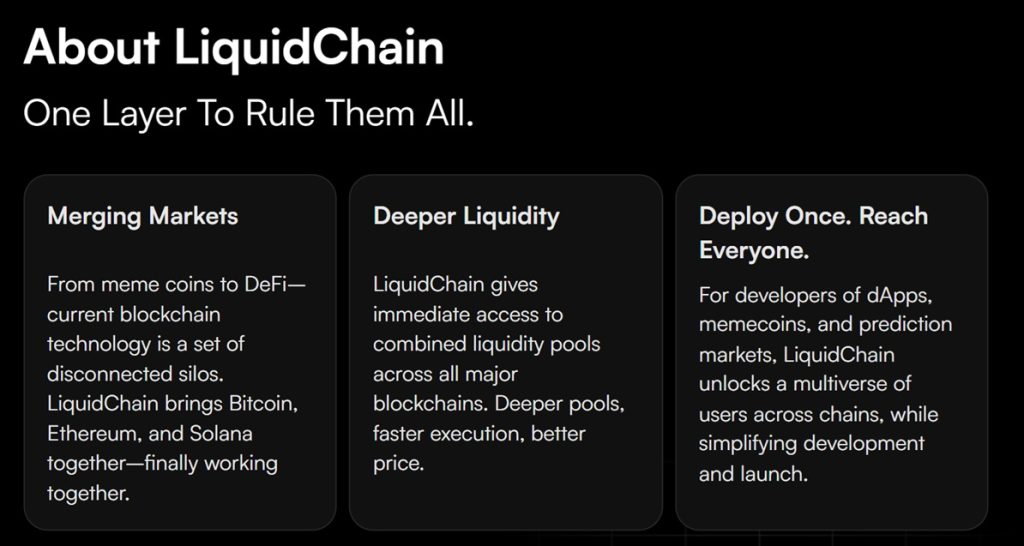
That build-once proposition is a strong reason for developers to experiment with LiquidChain. Creating an application is already expensive, and repeating development, auditing, and maintenance across several chains adds more work before the product has found users.
LIQUID itself gives holders exposure to activity inside this shared layer, with the token intended to pay network and execution fees, while also supporting staking and liquidity provision.
Developers can also benefit from grants used to seed new applications, and liquidity providers are designed to receive proportional rewards from the network’s combined pools.
The project has allocated 35% of its 11.8 billion-token supply to development, with another 32.5% assigned to marketing, which recognizes the two jobs ahead: LiquidChain must build functioning infrastructure and persuade applications and liquidity to use it.
Reason 3: LIQUID Sits in the Middle of Network Activity
Users will need LIQUID to pay execution fees when interacting with applications on the Layer 3. Meanwhile, holders can stake the token, and liquidity providers can earn rewards for supplying shared pools that enable cross-chain trading and lending. LIQUID will also support governance, giving holders a say in how the network develops.
That creates several potential sources of demand tied to actual use: a trader accessing liquidity across several ecosystems generates network activity, and a developer launching an application brings more users and transactions. Liquidity providers lock capital into the system to keep those markets functioning.
The opportunity is greater than the activity on any single chain, with LiquidChain designed to coordinate transactions originating from Bitcoin, Ethereum, and Solana. In effect, LIQUID occupies the middle of a shared execution layer that serves three major crypto economies.
The token’s utility will only become meaningful if LiquidChain attracts applications, users, and deep liquidity, but the network model gives LIQUID a clearer purpose than relying on artificial scarcity alone.
One Token at the Point Where Three Markets Meet
LiquidChain is still at the start of its journey, but its three-part case is compelling. Fragmentation is a real and expanding problem, and LiquidChain proposes a user-friendly way to reduce it. LIQUID then sits inside the resulting economy as the token used for fees, staking, and liquidity incentives.
The presale remains early compared with projects that have already raised tens of millions, which entails greater risk but also more room for the protocol to gain recognition through 2026 and 2027.
Crypto may never converge on a single winning blockchain, but LiquidChain is making the more compelling case that the networks can remain distinct while the borders between them gradually disappear.