


 Some of the links on this site may be affiliate links. ICOBench may receive advertising commissions when users visit recommended platforms via our affiliate links, at no additional cost to you. All recommendations are based on a comprehensive review process.
The search for the best altcoins to buy has picked up after KAITO extended one of the largest recoveries among established mid-cap tokens. KAITO traded at approximately $1.25 on July 29, gaining 9.33% over 24 hours and lifting its market capitalization to $302.5 million. The token has now recovered more than 360% from its February low of $0.2714, although it remains well below the $2.92 peak reached in 2025.
The move comes as the wider market regains some ground, with CoinMarketCap placing the total cryptocurrency market capitalization at roughly $2.19 trillion, up 1.03% from the previous day, while Bitcoin dominance remains high at approximately 58.6%, leaving altcoins competing for a relatively narrow share of incoming capital.
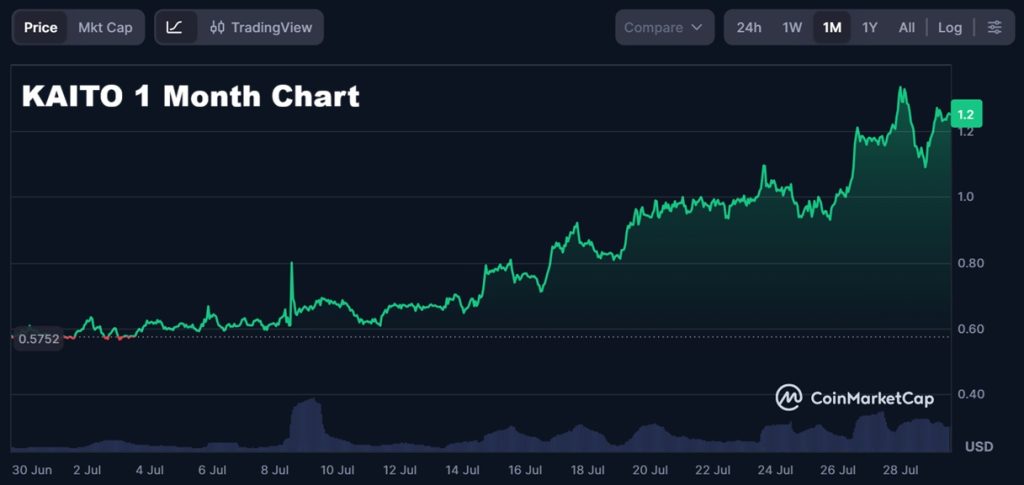
KAITO’s rebound shows that traders are still prepared to return quickly when a token has an identifiable product and a reason to exist. The same filter can be applied to the highest-quality presales, such as LiquidChain, which is building cross-chain infrastructure; Bitcoin Hyper, which aims to make Bitcoin usable for faster payments and applications; and Maxi Doge, which brings meme coin speculation to the gym crowd.
These projects are at different stages and carry different risks, but each has raised enough capital to show genuine presale demand as they move towards launch.
LiquidChain Targets DeFi’s Fragmented Liquidity
LiquidChain is a proposed Layer 3 network designed to connect Bitcoin, Ethereum, and Solana – rather than ask users and developers to remain inside one ecosystem. Its presale has raised $922,000, with LIQUID currently offered at $0.0148. The project also gives staking of 1,220% APY as an early incentive.
The mechanics, laid out in the LiquidChain whitepaper (PDF), place assets held on the supported base chains within unified liquidity pools, while a cross-chain virtual machine executes operations across multiple blockchains. A proof engine verifies the relevant Bitcoin, Ethereum, and Solana states before an operation is settled. In short, the major blockchains are all accessible at once.
The view is different from the third layer. 👁
You’ll understand soon. pic.twitter.com/P2WOELSTjI
— LiquidChain (@getliquidchain) July 27, 2026
In doing so, the design addresses a persistent DeFi problem: liquidity is spread across chains, each of which uses different models, virtual machines, and settlement rules. Moving your capital around them requires separate bridges, wrapped assets, and several transactions – all steps that introduce fees and security risks while making cross-chain applications harder to build.
LiquidChain’s proposed “build once” model gives developers access to Bitcoin capital, Ethereum’s DeFi markets, and Solana’s fast execution through one system. Unified trading, lending, and staking applications are among the uses. LIQUID’s Proof-of-State validation layer anchors transactions to the underlying networks rather than replacing their existing consensus mechanisms.
LIQUID is used for transaction fees, staking, and network participation after launch, and SpyWolf and CertiK audits add another layer of scrutiny ahead of deployment.
Bitcoin Hyper Brings Faster Execution to Bitcoin
Bitcoin Hyper has raised $32.9 million, making it the largest presale in this group by a wide margin – and one of the largest in crypto in 2026.
The problem it tackles is well-known: Bitcoin is the largest cryptocurrency, but its base layer was not built for high-volume applications, with throughput commonly estimated at three to seven transactions per second, and slow confirmation times making small, frequent payments difficult during busy periods.
Bitcoin Hyper’s answer is a Layer 2 execution system that processes activity away from the base chain, before recording the resulting state back to Bitcoin.
The plan is simple.
Take Bitcoin further. 🚀⚡️https://t.co/VNG0P4GuDo pic.twitter.com/gMYVQUIxBT
— Bitcoin Hyper (@BTC_Hyper2) July 28, 2026
BTC is first brought onto the protocol through a canonical bridge, and the network then represents that BTC on its Layer 2, where a Solana Virtual Machine-compatible execution environment processes transfers and smart contract interactions at Solana-esque speeds. Transactions are grouped, compressed, and checked, then periodically submitted to Bitcoin for settlement.
The SVM component expands the concept beyond a simple payment rail: Developers familiar with Solana-style tooling can build exchanges, lending applications, games, and tokenized asset platforms while still using Bitcoin as the underlying settlement anchor. HYPER is used to pay network fees, support staking, and provide access to ecosystem governance.
The project’s strongest argument is the size of the market it is addressing. Bitcoin has a market capitalization above $1.2 trillion, yet most decentralized applications and on-chain trading remain concentrated elsewhere. So even a modest shift toward Bitcoin-native payments and applications can create demand for infrastructure capable of processing activity, without placing every action directly on the base chain.
Bitcoin Hyper has also completed contract reviews through Coinsult and SpyWolf. The $32.9 million raise does not guarantee adoption, but it shows that crypto holders can already see the size of the opportunity.
HYPER is priced at $0.01368, while staking currently offers 36% APY.
Maxi Doge Gives the Dog-Coin Trade a New Identity
Maxi Doge is the speculative entry on our list, with a presale that has raised $4.8 million without an exchange listing, and MAXI priced at $0.00028. Holders can also place presale tokens into the project’s staking pool, which currently offers 64% APY.
MAXI is built around community incentives, where stakers receive daily token distributions, trading contests reward participants producing the strongest returns, and planned partnerships with futures platforms will support gamified tournaments. The project has allocated 25% of its supply to the Maxi Fund, 40% to marketing, 15% to development, 15% to liquidity, and 5% to staking rewards.
Friday night: "I'll keep it chill and won't stay up all weekend trading"
Monday morning: pic.twitter.com/OGFfZNxdNe
— MaxiDoge (@MaxiDoge_) July 27, 2026
Maxi Doge’s muscular Doge character deliberately drops the cute image associated with earlier dog coins – the theme is all gym culture, aggressive trading, and relentless competition. That gives MAXI an identifiable audience in a sector where many tokens differ only by name and mascot.
The planned contests are important because they provide activity after the token launches. Community members have reasons to follow rankings, enter events,, and share results rather than passively waiting for social media attention. Futures partnerships and exchange listings appear in the later stages of the project roadmap, while SolidProof and Coinsult have audited the token contract.
Meme coins remain heavily dependent on attention, and MAXI will need to convert its presale audience into active holders after trading begins. But raising $4.8 million before any market listing gives it a better starting position than an anonymous token that launches directly on a decentralized exchange.
Product Fit Is Becoming the Altcoin Test
KAITO’s recovery is a useful reminder that altcoins can rebound quickly once buyers reconnect a token with a functioning product and an active market. Presales face a harder test because their systems are not yet operating at full scale: Capital raised, technical design, and community retention are therefore more useful than ambitious price targets.
LiquidChain has the broadest infrastructure proposition; Bitcoin Hyper has the largest raise and the clearest addressable market; and Maxi Doge offers the speculative meme coin trade.