Some of the links on this site may be affiliate links. ICOBench may receive advertising commissions when users visit recommended platforms via our affiliate links, at no additional cost to you. All recommendations are based on a comprehensive review process.
Bitcoin is still the center of crypto’s financial gravity, but it has never become the everyday payment network its earliest supporters imagined. As BTC trades near $63,100 today, down 2.77% over 24 hours and 5.55% over seven days, the question of what Bitcoin is used for remains up for debate.
The wider market moves in the same direction as Bitcoin – ETH also down 3% on the day – with Bitcoin dominance near 58.6%. That leaves nearly three-fifths of the market’s value attached to a network that processes only a small number of base-layer transactions each second.
Bitcoin’s deliberate limits help preserve its security and decentralization, but also explain why Ethereum and Solana have become the home for fast trading, lending, games, and on-chain applications.
Bitcoin Hyper (HYPER) wants to give BTC the chance to be involved in modern finance by building a faster execution layer around BTC rather than trying to redesign Bitcoin itself.
HYPER, priced at $0.01368 in its presale, has now raised $32.9 million, while holders can earn 36% APY during staking.
How Bitcoin Hyper Turns BTC Into a Usable Asset
Bitcoin Hyper begins with a simple question: what would Bitcoin look like if people could do more than hold it?
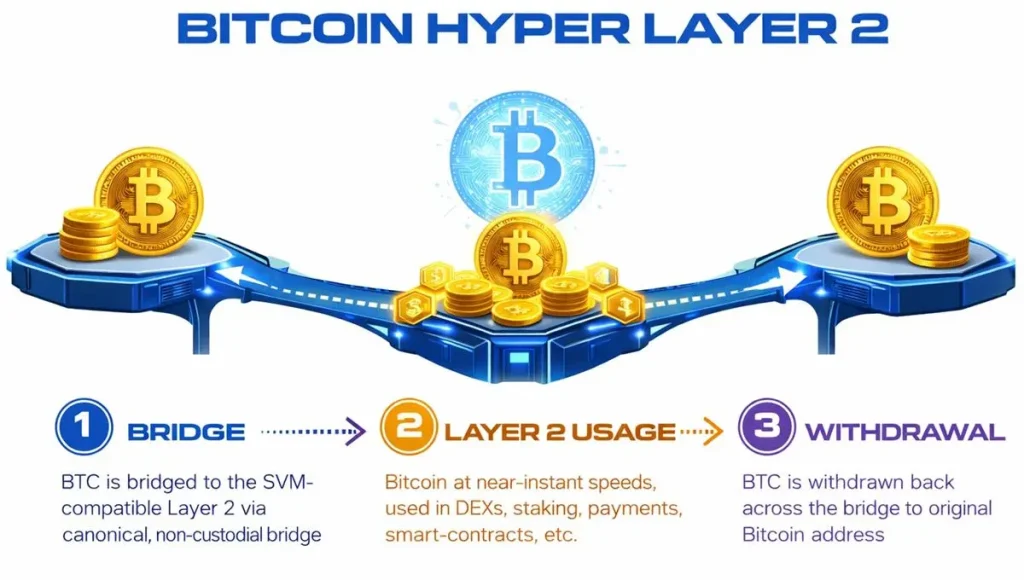
Its answer combines Bitcoin settlement with the Solana Virtual Machine, or SVM. Once moved onto Bitcoin Hyper, the value of your BTC can be transferred with near-instant finality and used within applications such as decentralized exchanges, staking platforms and other financial tools. Transactions are batched and compressed before the network periodically commits its state to Bitcoin’s Layer 1. Zero-knowledge proofs confirm the validity of those transactions.
At any time, a user can submit a request on the Layer 2 and release the corresponding BTC back to their Bitcoin address – but in the meantime, they can actually use their BTC rather than holding it.
The plan is simple.
Take Bitcoin further. 🚀⚡️https://t.co/VNG0P4GuDo pic.twitter.com/gMYVQUIxBT
— Bitcoin Hyper (@BTC_Hyper2) July 28, 2026
The project says Bitcoin does not need to become Solana – its base layer can remain slow, conservative and difficult to alter. The activity that demands greater speed can happen elsewhere, with Bitcoin retained as the final settlement layer.
It is similar to the role central bank money plays beneath modern financial systems – most payments do not involve trucks carrying physical cash between banks. Faster networks handle the visible activity, while the hardest form of money sits beneath them. Bitcoin Hyper applies that idea to programmable money.
HYPER is the network’s native token, covering transaction fees, staking, and governance. The project has also allocated 30% of its token supply to development and 15% to community rewards, suggesting that network construction and user incentives are intended to continue after the presale ends later this year. Its token contract has undergone reviews by Coinsult and SpyWolf.
Can HYPER Become the Next 100X Crypto?
Ethereum already has a crowded scaling sector, with multiple networks competing for developers, liquidity, and users. Bitcoin has fewer comparable ecosystems relative to its market size – and that market is roughly three times bigger.
A successful Ethereum Layer 2 must prise users away from several established competitors, but Bitcoin Hyper is targeting capital that already exists in BTC but has relatively few places to go. Bitcoin’s roughly 58.6% share of the cryptocurrency market makes even limited adoption significant.
The $32.9 million raised by the presale shows that investors recognize the scale of that opportunity – Bitcoin as payments remains the elusive golden goose.
For HYPER to deliver exceptional returns, the network will need more than quick transfers; bridges must work reliably, and developers must create applications worth visiting. Those demands are considerable, which is why the potential valuation is high. Bitcoin is the most recognized digital asset in the world, yet much of its value remains absolutely frozen.
A Layer 2 capable of making some of that capital productive can start to be compared to Ethereum-scale Layer 2s, which regularly hit low-billion-dollar market caps. Bitcoin Hyper’s success as a Layer 2 for BTC, placing the speed of Solana on top of the base chain, makes it a contender as the next 100x crypto.
Satoshi Nakamoto described Bitcoin as peer-to-peer electronic cash, but the market embraced it more readily as digital gold – probably because there was little choice.
Bitcoin Hyper says the two ideas do not have to remain separate: Bitcoin can serve as a store of wealth at its core, while faster infrastructure restores movement and currency.
Bitcoin’s Second Act May Be Faster
The first era of Bitcoin showed that digital scarcity could survive without a central authority – the next may depend on whether that scarce asset can move quickly without surrendering what made it valuable.
Bitcoin Hyper is attempting that difficult compromise. It leaves Bitcoin’s foundations alone, adds speed where speed is needed with an assist from Solana, and gives developers a programmable environment built around BTC.
Few crypto projects can address a market this large without first having to create the underlying demand – Bitcoin has the capital, the users, and the cultural weight. HYPER adds the payment layer.