Some of the links on this site may be affiliate links. ICOBench may receive advertising commissions when users visit recommended platforms via our affiliate links, at no additional cost to you. All recommendations are based on a comprehensive review process.
Crypto assets have been showing limited but sporadic strength today, as broader volatility keeps traders cautious ahead of this week’s FOMC meeting. Bitcoin has held near the $63,000 level (down 2.62%) amid mixed signals from equity markets, while the total crypto market cap sits around $2.17 trillion (itself down roughly 2.5%).
The search for the best altcoins to buy has intensified among investors looking past short-term noise, and some buyers have been tempted by DeXe (DEXE), which has rebounded roughly 20% since early this morning. However, DEXE also remains down about 93% from its all-time high, which it reached on July 12 before an extreme sell-off between July 13 and July 23 erased the vast majority of its value. Skeptics have also noted that DeXe’s team has not posted updates on its X account or other social channels since July 9, leaving holders in the dark without an official response to the price collapse for over two weeks.
Despite the latest round of market volatility, some established large-caps and carefully structured early-stage opportunities have drawn renewed attention. Crypto presales in particular have been able to keep attracting capital, offering entry points ahead of planned exchange listings and mainnet milestones. Three names are standing out right now as the best altcoins to buy for those seeking exposure across liquidity infrastructure, smart contract leadership, and Bitcoin scaling: LiquidChain (LIQUID), Ethereum (ETH), and Bitcoin Hyper (HYPER).
LiquidChain (LIQUID)
LiquidChain (LIQUID) is building a Layer 3 network designed to bring Bitcoin, Ethereum, and Solana liquidity into a simple execution environment. The project aims to solve fragmented capital, multi-step bridging friction, and wrapped-asset risks by creating unified liquidity pools, a high-performance virtual machine, and trust-minimized cross-chain proofs. Developers can deploy once and reach users across the three major chains, while users gain single-step atomic settlements.
The view is different from the third layer. 👁
You’ll understand soon. pic.twitter.com/P2WOELSTjI
— LiquidChain (@getliquidchain) July 27, 2026
The LIQUID token is currently being sold in its public presale at $0.01484. Roughly $920,000 has been raised toward a soft target near $1 million, with the sale now in Stage 89 and listing stages expected soon. Staking rewards are advertised at approximately 1,220% APY, giving early participants a high-yield option while the network moves toward mainnet.
LIQUID’s token utility centers on liquidity staking, payment of network fees, and funding for developer grants. Total supply stands at just over 11.8 billion tokens, with allocations directed toward development, the core team, rewards, growth, and listings.
The project’s timing aligns with a market that still favors projects addressing real interoperability pain points. With capital remaining siloed across major chains, LiquidChain’s unified settlement layer and its ability to capitalize on growing demand for seamless multi-chain activity make it one of the best altcoins to buy now.
Ethereum (ETH)
Ethereum (ETH) remains the Web3 industry’s dominant smart contract platform, powering the majority of DeFi activity, NFT markets, and Layer 2 scaling solutions. Its current price (near $1,880) reflects a 24-hour dip of 4%, and its market cap is around $227 billion. Although still well below its prior peak above $4,900, the Ethereum network continues to benefit from sustained developer activity, ongoing upgrades, and institutional interest via spot ETFs that have posted multi-week net inflows.
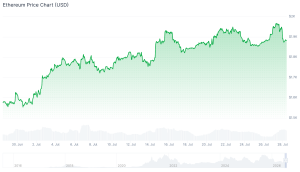
The project’s shift toward proof-of-stake and the long-running proliferation of rollups have reduced costs and increased throughput for everyday users, and Ethereum’s account model and mature tooling still attract the largest share of new protocol launches. Recent price action has even shown relative strength against Bitcoin, hinting at potential rotation into the broader smart contract sector when risk appetite returns.
Bitcoin Hyper (HYPER)
Bitcoin Hyper (HYPER) is developing a Layer 2 network that settles transactions on Bitcoin while using the highly optimized Solana Virtual Machine for execution. The design targets Bitcoin’s well-known constraints around transaction speed, fees, and programmability. Users can deposit native BTC through a decentralized canonical bridge, receive equivalent tokens on the Layer 2, and interact with payments, DeFi, NFTs, and dApps at far lower cost and latency before withdrawing back to the base chain.
The plan is simple.
Take Bitcoin further. 🚀⚡️https://t.co/VNG0P4GuDo pic.twitter.com/gMYVQUIxBT
— Bitcoin Hyper (@BTC_Hyper2) July 28, 2026
The HYPER token is available via its official presale at a price of $0.0136838 per HYPER. Nearly $33 million has already been raised, and staking is live at 36% APY for early participants. Planned HYPER listings on decentralized venues and major centralized exchanges are targeted for later in Q3. HYPER’s token use cases include gas fees payments on the L2, staking, ecosystem access, and developer incentives.
As Bitcoin continues to serve primarily as a store of value, demand for scalable secondary layers that preserve its security model remains strong. Bitcoin Hyper’s SVM integration, non-custodial bridging, and upcoming exchange listing debuts give participants exposure to one of the most advanced and high-momentum Bitcoin scaling efforts currently on the market.