


 Some of the links on this site may be affiliate links. ICOBench may receive advertising commissions when users visit recommended platforms via our affiliate links, at no additional cost to you. All recommendations are based on a comprehensive review process.
Bitcoin was created as peer-to-peer electronic cash, but its greatest success has come as an asset people hold rather than money they routinely spend.
The network’s roughly 7 transactions-per-second capacity remains sufficient to settle high-value transfers securely, but it cannot support the fluid, inexpensive activity we expect as modern blockchain networks become more useful in day-to-day life.
That limitation looks more important when the wider market is moving. Bitcoin traded at $64,893.65 on July 27, up 0.47% over 24 hours and 0.76% across 7 days. Ethereum rose more decisively, gaining 2.60% in 24 hours and 4.11% over the week to $1,940.29.
CoinMarketCap put the total cryptocurrency market cap at approximately $2.23 trillion, up 1.07% over the previous day, while Bitcoin dominance remained high at 58.67%. CoinMarketCap data shows a market still anchored by Bitcoin, even as faster programmable networks attract more immediate momentum.
Bitcoin does not lack value, recognition, or liquidity, but it does lack a broad execution layer capable of putting those advantages to work at consumer speed. That is why Bitcoin Hyper (HYPER) seems to be getting attention: The Layer 2 project has raised $32.9 million at a current presale price of $0.01368, while its staking program offers an APY of 36%.
How Bitcoin Hyper Turns Bitcoin Into a Payments Network
Bitcoin Hyper’s design begins with a refusal to alter what Bitcoin already does well. The base chain remains the place where value is ultimately secured and settled, and faster activity is moved to a separate Layer 2 built around the Solana Virtual Machine, or SVM.
The locked Bitcoin value can then move through Layer 2 at a lower cost and with near-instant execution, with the SVM playing an important role. Ethereum-compatible technology dominates much of the Layer 2 market, but Bitcoin Hyper is aiming for the parallel execution and high throughput associated with Solana’s architecture – and using it with BTC.
When Bitcoin needs a little more juice… ⚡️https://t.co/VNG0P4GuDo pic.twitter.com/EGapRknVbl
— Bitcoin Hyper (@BTC_Hyper2) July 27, 2026
The intention is to give developers an environment suitable for payment applications, decentralized exchanges, lending protocols, and other on-chain services without forcing users to abandon Bitcoin as the underlying asset.
Periodically, transactions are batched and compressed before validity information is returned to Bitcoin. When users withdraw, the corresponding Layer 2 asset is removed, and BTC is released through the bridge.
The idea is ambitious, but the underlying idea is easy to understand: Bitcoin can remain deliberately slow and difficult to change (a key strength of BTC), while another network handles the everyday movement above it. Security and speed no longer need to occupy precisely the same layer. But what you can do is use Bitcoin as a currency.
Could HYPER Be the Next Crypto to Explode?
Bitcoin Hyper is entering a much larger potential market than a Layer 2 serving a smaller chain. Bitcoin’s market capitalization stood near $1.3 trillion on July 27, yet much of that capital remains economically passive. It can be transferred, held, or used through external custodial products – but it does not circulate through native applications as freely as assets on Ethereum or Solana.
Unlocking even a small part of that dormant liquidity could mean massive things for Bitcoin Hyper, bringing a whole new layer of applications to Bitcoin – a segment that has rarely taken off. The HYPER token, meanwhile, is designed to serve as the network token for transactions, staking, and governance.
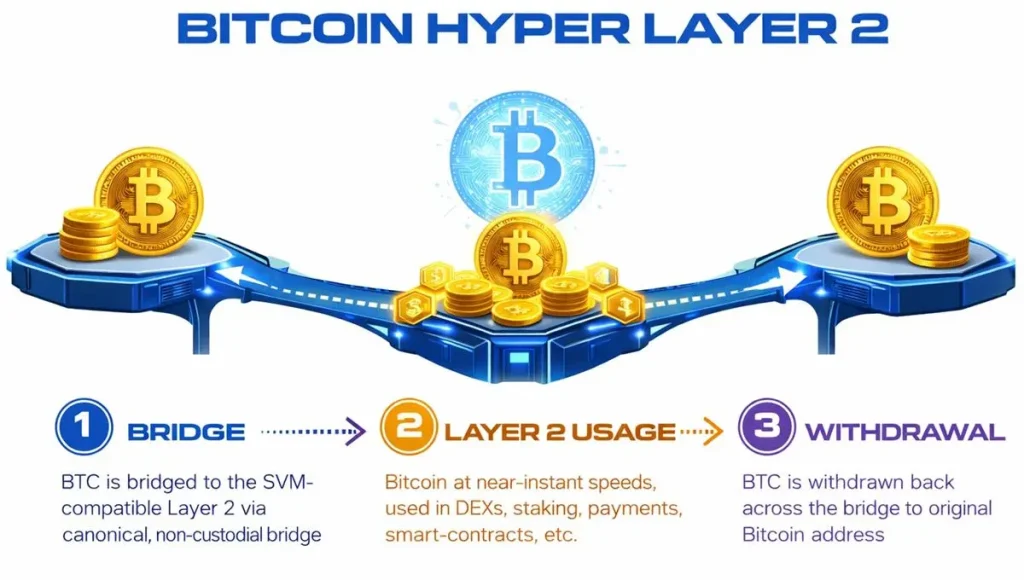
The presale total offers an early indication that investors understand the opportunity. Raising $32.9 million before exchange trading begins shows how keen the BTC community is on the idea. The 36% staking APY also encourages holders to remain involved while the network develops, rather than treating HYPER solely as a short-term presale position. The project has also undergone smart contract audits by Coinsult and SpyWolf.
Its larger advantage may be philosophical: Bitcoin began as money that could move without permission, but over time, scarcity became the dominant story, and payments became secondary. Bitcoin Hyper is trying to recover the original idea. Digital gold on one hand, but spendable, programmable and useful on the other.
Bitcoin’s Second Act May Happen Above the Base Chain
Bitcoin does not need to become Ethereum or Solana at the protocol level – its conservative design is part of why it is so trusted. The more credible path is to keep that foundation intact and build faster systems on top of it.
With $32.9 million raised, an SVM-powered execution layer, and a bridge intended to connect BTC with modern on-chain applications, HYPER has moved beyond being a small experimental presale.
Its success will depend on delivery and adoption, but the question it raises is now difficult to ignore: what happens when the world’s largest cryptocurrency begins to move like money again?