


 Some of the links on this site may be affiliate links. ICOBench may receive advertising commissions when users visit recommended platforms via our affiliate links, at no additional cost to you. All recommendations are based on a comprehensive review process.
Crypto has spent years building faster chains, cheaper execution layers, and increasingly sophisticated financial tools – but scores close to zero for making those systems work together. It is a shame because while Bitcoin holds the deepest pool of crypto capital, Ethereum is the home of decentralized finance, and Solana is all about speed for consumer-scale trading – but users must effectively still choose between them.
Can that change? Can users of Bitcoin (currently trading at $65,996.35) also use Ethereum ($1,921.22) in one transaction without incurring costs, bridges, and risks? That’s where Layer 3s, spearheaded by LiquidChain (LIQUID), come in.
Because if Layer 1 blockchains created independent economies, and Layer 2 networks made some of those economies faster and cheaper, then Layer 3 is more ambitious: build an execution layer capable of using liquidity and users from several chains at once.
LiquidChain is pursuing that model across Bitcoin, Ethereum, and Solana, in a presale that has raised $915,000, with LIQUID priced at $0.0148 and a current staking rate of 1,232% APY.
How LiquidChain’s Layer 3 Model Works
LiquidChain is designed as a common execution and settlement environment rather than another isolated base chain. Its whitepaper describes unified liquidity pools in which assets from Bitcoin, Ethereum, and Solana can be represented and used within the same cross-chain market.
A cross-chain virtual machine with a unified proof engine is the key to the ecosystem, executing transactions that reference several underlying blockchains at once – verifying changes to Bitcoin, Ethereum, and Solana in real time. The goal is atomic settlement: every part of a multi-chain transaction completes (otherwise, none of it does).
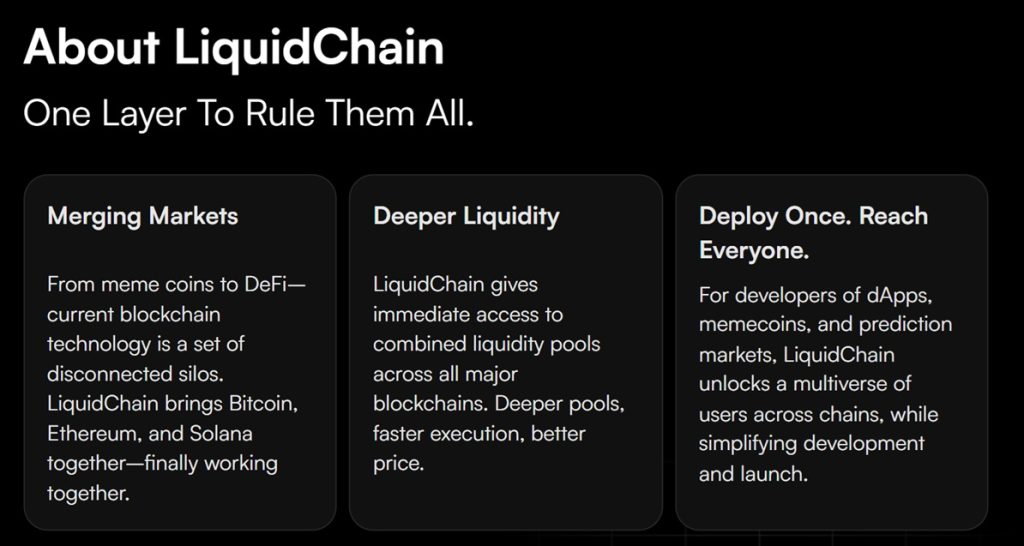
Today’s bridges often force users to move assets manually, then wait for confirmations and accept another layer of smart contract risk. Meanwhile, developers face a parallel problem: a product that wants customers on three chains requires separate deployments, liquidity incentives, and maintenance work for each chain.
LiquidChain proposes a build-once model in which developers use its Solana-based software development kits to create applications that reach users and liquidity across all three ecosystems. Planned uses include shared order books, cross-chain swaps, lending, borrowing and staking, with a roadmap that moves from testnet infrastructure and developer APIs to unified liquidity pools, mainnet deployment, derivatives, and multi-chain lending.
The LIQUID contract has also been reviewed by SpyWolf and is listed by CertiK, with no high-severity vulnerabilities.
Could LIQUID Be the Next Crypto to Explode in 2026?
LiquidChain’s opportunity rests on a simple idea: blockchain growth has produced abundance without unity. Crypto has more block space, liquidity, and developer talent than ever, yet much of that value remains divided by incompatible networks.
A Layer 3 can change how new applications are built. Instead of asking whether a lending market belongs on Ethereum or Solana, a developer could design it around capital from both, potentially adding Bitcoin liquidity as well. Traders can care less about which chain holds an asset and more about where it can be used most efficiently.
The difficult part will be execution. Cross-chain systems must remain fast without weakening verification, and liquidity does not become unified merely because the infrastructure exists. LIQUID will need developers, market makers, and applications capable of generating real transaction demand.
But its early fundraising shows that investors are willing to support that attempt, with a 1,232% staking APY providing an additional incentive during the presale.
The Next Era May Belong Between the Chains
Bitcoin, Ethereum, and Solana have already proved that separate blockchain economies can attract billions of dollars and millions of users. The next breakthrough may come from making those economies feel less separate.
LiquidChain is building for that possibility and, if its unified execution layer works as planned, LIQUID does not need to defeat the largest blockchains – just make them work together.