


 Some of the links on this site may be affiliate links. ICOBench may receive advertising commissions when users visit recommended platforms via our affiliate links, at no additional cost to you. All recommendations are based on a comprehensive review process.
Bitcoin remains crypto’s greatest achievement, but it has never become the everyday financial network imagined in its earliest years. Its base layer prioritizes security and decentralization over speed, leaving payments, programmable applications, and on-chain activity to faster networks.
Today, Bitcoin trades at $64,158.80, up 2.82% across the week. Ethereum is at $1,855.73, and has gained 4.79% over seven days. CoinMarketCap puts the total crypto market capitalization at approximately $2.2 trillion, with Bitcoin controlling 58.6% of the market. The market is still dominated by BTC, even as much of crypto’s useful economic activity takes place elsewhere.
That contradiction is creating an opening for Bitcoin Layer 2 projects, which don’t aim to rewrite Bitcoin or weaken the qualities that made it valuable, but to build an execution environment around it. One where BTC can move faster and support applications that its base chain was never designed to handle.
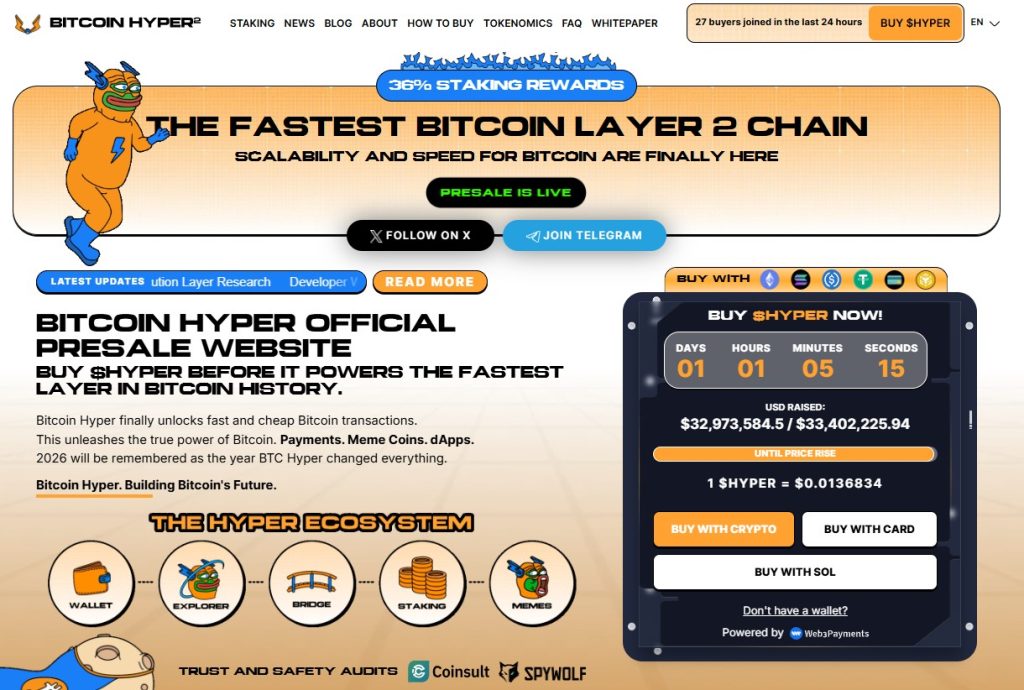
Bitcoin Hyper (HYPER) has attracted an incredible $32.9 million in presale funding around that idea, currently priced at $0.01368, while its staking program offers an APY of 36%.
How Bitcoin Hyper Extends What Bitcoin Can Do
Bitcoin Hyper is designed as a Layer 2 network that settles back to Bitcoin while moving day-to-day execution away from its slower base chain.
The project’s whitepaper describes a canonical bridge through which users deposit BTC to a designated Bitcoin address. The protocol then checks transaction proofs before an equivalent amount of BTC is created on the Layer 2.
Once there, the wrapped Bitcoin can move through an environment built around the Solana Virtual Machine. This is the more ambitious part of the design – giving developers the speed and programmability needed to create decentralized exchanges, payment services, lending tools, staking products, games, and other applications around Bitcoin liquidity, let alone make BTC payments instant and effectively fee-less.
Hyper feeling charged up and ready to power a whole city. ⚡️⚡️https://t.co/VNG0P4GuDo pic.twitter.com/VHU291N7qk
— Bitcoin Hyper (@BTC_Hyper2) July 20, 2026
Transactions will then be batched and compressed, with zero-knowledge proofs used to confirm their validity. The Layer 2 state is then committed periodically to Bitcoin, keeping all of Bitcoin’s PoW security, but without congesting the chain with thousands of transactions per second.
HYPER is used as the network token for transaction fees, staking, and governance, and has already passed audits from Coinsult and SpyWolf on its website – suggesting launch is coming soon.
Can HYPER Be the Next Crypto to Explode?
Bitcoin Hyper is receiving attention because it approaches a market that is already enormous. Layer 2 networks built around newer blockchains must compete for users, liquidity, and relevance – but Bitcoin begins with more than half of crypto’s market cap (yet very little on-chain use).
The opportunity is to convert some of Bitcoin’s dormant capital into active capital, and Bitcoin Hyper describes its vision as helping transform Bitcoin from something people simply hold into something they actively engage with. Crucially, it does not propose changing Bitcoin itself – just creating an environment in which people can access tools, applications, and services that make using Bitcoin easier.
That distinction cuts to the heart of Bitcoin’s next phase: Bitcoin does not have to become Ethereum or Solana. It can remain deliberately conservative while separate networks handle experimentation. Users can still treat BTC as long-term savings, but gain the option to spend it, deploy it, or use it inside applications without accepting the delays and limitations of Layer 1 for every action.
The $32.9 million raised during the HYPER presale indicates that this argument has already found a sizeable audience. Buyers are backing the possibility that Bitcoin’s economic value and its usable infrastructure can finally begin to converge.
The 36% APY available through staking gives early participants another way to engage with the token before the wider network economy develops. Rewards will naturally change as more tokens are staked and the project matures, but the mechanism encourages holders to commit rather than leave HYPER idle.
Bitcoin Does Not Need to Stand Still
Bitcoin proved that digital scarcity could survive without a company, government or central operator, but that achievement should not condemn it to becoming a museum piece.
Its base layer can remain slow, cautious, and difficult to change – those are strengths when billions of dollars depend on the ledger remaining intact. Around it, however, there is room for faster systems that treat Bitcoin not only as collateral or digital gold, but as money that can move through a modern application economy.
Bitcoin Hyper suggests that the next chapter of BTC will be written above the base chain and, in turn, bring Bitcoin back into actual use.