


 Some of the links on this site may be affiliate links. ICOBench may receive advertising commissions when users visit recommended platforms via our affiliate links, at no additional cost to you. All recommendations are based on a comprehensive review process.
The global crypto market cap sits at $2.59T today, down 1.32% over the last 24 hours, and it’s a muted session across the board. Bitcoin itself is trading at $77,390, +0.49% on the day.
Meanwhile, the Layer 2 sector continues to attract serious capital, particularly around chains that can solve real throughput problems rather than just rebrand existing ones. Solana is holding at $85.19, essentially flat on both the day (-1.41%) and the week (-0.06%). Mantle (MNT) is $0.64, down 2.43% on the day but up 3.28% over the week, a modest recovery that reflects continued appetite for L2 plays.
But what’s the appetite for a Layer 2 solely focused on Bitcoin? That’s the goal of Bitcoin Hyper, and for good reasons. Bitcoin, while revolutionary as the first decentralized digital currency, was never designed for speed, scalability, or programmability. Bitcoin’s transaction speed is capped at around 7 transactions per second, which is what allows Ethereum and Solana to explode.
The question Bitcoin Hyper is answering is whether Bitcoin’s brand and security can finally be paired with the kind of execution speed that makes daily transactions practical – buying a coffee, paying a contractor, running a dApp – without leaving Bitcoin’s security layer behind.
Bitcoin Hyper (HYPER), currently priced at $0.013679, has raised $32.5 million in its presale, with early stakers earning 36% APY. $32 million is a huge raise for an early-stage project, and suggests the need for an L2 on Bitcoin.
How Bitcoin Hyper Brings Speed to BTC
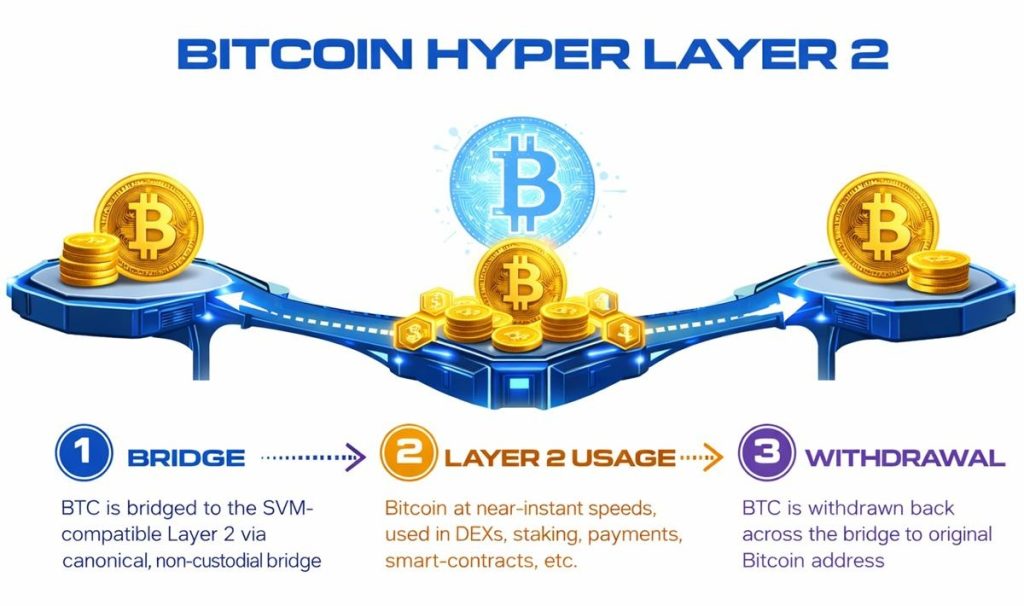
Bitcoin Hyper solves Bitcoin’s core limitations by introducing a Layer 2 solution that processes transactions with extremely low latency. By using the Solana Virtual Machine (SVM) to power the L2, it brings fast, scalable smart contracts to the Bitcoin ecosystem.
The technical architecture is straightforward but deliberate. Transactions are executed in a highly optimized L2 virtual machine and later settled on the Bitcoin Layer 1, enabling high-throughput, low-cost settlement without congesting the base network.
Speed isn’t the flex…
It's all about what you can do with it 🔥⚡️https://t.co/VNG0P4GuDo pic.twitter.com/exkLHVkJzt
— Bitcoin Hyper (@BTC_Hyper2) April 27, 2026
The choice of the SVM means Bitcoin Hyper can bring in smart contracts and decentralized applications – something previously impossible on native Bitcoin.
Moving BTC between layers is handled by a dedicated bridge mechanism. Users deposit BTC into the bridge, which mints equivalent tokens on Layer 2. These can be used within the Bitcoin Hyper ecosystem and later withdrawn back to native BTC at any time.
Gas fees are paid in HYPER, and the protocol includes optional burn mechanics tied to activity, a supply-side mechanic that could matter at scale. Smart contracts have been independently audited by both Coinsult and SpyWolf, and the completed audits suggest we are getting close to launch.
Why HYPER Could Be The Next 100X Crypto
The total supply of HYPER is fixed at 21,000,000,000 (a supply cap that symbolically mirrors Bitcoin’s own hard limit). With $32.5 million raised and the token still in presale at $0.013679, the combination of a credible utility layer and a low entry price tends to drive outsized moves post-listing.
The roadmap targets mainnet launch in Q3 2026, which includes deployment of the Bitcoin Hyper Layer 2 network, activation of the Canonical Bridge for BTC deposits and withdrawals, and integration of the Solana Virtual Machine for dApp support.
Exchange listings are targeted for Q4 2026, with onboarding of partner projects in DeFi, gaming, and NFT sectors planned alongside a DAO governance framework.
The market Bitcoin Hyper is competing for is larger than what Ethereum or Solana typically chase. Bitcoin’s brand recognition and $1.5 trillion market cap give any credible L2 built on top of it an addressable audience that no new chain can replicate.
The pitch to developers is also unusually clean: Solana-speed execution, Bitcoin-level security, and an existing token holder base that already understands the underlying asset.
With ETH L2s like Mantle holding billion-dollar valuations, HYPER has a pre-existing target to aim for. If Bitcoin can start to be used as currency – which, after all, was its original aim – then HYPER has the chance to join the big coins and become a household name.
The Presale Window Is Closing
Bitcoin spent years as a settlement layer while other chains built the applications. Bitcoin Hyper is making a direct move to restore the payment use case Satoshi originally imagined.
HYPER’s token listings are targeted for Q3 2026, aligned with the completion of the presale. Then the market can join the project.