


 Some of the links on this site may be affiliate links. ICOBench may receive advertising commissions when users visit recommended platforms via our affiliate links, at no additional cost to you. All recommendations are based on a comprehensive review process.
Sui (SUI) is trading at $1.036, up 7.21% on the day and 9.05% across the past week. Meanwhile Stellar (XLM) is at $0.17474, gaining 9.07% in 24 hours and 11.73% over seven days. It’s a good week for altcoins with strong product-market fits, which point to a broader re-evaluation of crypto infrastructure and the applications built on top of it.
While Layer 1 blockchains, such as Bitcoin, Ethereum, and Solana, provide the security and consensus, they still basically operate as disconnected networks offering different things. Bitcoin is effectively crypto’s store of value, Ethereum offers DeFi depth, and Solana is all about the transaction speed. But each new chain and L2 introduced a new structural problem: they split up global liquidity.
A user holding assets on Arbitrum cannot deploy them on Base or Optimism without going across bridges, paying multiple gas fees, and taking on smart contract risk, and it’s a drag that has become an active constraint on market efficiency.
So Layer 3 architecture is fast becoming the definitive answer to this fragmentation, building the connective tissue between chains. The industry needs a universal routing layer that connects the largest blockchains without forcing users to think about the underlying plumbing.
That is precisely the opening LiquidChain (LIQUID) is building into. Currently priced at $0.0145 per token with $676,000 raised in presale and a staking APY of 1,604%, the project is attracting attention as one of the best early-stage infrastructure plays to emerge this year.
How LiquidChain Works as a Cross-Chain Layer 3
LiquidChain is a network that sits above existing Layer 1 and Layer 2 environments and aggregates liquidity from all the chains. When a user executes a trade or moves capital, LiquidChain routes the transaction through the most efficient path across its connected chains.
The technical architecture rests on three components. Assets from Bitcoin, Ethereum, and Solana are verifiably represented on the L3, creating deep, fungible markets without wrapping.
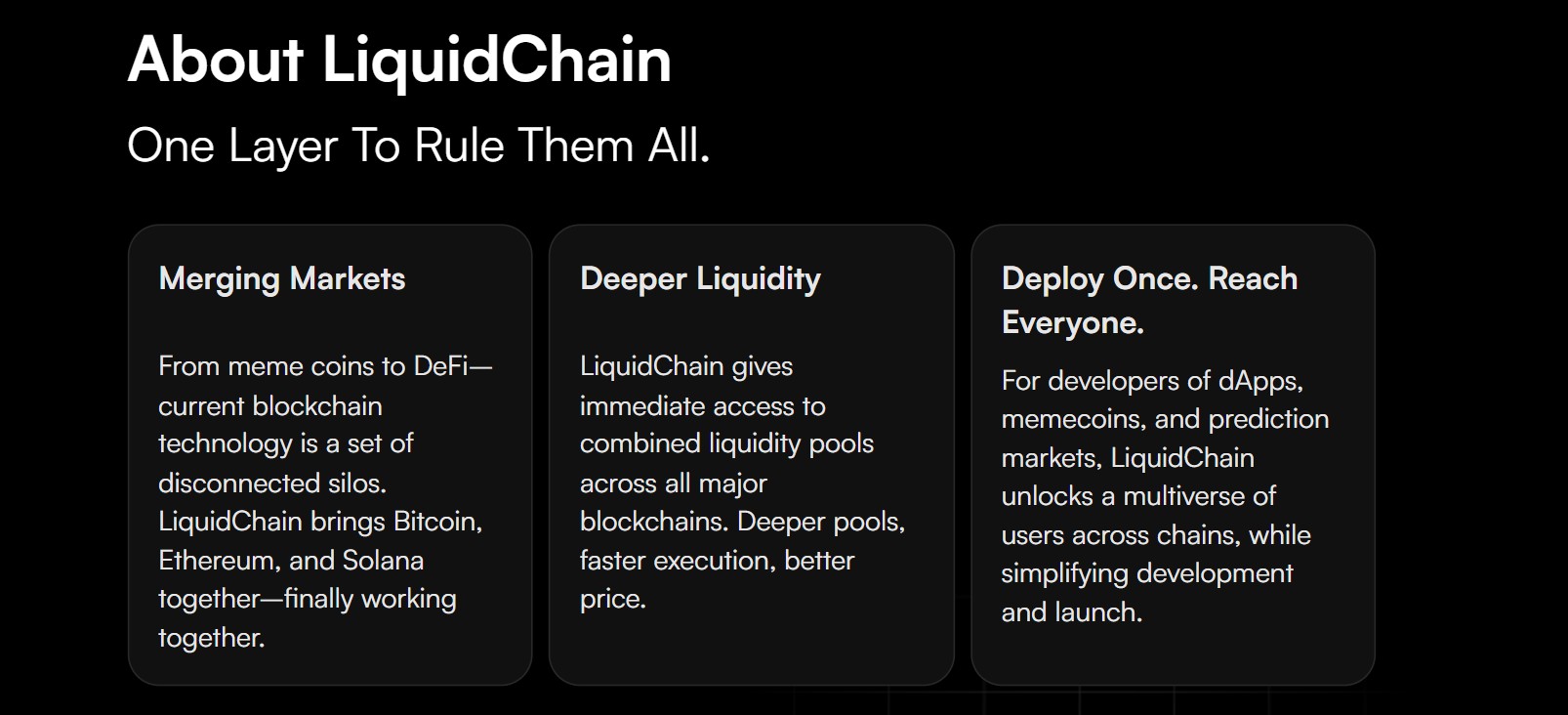
A Solana-based execution environment can handle the demands of real-time DeFi applications across multiple chains, along with a trust-minimized protocol that verifies Bitcoin UTXOs, Ethereum states, and Solana accounts, ensuring every transaction is settled atomically and securely across chains. The underlying consensus mechanism is a Proof-of-State Validation Layer, anchored to the three networks simultaneously.
LiquidChain bypasses traditional lock-and-mint bridge designs in favor of native asset routing, with a codebase that has already passed audits from both SpyWolf and CertiK. For a presale-stage project, dual audits at this point in development are an additional sign of technical credibility that is unusual for early-stage presale projects.
What it means, when live, is that a trader holding Bitcoin can access Ethereum-based DeFi strategies or Solana-native liquidity without having to move between multiple disconnected systems. Developers can deploy applications that tap into liquidity across chains simultaneously, gaining capital efficiency and reach. Post-launch, LiquidChain also aims to provide institutions with in-depth liquidity access on the L3 blockchain, bridging traditional capital into DeFi markets.
Why LIQUID Could Be the Next Crypto to Explode in 2026
The market cap math is hard to ignore, with a 100x from current levels only a $60 million market cap. Success in this arena is likely to give LIQUID a much larger valuation. For context, Stellar’s market cap sits in the six-billion dollar range despite operating as a payments-focused Layer 1 without a unified liquidity model.
Sui, which launched as a high-performance Layer 1, has already built a market cap north of $4 billion. LIQUID, at presale pricing, represents a fraction of either with a use case that, if executed, sits above both of them.
The Order strategizes.
The Order executes. ⟁👁https://t.co/vqvBcdSQYC pic.twitter.com/cCjkw54KPh
— LiquidChain (@getliquidchain) April 17, 2026
In the short term, forecasts suggest LIQUID could reach around $0.110 in 2026-2027 once the token lists on major exchanges, and early demand grows among DeFi users and developers.
We expect LIQUID to debut on decentralized exchanges prior to mainnet launch, with centralized listings targeted for Q3 2026.
In the meantime, holders can stake LIQUID for a ~1,600% APY (a figure that will drop over time, but right now it is an effective way to build a position).
The Layer 3 Window Is Open
The concept of the next crypto to explode gets thrown around liberally in this market. Most of the time, it describes a momentum trade with no underlying infrastructure. But LiquidChain is different in that the underlying problem it targets, fragmented liquidity across chains, is a persistent problem in DeFi, and a working solution can capture meaningful TVL from liquidity providers seeking chain-agnostic yield.
LiquidChain’s Layer 3 design, cross-chain liquidity focus, and 2026 launch timeline make this an excellent moment to learn about the protocol and take a position. But with audits complete, the window for presale entry may close soon.