


 Some of the links on this site may be affiliate links. ICOBench may receive advertising commissions when users visit recommended platforms via our affiliate links, at no additional cost to you. All recommendations are based on a comprehensive review process.
Chain fragmentation can be a choke on decentralized finance. The industry has spent the last three years building high-speed Layer 2 networks to escape Ethereum’s base-layer congestion, and it has worked. But it’s created a fractured landscape.
On the Layer 2 front, Arbitrum (ARB) currently trades around $0.10 with a $600 million market cap, and Mantle (MNT) sits near $0.67 today with a $2.2 billion market cap. Both have massive valuations because they process transactions cheaply, but they still operate as isolated silos.
For instance, a user holding USDC on Arbitrum cannot easily deploy it into a yield protocol on Mantle. They have to bridge the asset, pay a toll, wait for finality, and assume smart contract risk at every hop.
These issues are driving the 2026 narrative away from isolated L2s and toward universal routing layers that sit above them. Infrastructure that connects disparate networks is becoming an operational requirement, especially when large sums of money are involved.
One network capturing immediate volume is LiquidChain (LIQUID), a presale protocol that has already raised $647,000 in its early funding round, showing how high the demand is for cross-chain interoperability. The token is currently priced at $0.01447 before a single exchange listing.
How LiquidChain Restructures Cross-Chain Communication
Layer 1 and 2 networks are complicated, but LiquidChain simplifies their use by operating as a shared liquidity and messaging layer above the existing chains. Rather than competing with Arbitrum or Mantle for base-level execution, LiquidChain uses them as settlement layers, while handling the user-facing routing. When a user executes a trade or transfers an asset, LiquidChain communicates across chains using a decentralized sequencer network.
This bypasses the traditional necessity of locking assets in a bridge smart contract, waiting for finality, and minting wrapped equivalents on the destination chain.
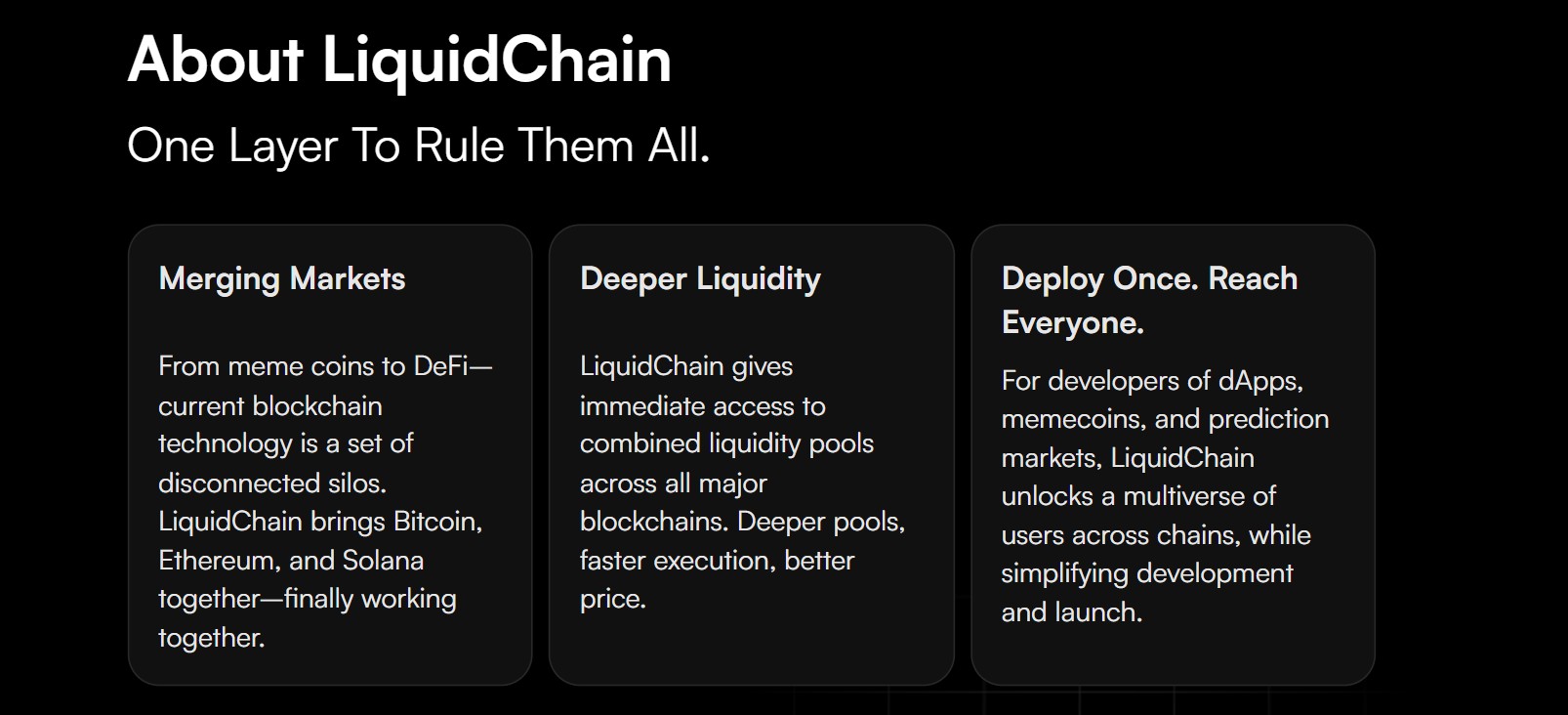
Let’s simplify that a bit: The protocol reads the state of connected Layer 2 chains simultaneously so that, if a user wants to deploy capital parked in one location to a decentralized exchange elsewhere, LiquidChain routes the execution logic natively. The user pays a single transaction fee in LIQUID, and the protocol handles the underlying gas fees on the target chains. The user experience shifts from a multi-step, high-risk bridging process to a single-click transaction.
Security remains the critical vulnerability for cross-chain messaging so LiquidChain structures itself around isolated security modules rather than giant smart contracts. If one chain connection experiences a delay or reorganization, the rest of the network stays secure. LIQUID’s code relies on audited frameworks from external firms such as Certik and SpyWolf. With these audits complete, it looks like the project is well on the way to launching.
Catalysts For A Bullish Market Revaluation
The current market is arguably tired of choice when it comes to cloned decentralized exchanges and derivative Layer 2s. Meanwhile, the massive valuations of incumbent networks leave little room for exponential growth, with projects like Arbitrum and Mantle already at saturated market caps, limiting the upside for new capital entering the ecosystem.
This discrepancy in market caps creates more opportunities for early-stage interoperability protocols. LiquidChain is available at the presale price of $0.01447, unencumbered by the bloated valuations of legacy networks, while providing the utility the market actually needs.
The next layer starts here. 👁⟁https://t.co/vqvBcdSQYC pic.twitter.com/vBzPngPk2e
— LiquidChain (@getliquidchain) April 6, 2026
Traders seeking out the best crypto presales for April 2026 can actively filter for projects that solve real architectural bottlenecks rather than those issuing memetic derivatives. LiquidChain fits the strict criteria of an infrastructure play with a new and useful product-market fit.
The aggressive tokenomics factor heavily into the network’s near-term price discovery. A staking APY of 1666% is extreme, to say the least, but is there to reward early conviction holders in the run-up to exchange listings. Meanwhile, the $647,000 already raised demonstrates that the market is willing to invest capital in the project.
The Collapse Of Network Silos
The era of isolated blockchain networks may soon be over, especially if developers and users refuse to tolerate the friction of walled gardens. It’s a lesson from TradFi that capital demands easy pathways.
Arguably, the next phase of decentralized finance relies entirely on protocols that remove the pain points of multi-chain routing, and Layer 3s are the answer to this problem.
LiquidChain is exactly where the industry is heading, and the next trend is not another L2, but a Layer 3 that treats them all as assets and liquidity pools.