Some of the links on this site may be affiliate links. ICOBench may receive advertising commissions when users visit recommended platforms via our affiliate links, at no additional cost to you. All recommendations are based on a comprehensive review process.
 The crypto market is experiencing a turbulent period as geopolitical tensions weigh on legacy assets, while specific altcoins find localized momentum. Over the weekend, Bitcoin and Ethereum faced downward pressure following renewed threats from the U.S. administration regarding Iranian energy infrastructure, which pushed oil prices to $110 a barrel and sent institutional traders toward defensive positioning.
Despite this “risk-off” mood in the headlines, mid-cap stalwarts like Cardano and Chainlink have defied the broader slump, posting intraday rallies of roughly 6% as buyers look for value in oversold utility tokens.
Current data from CoinMarketCap shows a total market capitalization of $2.36 trillion, with Bitcoin dominance holding steady at 56.1%. This stability suggests that while major coins struggle amid political uncertainty, liquidity is beginning to circulate into high-conviction infrastructure plays. One such project, LiquidChain (LIQUID), has been raising capital to solve the very liquidity silos that currently keep the market fragmented.
Having already raised $639,000 in its early funding rounds, LiquidChain has emerged as a high-risk, high-reward play in a largely stagnant market. As legacy chains struggle with congestion and isolated pools of capital, LiquidChain’s promise of a unified liquidity layer is positioning it as a standout candidate among the best crypto to buy in 2026.
Cardano and Chainlink Lead a Mid-Cap Recovery
The crypto market has bounced back this Monday, with Bitcoin rising 4% to edge back to $70,000, while Ethereum and XRP have both registered similar gains. Amongst the top 20 cryptocurrencies, Cardano and Chainlink have seen the most growth, rising 6.33% and 6.08% respectively over the past 24 hours.
This jump isn’t just a random price fluctuation; it’s a symptom of a market looking for utility that works regardless of Bitcoin’s price action. Cardano has benefited from a surge in institutional dApp deployments, while Chainlink’s rally is tied to its growing dominance in the Real-World Asset (RWA) sector. These gains show that capital is willing to move into “proven” infrastructure even when the global outlook remains murky.
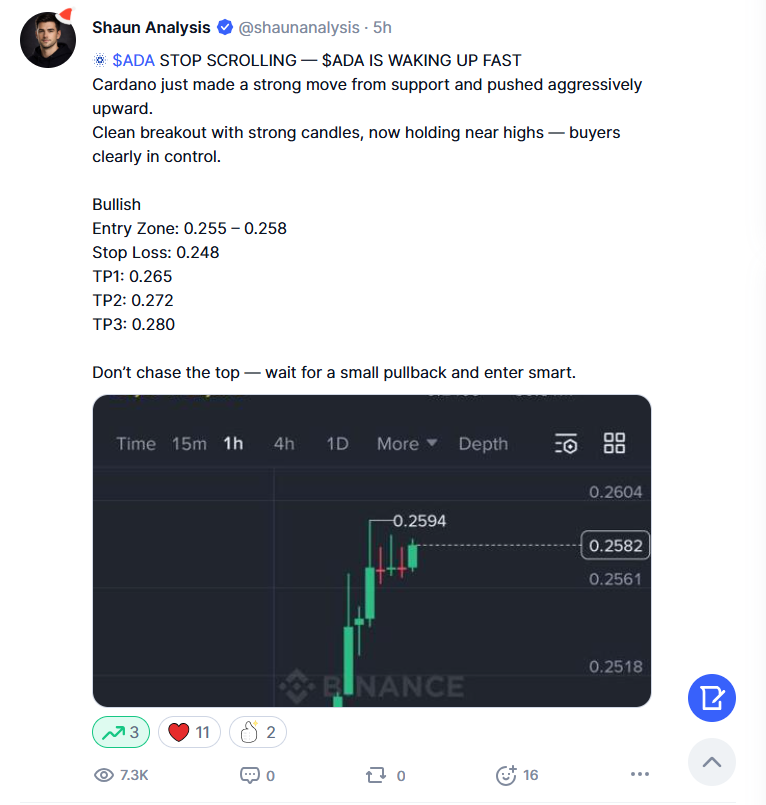
This 6% move signifies a technical breakout from long-standing resistance levels for both assets. Cardano’s ecosystem has seen a 12% rise in Total Value Locked (TVL) over the last 48 hours, suggesting that users are actually interacting with the chain rather than just holding the coin. Meanwhile, Chainlink’s Cross-Chain Interoperability Protocol (CCIP) continues to set the standard for institutional data feeds, making LINK a “safety trade” for those who want exposure to blockchain utility without the extreme volatility of micro-caps.
However, for many participants, a 6% move on a multi-billion dollar asset feels like a secondary consolation prize. While these tokens provide stability, they lack the exponential trajectory seen in earlier cycles.
This is why we are seeing significant capital flowing into projects like LiquidChain. Investors are using the profits from these 6% rallies to seed positions in high-yield, emerging projects that aren’t yet correlated to the daily “noise” of the majors.
How the Unified Layer 3 Architecture Powers LiquidChain
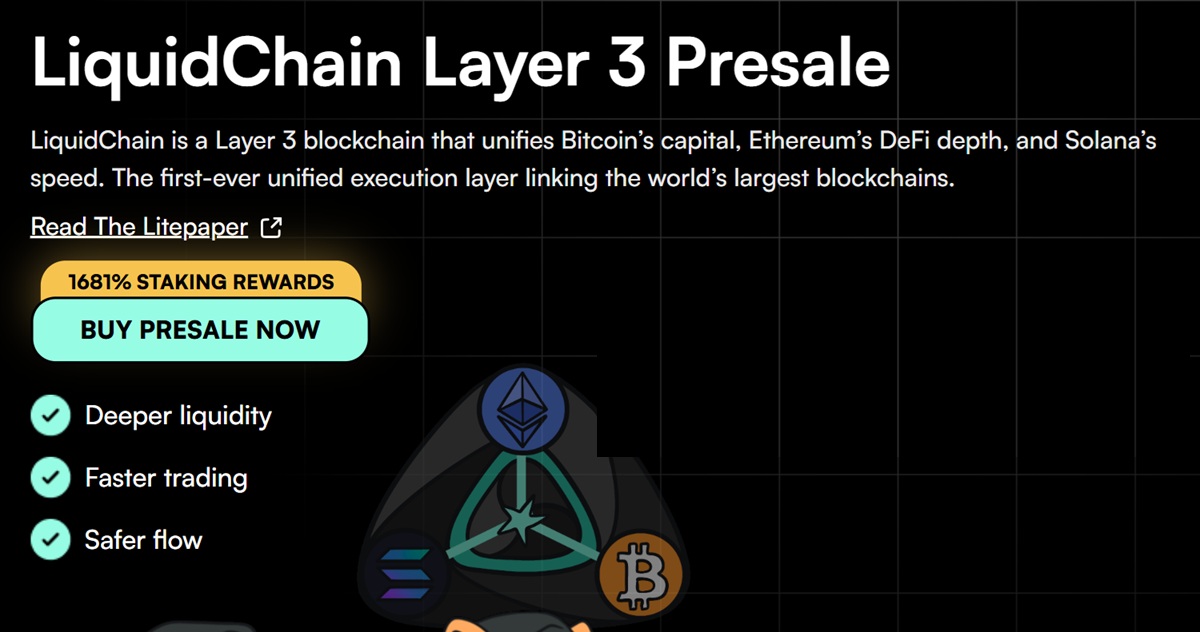
LiquidChain operates as a dedicated Layer 3 (L3) solution specifically engineered to aggregate liquidity across EVM-compatible chains and the burgeoning Bitcoin L2 ecosystem. Unlike traditional bridges that often introduce security risks through wrapped assets, LiquidChain uses a “Deploy-Once” architecture.
This allows developers to launch a protocol on LiquidChain and instantly tap into liquidity sitting on Ethereum, Solana, and Bitcoin simultaneously. By acting as a universal execution layer, it removes the friction of multiple wallet signatures and gas fees across different networks.
The technical foundation of the project has been verified through a multi-stage security process, with audits successfully completed by SpyWolf and CertiK. These reports focus on the integrity of the cross-chain messaging protocol, which is the “plumbing” that allows LIQUID to move value without the typical 24-hour settlement delays seen on older inter-chain solutions.
For the end-user, this translates to a “one-click” experience where an asset on Arbitrum can be used as collateral for a loan on a Bitcoin-native protocol without the user ever leaving the LiquidChain interface.
The tokenomics of the LIQUID ecosystem are built around a deflationary model where a portion of the transaction fees generated by the cross-chain aggregator are used to buy back and burn tokens. This creates a direct link between network utility and token value. The current staking dashboard reflects a community-first approach, prioritizing long-term lockers to ensure that the network remains stable during its initial growth phase.
Why LiquidChain Targets 10x Growth in a Bullish 2026 Window
The reason LiquidChain is being discussed as a potential 10x crypto lies in its timing. The 2026 market has been characterized by a “liquidity wall”; there is plenty of capital, but it is stuck in isolated ecosystems. As institutional interest in Bitcoin ETFs matures, those same institutions are now looking for ways to put that capital to work in DeFi. LiquidChain’s ability to “bridge the unbridgeable” by connecting Bitcoin liquidity to Ethereum’s DeFi stack makes it a primary infrastructure play for the rest of the year.
While the “majors” like Bitcoin and Arbitrum are sensitive to every social media post from Washington, infrastructure projects like LiquidChain are valued on their throughput and integration. The current presale price of $0.0145 represents a valuation that doesn’t yet account for the planned integrations with major retail payment providers. According to an official update on their X (Twitter) account, the team is currently finalizing a protocol that would allow real-world assets (RWAs) to be traded against cross-chain liquidity pools, a move that would significantly expand the token’s addressable market.
In a market where Cardano and Chainlink are fighting for 6% gains, the move toward an unlisted, high-utility asset like LIQUID represents a strategic pivot toward growth. The project’s recent social media commentary suggests that “the era of the siloed blockchain is ending,” and those who control the flow between chains will command the next cycle’s valuation premiums.