


 Some of the links on this site may be affiliate links. ICOBench may receive advertising commissions when users visit recommended platforms via our affiliate links, at no additional cost to you. All recommendations are based on a comprehensive review process.
One of the biggest problems in crypto right now? Chain fragmentation, which has stopped being a technical nuisance and started becoming frustrating. Liquidity sits in silos across different chains, meaning users need to jump between ecosystems and pay fees along the way.
It is arguably one of the largest problems of 2026 to solve, and it has led to the development of Layer 3s. Where Layer 2 scaling solved throughput for individual ecosystems, Layer 3 is now trying to solve coordination between them. Think of it like this: instead of choosing between Bitcoin for security, Ethereum for composability, or Solana for speed, route across all three invisibly.
That’s what’s drawing attention to LiquidChain, a cross-chain Layer 3 network built around the idea that liquidity should move as easily as data.
LiquidChain (LIQUID) is currently priced at $0.0144, with $625,000 raised in presale so far and staking yields at 1716% APY.
How LiquidChain Brings BTC, ETH, SOL Together
LiquidChain‘s core idea treats Bitcoin, Ethereum, and Solana less like competitors and more like execution environments that can be routed between. LIQUID sits on top, coordinating transactions, liquidity, and state without forcing users to commit to a single base layer.
Bitcoin remains the anchor for value and security while Ethereum still dominates in programmable finance. Solana has proven that speed and low fees can attract real user activity. LiquidChain attempts to combine those strengths by allowing assets and instructions to move across them through a unified layer – basically, when using LIQUID it doesn’t matter what chain you’re on.
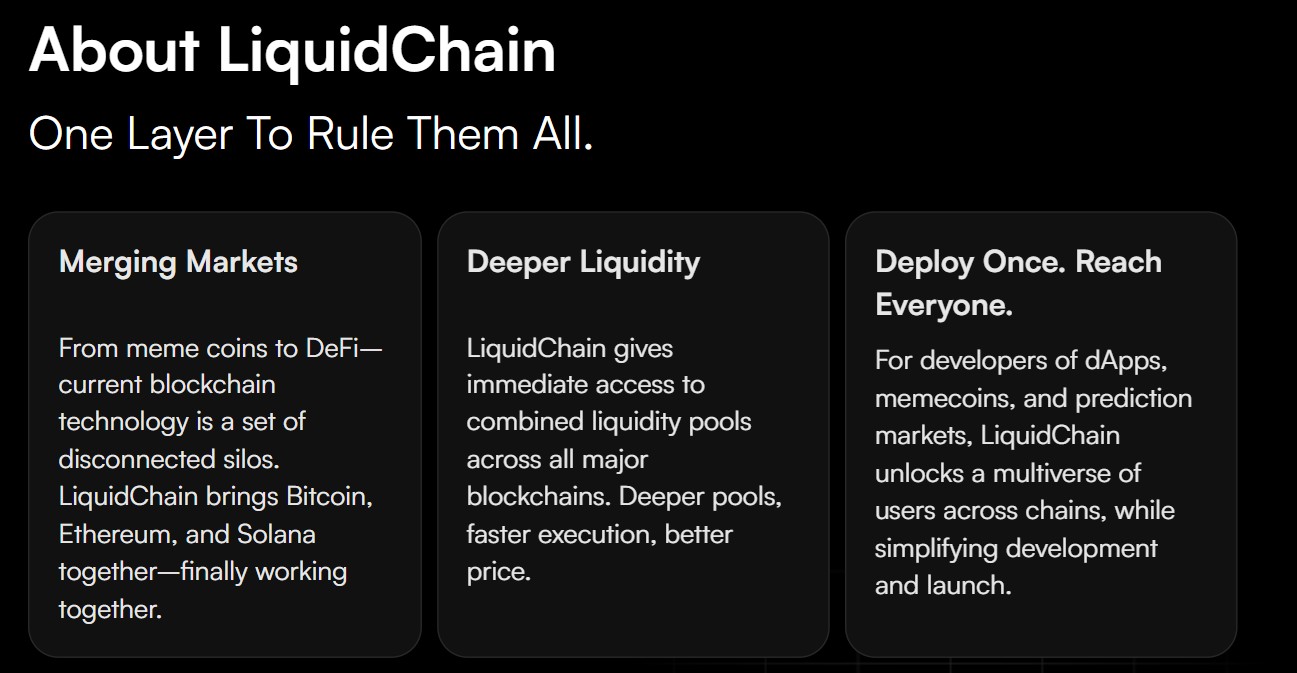
Instead of bridging assets manually, users can interact with the Layer 3 once it is live, which can handle routing and settlement behind the scenes. Execution can occur on one chain and settle on another, with the Layer 3 coordinating both.
In essence, liquidity pools are not confined to a single chain but are available across multiple networks. This allows deeper liquidity aggregation without forcing fragmentation into wrapped assets or synthetic representations.
It also reduces reliance on traditional bridges, which have historically been one of the weakest points in cross-chain infrastructure.
Security is handled through audited smart contract frameworks, with audits completed by SpyWolf and Certik.
The 1716% APY is a massive figure, and one we expect will not last long, but for early adopters, it is a fantastic way to build your holdings. If you choose not to stake, you are still getting an excellent presale price of $0.0144 per LIQUID.
Why LiquidChain Could Be the Next Crypto to Hit $1
A low entry price combined with a credible narrative can pull in capital quickly, especially in sectors that feel underbuilt. That’s a hint as to how LIQUID can be the next crypto to hit $1.
Layer 3 is one of the exploding narratives of 2026 – we have established base layers, L2s creating speed and low fees, but the solo’d liquidity is the next crunch point. That’s where LiquidChain has both a first-mover advantage and the right plan of attack. It is not trying to be faster than Solana or more secure than Bitcoin, but instead to make both chains, and more, accessible within a single framework.

The early presale raise of $625,000 is modest compared to some of the larger campaigns in this cycle, but that can work in its favor. Smaller raises often imply more room for upside, and a $1 target is less than a 100x from here. Following that through to market cap, LayerChain can target less than a $70 million market cap for a 100x – and that is a small valuation if the project starts delivering on its goals.
LIQUID enters a market that has started to care about infrastructure again, even in a predominantly speculative market. Systems that solve real bottlenecks find their investors and their users.
There is an interesting nexus here. Bitcoin continues to anchor the market, Ethereum remains the default for DeFi, and Solana has the speed. A Layer 3 that connects all three is a logical next step.
A Bet on Connection Over Competition
Most blockchain projects still frame themselves as alternatives, but LiquidChain frames itself as connective tissue. If the next phase of the market is about linking ecosystems rather than replacing them, then the project that makes that happen sits in a strong position.
LiquidChain is early, and the numbers reflect that, with a low entry price, a moderate presale raise, and aggressive staking incentives. What happens next depends on whether LIQUID can translate that early momentum into actual usage.
But LIQUID has come out of the gates with an excellent plan, completed audits, and an alluring early price. In a market that rewards infrastructure when it makes sense, LIQUID is one to watch for the next cycle.