


 Some of the links on this site may be affiliate links. ICOBench may receive advertising commissions when users visit recommended platforms via our affiliate links, at no additional cost to you. All recommendations are based on a comprehensive review process.
Fragmentation is one of those looming problems in crypto. Liquidity sits in silos, users bounce between chains, and even basic actions like swapping, staking, and bridging all carry tolls and friction that feel increasingly outdated for a market pushing toward mainstream scale.
It’s one thing switching continents and having to remember to drive on the other side of the road, but imagine if roads were built differently, had different widths, only accepted certain cars – that’s the way blockchains are beginning to go.
The result is predictable, in that investors get stressed, developers duplicate effort, and the user experience fractures just when we think adoption should accelerate.
That’s why the Layer 3 narrative has started to pick up pace in 2026. Layer 2 scaling solved cost and speed on individual chains, but it still doesn’t address the bigger issue: chains still don’t talk to each other cleanly.
One of the projects fixing that is LiquidChain (LIQUID). The price is $0.0143, and $622,000 has already been raised in the presale. The project’s goals and already audited code have led it to enter the conversations about the next crypto to hit $1, as cross-chain liquidity becomes a focal point again.
How LiquidChain’s Layer 3 Architecture Works
LiquidChain describes itself as existing above current blockchains rather than alongside them. The Layer 3 exists as a coordination layer, unifying liquidity across major ecosystems like Bitcoin, Ethereum, and Solana without forcing users into a single-chain environment.
At a technical level, the design leans on aggregation rather than replacement. Instead of asking users or developers to migrate assets or applications, LiquidChain routes interactions across chains to hide that underlying complexity. The goal is to make cross-chain activity feel like it’s happening on one system, even when it isn’t.
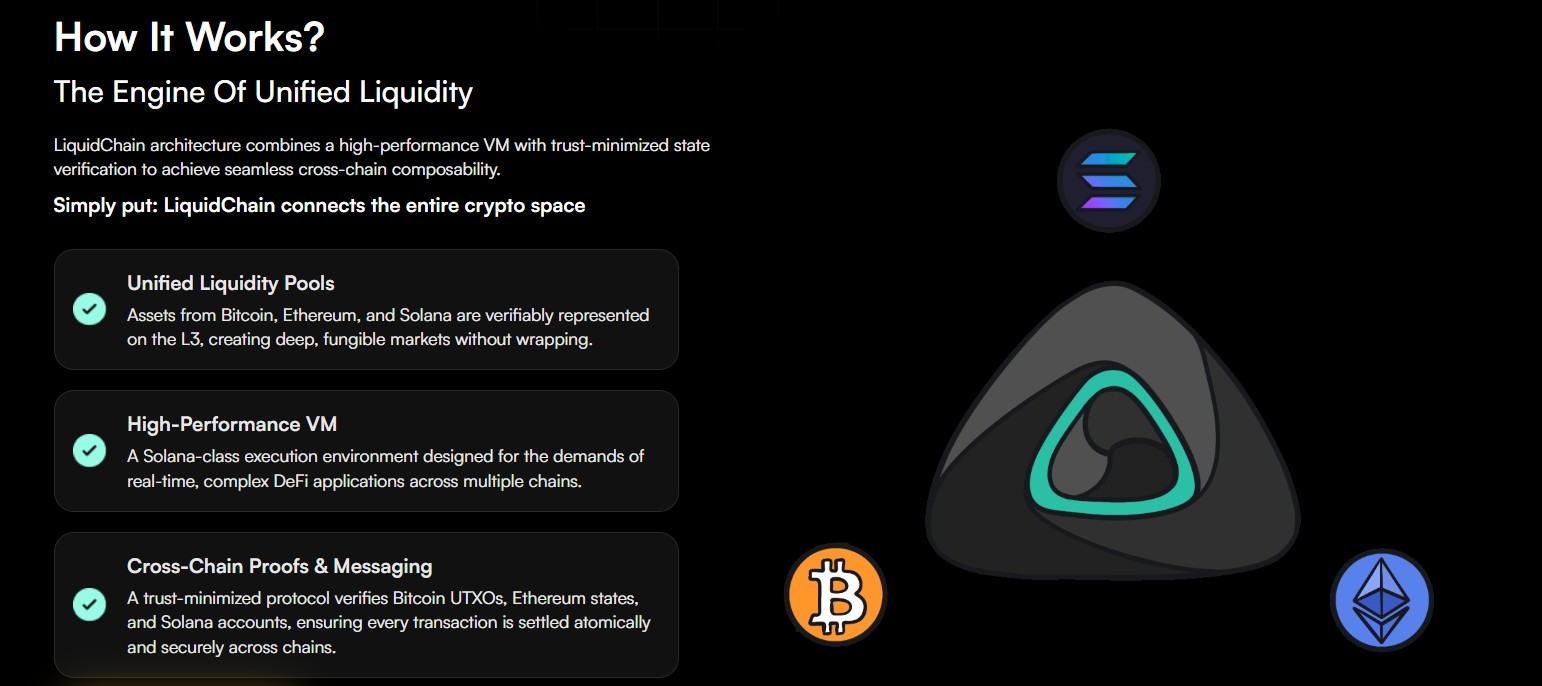
Bitcoin, Ethereum, and Solana each dominate different parts of the market: Bitcoin holds the bulk of long-term capital, Ethereum remains the default for DeFi infrastructure, and Solana’s reputation is for speed and retail-facing applications. None of them will go away anytime soon, but none of them solves interoperability on their own.
LiquidChain’s model tries to pull those strengths into a single liquidity layer. Users shouldn’t need to think about which chain they’re using; they interact with liquidity directly, with routing handled behind the scenes.
The staking mechanics add another layer to the design. An extreme 1,724% APY will entice early enthusiasts (we expect the rate to drop as more stakers arrive), and is a great way to quickly build a position.
Audits from SpyWolf and CertiK are already in place, which suggests the infrastructure is in place behind the scenes.
Why LiquidChain Could Be the Next Crypto to Hit $1
The next crypto to hit $1 conversation tends to attract noise, but in this case, it’s tied to a more structural argument. Projects that sit between ecosystems, rather than inside them, have a strong chance of capturing outsized value.
During bullish times, money doesn’t stay neatly contained within a single chain but moves as traders rotate between narratives. Every time liquidity shifts between ecosystems, friction reemerges. Projects that reduce that friction – and help capital move more – tend to benefit.
We expect cross-chain activity to increase through 2026, driven by renewed institutional interest, retail re-entry, and gradually more accepting legislation, with aggregation layers becoming more valuable by default.
They don’t need to dominate a single niche, simply to help money move at low cost and high speed. A project that treats all blockchains as a single source, rather than each as a silo, will gain an advantage here.
Just digging into $LIQUID / @getliquidchain Layer 3
Unified liquidity + real-VM speed = next-gen infrastructure
Bullish
— FISHER ✨ (@worldoffisher) November 3, 2025
As LiquidChain is still in presale, its price is suitably low, at $0.0143. To reach $1, the token effectively needs to 75x. That places LIQUID’s market cap at less than $60million – which is still a very small project in crypto terms. L2s currently sit at around $600 – $800 million, and in bull runs regularly hit $2-4 billion, easily visible if you see the chart for Arbitrum.
LIQUID being useful in the market suggests a market cap around these levels, although we are staying conservative for now, given the project’s early stage, and targeting a $50 million market cap as a first step.
The $622,000 raised so far suggests traction is already beginning, and the market is warming up to the narrative. A project that connects the liquidity of Bitcoin, Ethereum, and Solana will gain attention once we see it working.
That said, execution will decide everything. But if LiquidChain can deliver even a portion of what it’s aiming for, it enters a category with fewer direct competitors than headline sectors like AI tokens or meme coins.
A Bet on Connectivity Over Competition
Projects that compete for dominance tend to rise and fall with their specific ecosystems, but projects that connect ecosystems can benefit regardless of which chain is leading at any given moment. It’s a different kind of exposure – less about picking winners, more about enabling movement.
Whether that translates into a move toward $1 is still an open question. But the underlying thesis, linking Bitcoin, Ethereum, and Solana through a unified liquidity layer, puts LiquidChain in a position where it doesn’t need to rely on a single narrative to gain traction.
It only needs the market to keep doing what it already does: moving capital across chains. If that continues through 2026, the projects sitting in the middle of that won’t stay overlooked for long.