


 Some of the links on this site may be affiliate links. ICOBench may receive advertising commissions when users visit recommended platforms via our affiliate links, at no additional cost to you. All recommendations are based on a comprehensive review process.
The dream of a multi-chain future is often mired by the fragmented nightmare for the average trader. We were told that Layer 2 solutions would solve Ethereum’s congestion, and they did, but at the cost of isolating liquidity into dozens of competing chains.
Money needs to be fluid rather than trapped behind bridge risks and incompatible protocols, and it is a hurdle for the next stage of crypto, creating a need for a unifying layer that doesn’t just add more block space, but aggregates the value already scattered across the ecosystem.
While Layer 2s were the story of 2024 and 2025, they focused almost exclusively on throughput and gas fees. They succeeded in making transactions cheap, but they failed to maintain a cohesive user experience.
That’s why the narrative is shifting toward Layer 3 protocols, specialized environments that sit atop existing networks to provide a specific utility. In this case, the utility is liquidity – a way to make the existing fast chains talk to each other without needing bridging.
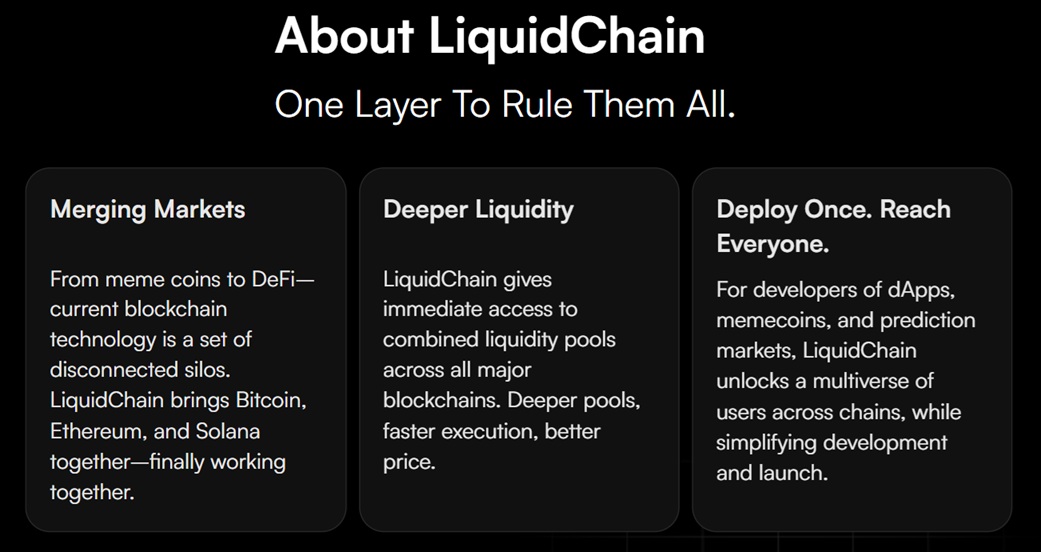
LiquidChain is the first L3 to take that spotlight. The project describes itself as the connective tissue for the industry’s largest blockchains, aiming to resolve the liquidity issues that have plagued DeFi for years.
Currently in presale, the project has already raised $622,000 at $0.0143 per token. For those looking at passive yield, the protocol is offering a staking APY of 1720%.
The Mechanics of a Liquidity-First Layer 3
LiquidChain is designed specifically to serve as a liquidity settlement layer. While Layer 2s focus on scaling execution, LiquidChain’s Layer 3 focus is on scaling capital efficiency. It operates by creating a unified interface that can pull liquidity from various underlying chains – Ethereum, Arbitrum, Optimism, and others -and present it as a single, deep pool for decentralized applications.
The technical hurdle LiquidChain addresses is how moving assets between Layer 2s requires a withdrawal to the mainnet or a third-party bridge, both of which introduce latency and security risks. LiquidChain’s architecture uses a messaging protocol to verify states across these chains simultaneously.

This allows a developer to build a dApp on LiquidChain that draws liquidity from multiple networks simultaneously, without the end user needing to know where their liquidity is sourced. It is a layer that treats the entire Ethereum ecosystem as one giant database of value.
Security has been handled via audits by both SpyWolf and Certik. Having secured the infrastructure before the mainnet launch, the team is betting that institutional-grade security will be the deciding factor for whales looking to park significant capital in a new L3.
Why 2026 Could Be the Year of the LIQUID Explosion
The bullish case for LiquidChain rests on the convergence of the Layer 3 narrative with its current presale market cap. At $0.0143, the token is priced for an audience that understands the first-mover advantage in the L3 sector before the protocol gets to work.
If LIQUID helps free up the daily volume currently moving through fragmented L2 bridges, the 100x projections floating around analyst circles start to look less like hopium and more like a standard re-evaluation. We have seen this pattern before with early L2s: the market ignores the infrastructure until it becomes indispensable.
With a current market cap of $622,000, a 10x from here becomes $6.2 million, and a 100x becomes $62 million – still a fraction of the billions we have seen L2s get to. We would expect a sensible valuation for a successful LiquidChain launch to be closer to $200 million, which is about 400x.
While we expect the 1720% staking APY to drop as more stakers join the pool, it is an extraordinarily healthy APY for those with early conviction, helping to build a LIQUID position rapidly while waiting for launch.
The two key catalysts will be a successful launch (which, in turn, will lead to exchange listings) and the market realization that chain-hopping is a poor user experience. Investors are tired of managing a dozen wallets for a dozen chains. LiquidChain’s value proposition is simplicity, and if it successfully links the biggest blockchains as promised in its whitepaper, it has a good shot at becoming the default gateway for DeFi.
So we suggest the project isn’t competing with other presales but with the very concept of fragmentation. And the protocol that solves the liquidity problem is the one that wins the cycle.
Final Thoughts on LIQUID
LiquidChain is entering the market at a moment when the technical debt of the L2 era has finally come due.
The project’s focus on Layer 3 liquidity aggregation addresses the most glaring weakness in the current crypto infrastructure and, with $622,000 raised and a clear audit trail from Certik and SpyWolf, the foundation is objectively solid.
The project is the best crypto presale for those who believe that the future of crypto isn’t more chains, but better connections between them. That said, the LIQUID presale is the last chance to catch this L3 shift before the market at large realizes that fragmentation is a solved problem.