

 Some of the links on this site may be affiliate links. ICOBench may receive advertising commissions when users visit recommended platforms via our affiliate links, at no additional cost to you. All recommendations are based on a comprehensive review process.
XRP has one of the most passionate communities in crypto. But passion does not change fundamentals. A growing body of analysis suggests that holding XRP means funding Ripple’s corporate moves while getting little in return.
Meanwhile, a different kind of project is growing. BMIC ($BMIC) is building quantum-safe infrastructure with a token model designed so that holders actually benefit when the protocol succeeds. The presale is active now, and it offers something XRP never has: alignment between the project and the people who hold its token.
Before We Explain What’s Actually Going On With XRP, Let’s Talk About BMIC.
BMIC: Full-Stack Wallet
BMIC is building what it calls a quantum-secure finance stack. That means a wallet, a staking system, and a payment layer all protected by post-quantum cryptography and signature-hiding smart accounts. The goal is to secure digital assets against a future where quantum computers can break today’s cryptographic standards.
What makes BMIC different from other projects is that the token is designed to capture value from everything the ecosystem does. It is not a governance token where holders vote but get nothing else. It is not a token that Ripple Labs can sell to fund acquisitions while equity shareholders get the real upside. BMIC holders actually participate.
The token is used to access wallet services and enterprise-grade APIs. It can be staked to help secure the network, with rewards flowing to participants. It enables governance over protocol decisions. It can be converted into compute credits for quantum workloads through a burn mechanism that reduces supply. And a fixed percentage of company revenue funds token buybacks and burns, which basically creates deflationary pressure over time.
The team allocation is only 3%, which is significantly lower than industry standard. Fifty percent of the supply goes to the presale, giving the public real access at the ground floor. The roadmap shows clear milestones, with wallet alpha coming in mid-2026 and quantum compute integration in 2027.
The presale offers entry at prices starting from $0.048485 per token, with structured increases across phases and the launch price expected to exceed the final presale tier. Nearly half a million dollars has already been raised.
What an Analyst Just Pointed Out About XRP
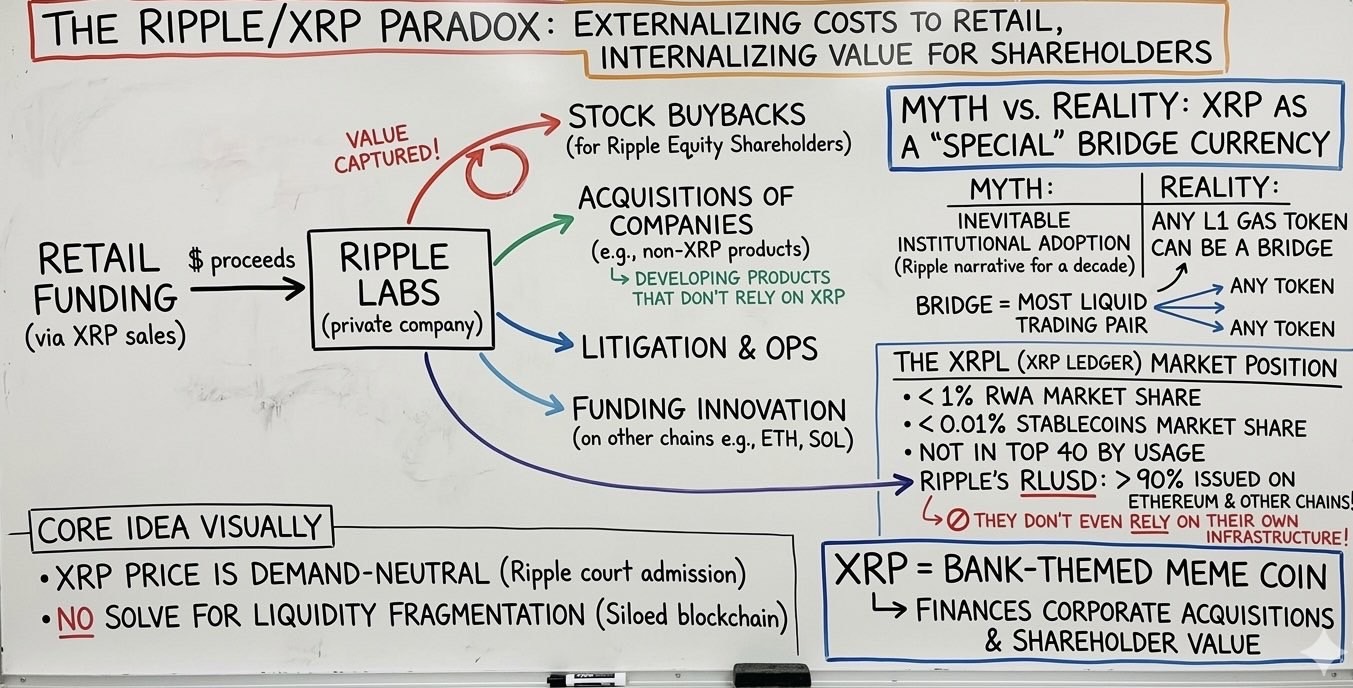
A detailed post from an analyst named Djani lays out the case against XRP in a way that is hard to ignore. The argument is straightforward: Ripple has spent the past decade selling XRP to retail while promoting a narrative about inevitable institutional adoption.
In reality, Ripple uses the proceeds from XRP sales to acquire real companies, develop products that do not rely on XRP, and fund stock buybacks. All of this benefits Ripple Labs shareholders, with little to no value created for the XRP token itself.
Source: X/@DjaniWhaleSkul
The post points out that the idea of XRP as a special bridge currency does not hold up. Any token can fulfill that role. Every layer one gas token already does. Being a bridge currency simply means being the most liquid trading pair on a blockchain. There is nothing inherently unique about XRP in this regard. Ripple even admitted in court filings that XRP’s bridge currency use case is demand-neutral. It does not impact price.
The analyst also notes that while XRP can act as a bridge currency on its own chain, the XRP Ledger has relatively low adoption among asset issuers. It is not even in the top 40 by usage, with less than 1% market share in real-world assets and less than 0.01% in stablecoins. Ripple itself issued 90% of its RLUSD stablecoin on Ethereum and other non-XRP Ledger chains. They do not even rely on their own infrastructure.
The conclusion is blunt. XRP’s role appears to be that of a bank-themed meme coin that Ripple sells to retail investors to finance corporate acquisitions and stock buybacks. Ripple externalizes costs to XRP holders while internalizing value for its shareholders.
Why BMIC Is Simply a Better Bet Than XRP Right Now
XRP has been around for over a decade. The narrative has always been that banks are coming, that institutional adoption is just around the corner. But after twelve years, the evidence for that narrative is thin. Ripple has built a valuable business, but the value has not flowed to XRP holders. It has flowed to equity shareholders through acquisitions and stock buybacks.
BMIC offers something different. The token holders are not funding corporate moves that benefit someone else. They are participating in an ecosystem where the token is required for services, staked for security, burned for compute access, and reduced in supply through revenue-funded buybacks. The team took only 3%, so they are aligned with long-term holders, not positioned to dump on them.
The quantum security angle adds another layer. XRP faces the same vulnerability as every other token: public keys exposed on-chain that quantum computers will eventually be able to exploit. BMIC is building protection for that future now, not waiting to patch things later.
Meet the future of quantum-secure Web3 with BMIC:
Presale: https://bmic.ai/
Social: https://x.com/BMIC_ai
Telegram: https://t.me/+6d1dX_uwKKdhZDFk