


 Some of the links on this site may be affiliate links. ICOBench may receive advertising commissions when users visit recommended platforms via our affiliate links, at no additional cost to you. All recommendations are based on a comprehensive review process.
Cryptocurrency has moved past the era of simple scaling. While 2024 and 2025 saw an explosion of Layer 2 networks that promised cheap transactions, they inadvertently created a secondary crisis: chain fragmentation.
Any trader finds their capital scattered across dozens of isolated environments, making it difficult for liquidity to flow where it is most needed. Investors are no longer looking for the fastest blockchain, but for the one that can actually aggregate the value currently sitting in siloed L2 ecosystems.
This philosophy has cooled interest in older stalwarts like Monero, which remains a regulatory lightning rod, and even high-performance platforms like Hyperliquid. Even as Hyperliquid has dominated the decentralized perpetuals market, it remains a specialized environment. What we need now is connective tissue protocols.
While Layer 2s were built to handle the volume of the masses, Layer 3s are being built to handle the liquidity of the institutions. The goal is to create a unified experience where a user doesn’t need to know which chain they are on, as long as market depth is available.
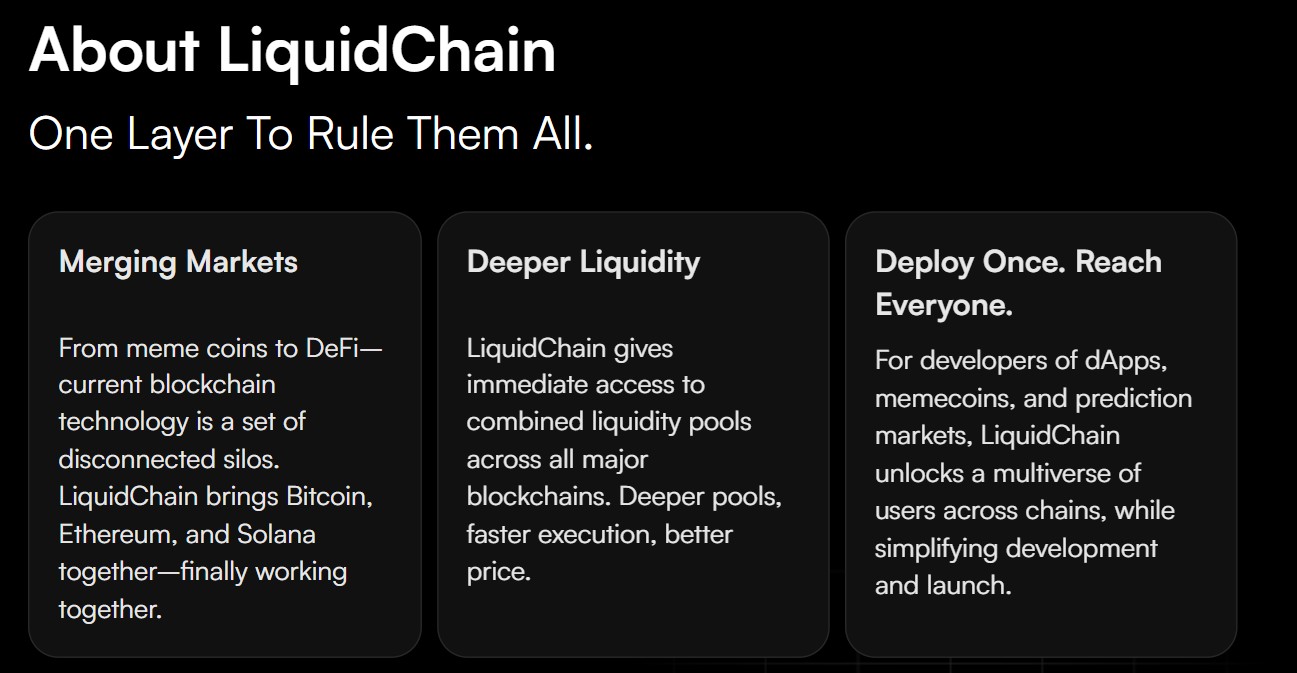
At the center of this is LiquidChain (LIQUID), a Layer 3 solution designed to help reduce the walls between the industry’s largest blockchains. The project is growing quickly, attracting investors because it addresses the fragmentation bottleneck head-on rather than just launching another network.
To date, the project has raised $622,000 in its presale phases, with the current price at 0.01435. Early participants are currently seeing a staking APY of 1724%, a rate that won’t last long, but is a great offer for early believers. All in all, LIQUID is shaping up to be the next crypto to explode, thanks to an ambitious but logical roadmap and an idea all of crypto can unite behind.
The Mechanics of Layer 3 Liquidity Aggregation
LiquidChain does not attempt to compete with Ethereum or the major Layer 2s for base-layer security. Instead, it functions as a specialized execution layer that sits on top of them and acts as a clearinghouse for fragmented liquidity. In the current market, moving a significant position from an Arbitrum-based DEX to a Base-based protocol often involves multiple hops, slippage, and bridge risk. LiquidChain’s architecture uses a cross-chain messaging protocol that enables atomic liquidity, allowing assets to be used across different chains without users manually bridging funds.
The technical backbone of the project has undergone rigorous scrutiny to ensure it can handle multi-chain interaction. The codebases have been audited by both SpyWolf and Certik, providing a level of transparency that has become a prerequisite for serious capital.

Unlike Monero, which focuses on obfuscating transaction data, or Hyperliquid, which optimizes for order-book speed, LiquidChain prioritizes the interoperability of value. It treats every other blockchain as a liquidity provider. When a trade is executed through a LiquidChain-connected dApp, the protocol scans all L2s to find the best price and deepest pool, executing the transaction via its own Layer 3 logic.
This effectively turns the entire Ethereum ecosystem into one giant, unified liquidity pool, with a roadmap that goes beyond token swaps and aims for cross-chain lending and yield farming that requires zero manual bridging from the user.
Why 2026 is the Bullish Year for LIQUID
The timing of LiquidChain’s market entry aligns with a broader exhaustion regarding ghost chains – networks with high TVL but near-zero use. Investors have become skeptical of Layer 2s that exist only to farm airdrops, and LiquidChain’s $622,000 raise suggests that the market is ready to fund infrastructure that solves existing problems rather than creating new ones.
The 0.01435 entry price is being viewed by many as a ground-floor opportunity before the protocol’s full integration with major decentralized exchanges. As more L2s launch, the problem LiquidChain solves only gets larger. Fragmentation is a growth industry, which makes the solution to fragmentation a high-conviction play.
The excellent 1724% staking APY is a powerful retention tool. This high yield is sustainable in the short term because it is tied to the protocol’s early-stage distribution model, intended to decentralize the LIQUID token as quickly as possible among active participants rather than venture capital.
In previous cycles, the money legos of DeFi were all on one chain, but now, those legos are spread across the room. LiquidChain is essentially the person putting them back together, occupying a neutral, utilitarian space. It doesn’t matter which Layer 2 wins the war for users; LiquidChain wins as long as there is more than one chain in existence.
This chain-agnostic bullishness is why the presale has maintained such steady momentum despite wider market fluctuations.
From Presale to Go Live
The transition from a speculative asset to a functional utility token is usually where crypto projects fail or fly. LiquidChain has bypassed the “speculation-only” phase by launching with a clear, audited product that addresses the most annoying part of using crypto today: the bridge.
With a solid foundation, verified security audits, and a massive incentive structure for early adopters, the project looks to be a primary beneficiary of the industry’s move toward a unified liquidity layer.
The current presale figures and the high staking rewards offer a window that is likely to close as the project moves toward its next phase of exchange listings and protocol integrations.
For those who have spent the last two years frustrated by the difficulties of moving assets between chains, the value proposition of LiquidChain is not just a theoretical improvement but a necessary evolution. Right now, it is in presale, but it will be one to watch once the market gets to price it.