


 Some of the links on this site may be affiliate links. ICOBench may receive advertising commissions when users visit recommended platforms via our affiliate links, at no additional cost to you. All recommendations are based on a comprehensive review process.
In XRP news today, Ripple has enabled direct swaps of XRP and RLUSD for its Healthcare XRPHAI reward token through the XRPH Wallet, opening the platform’s AI-driven healthcare ecosystem to the broader XRP community for the first time.
The activation comes against a backdrop of accelerating XRPL Utility metrics: XRP Ledger transaction activity rose 65% year over year. This raises a concrete question for investors: can a Healthcare AI platform built natively on the XRP Ledger convert that infrastructure advantage into durable, measurable adoption?
In case you missed today’s announcement:$XRP and $RLUSD can now be swapped into $XRPHAI through the XRPH Wallet 🚀
Access rewards through the growing Proof Of Health™ ecosystem 🔓
Download now on App Store or Google Play:
🤖https://t.co/UV3QSvnHmU pic.twitter.com/dKiO90JnT4
— XRP Healthcare (@XRPHealthcare) May 13, 2026
What this development is not is a simple token launch or liquidity event. XRPHAI is not acquired through speculative presale or passive holding; it is earned. That structural distinction is the first thing any investor should internalize before evaluating where this fits in the broader XRP ecosystem.
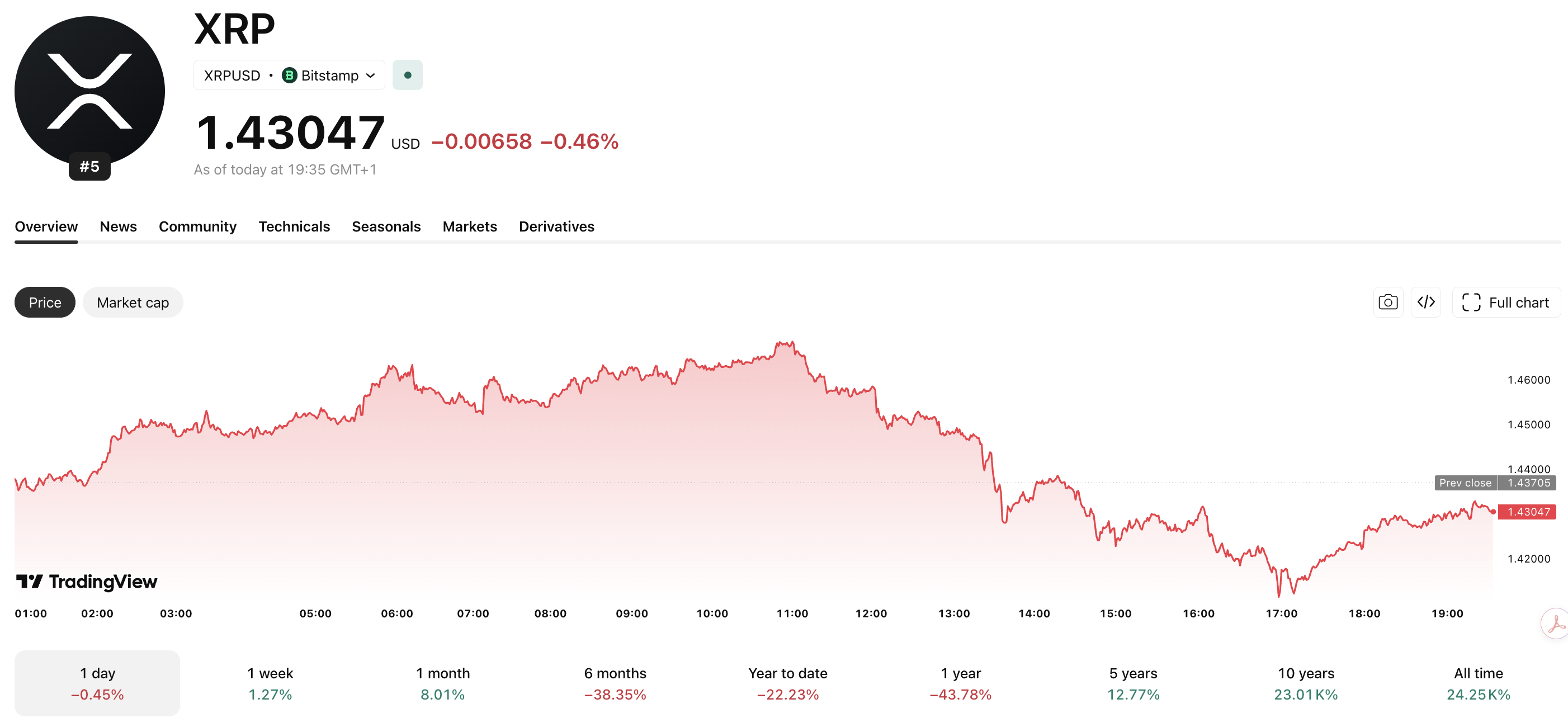
This XRP news dropped as the asset trades relatively flat over the past 24 hours, posting a modest loss of just -0.2%, trading at $1.43, and recording a daily trading volume of $2.29Bn.
XRP News: What the XRPHAI Swap Activation Actually Does for XRPL Utility
The XRPH Wallet, launched in 2023 and available for free on both the App Store and Google Play, now allows eligible users to swap XRP or RLUSD for XRPHAI directly within a single interface. This is not a cross-chain bridge or a DEX aggregator play. The entire transaction stack runs natively on the XRP Ledger, settling in three to five seconds at fees under $0.001.
XRP functions as the high-speed liquidity layer. RLUSD, Ripple’s USD-pegged stablecoin, handles stable-value transactions – critical for healthcare service pricing where volatility is a practical barrier to adoption. The wallet already supports multi-currency displays in USD, GBP, UGX, and AED, integrated invoicing, and QR-code payments, reducing transaction costs by up to 90% versus traditional healthcare payment rails.
The reward mechanism itself operates through what XRP Healthcare calls the Proof of Health framework. Users earn XRPHAI by completing verified wellness activities – health assessments, symptom tracking, wellness sessions – inside the XRPH AI App. The app and wallet are designed as a unified ecosystem: one handles AI-powered healthcare engagement, the other manages custody and payments.
On this huge XRP news, Laban Roomes, speaking for XRPH, framed the activation directly: “We’ve spent years building XRP-powered healthcare infrastructure for long-term global use. Opening XRP and RLUSD access to XRPHAI through the XRPH Wallet is another step toward connecting blockchain utility, healthcare engagement, and rewards at scale.”
On the supply side, XRPHAI has a fixed maximum of 1,000,000,000 tokens, with 100,000,000 currently in circulation. The issuing address has been permanently blacklisted; no further minting is possible. That structural ceiling matters for anyone evaluating the token’s long-term scarcity profile.
RELATED: XRP News: How the XRPH Dual-Layer Architecture Connects XRPL and Base for Healthcare Liquidity
DePIN Healthcare: Why Real-World Rails Change the Calculus for XRP Ecosystem Investors
like it or not, $XRP runs to $10 in easy mode once it flips $1.80.
the level is the level. it doesn't care about your bag, your bias, or your opinion of the project.
structure says reclaim $1.80 and the path opens. that's the trade.
be positioned or be loud about it. only one… pic.twitter.com/bNMhdKegWA
— Don 🐂 (@DonWedge) May 13, 2026
The XRP Healthcare model operates across two structural layers, a detail that matters for understanding where value accrues. XRPHAI handles participation and rewards earned through verified healthcare activities.
XRPH functions as an infrastructure multiplier, providing tiered earning boosts for active users. Both tokens are integrated into the XRPH Wallet for pharmacy and clinic payments, targeting the global healthcare payments market, which is roughly $595Bn.
This is the DePIN thesis applied to healthcare: physical infrastructure, pharmacies, clinics, wellness providers, connected to on-chain settlement rails, with behavior-verified rewards replacing speculative incentives.
Early pilots have run in both the United States and East Africa, with XRP Healthcare M&A Holding Inc. actively targeting pharmacy chain acquisitions in African markets to expand the network’s physical footprint.
The broader Ripple ecosystem context reinforces this structural shift. RLUSD recently received ADGM approval as a regulated fiat-referenced token in Abu Dhabi, allowing licensed institutional entities to use it directly.
This aligns with the XRPH Wallet’s Middle East expansion plans. Exchange integrations, including Bitstamp, have simultaneously deepened RLUSD liquidity on the institutional side.
Ripple’s $25M education initiative, focused on improving learning environments across the United States, signals that the organization is investing in ecosystem legitimacy beyond pure financial infrastructure.
For retail investors tracking XRPL Utility signals, these are parallel proof points: the ledger is being used for consequential real-world applications, not just financial speculation.