

 Some of the links on this site may be affiliate links. ICOBench may receive advertising commissions when users visit recommended platforms via our affiliate links, at no additional cost to you. All recommendations are based on a comprehensive review process.
In today’s Solana news, Western Union has officially moved on-chain. The 175-year-old remittance giant launched USDPT, its US dollar-pegged stablecoin, on the Solana blockchain on May 4, 2026, the most consequential institutional adoption event the network has seen to date.
Solana is trading at $85 with a market cap of $53Bn as of May 5, and the question every investor is now asking is whether this catalyst is enough to break the rangebound structure that has capped SOL since January.
BREAKING: @WesternUnion's @USDPT_ is live on Solana.
A federally regulated digital dollar, issued by @Anchorage Digital, integrated directly into Western Union's infrastructure across 200+ countries.
Borderless money is here. pic.twitter.com/KtkUvT00RX
— Solana (@solana) May 4, 2026
USDPT is issued by Anchorage Digital Bank, the first federally regulated crypto bank in the U.S., with wallet and settlement infrastructure provided by Fireblocks. The stablecoin is rolling out first in Bolivia and the Philippines, a combined market of 130 million people, with expansion to over 40 countries targeted by the end of 2026.
Western Union’s global remittance network serves more than 150 million customers across 190 countries. Moving even a fraction of that volume on-chain represents a structural shift, not a pilot.
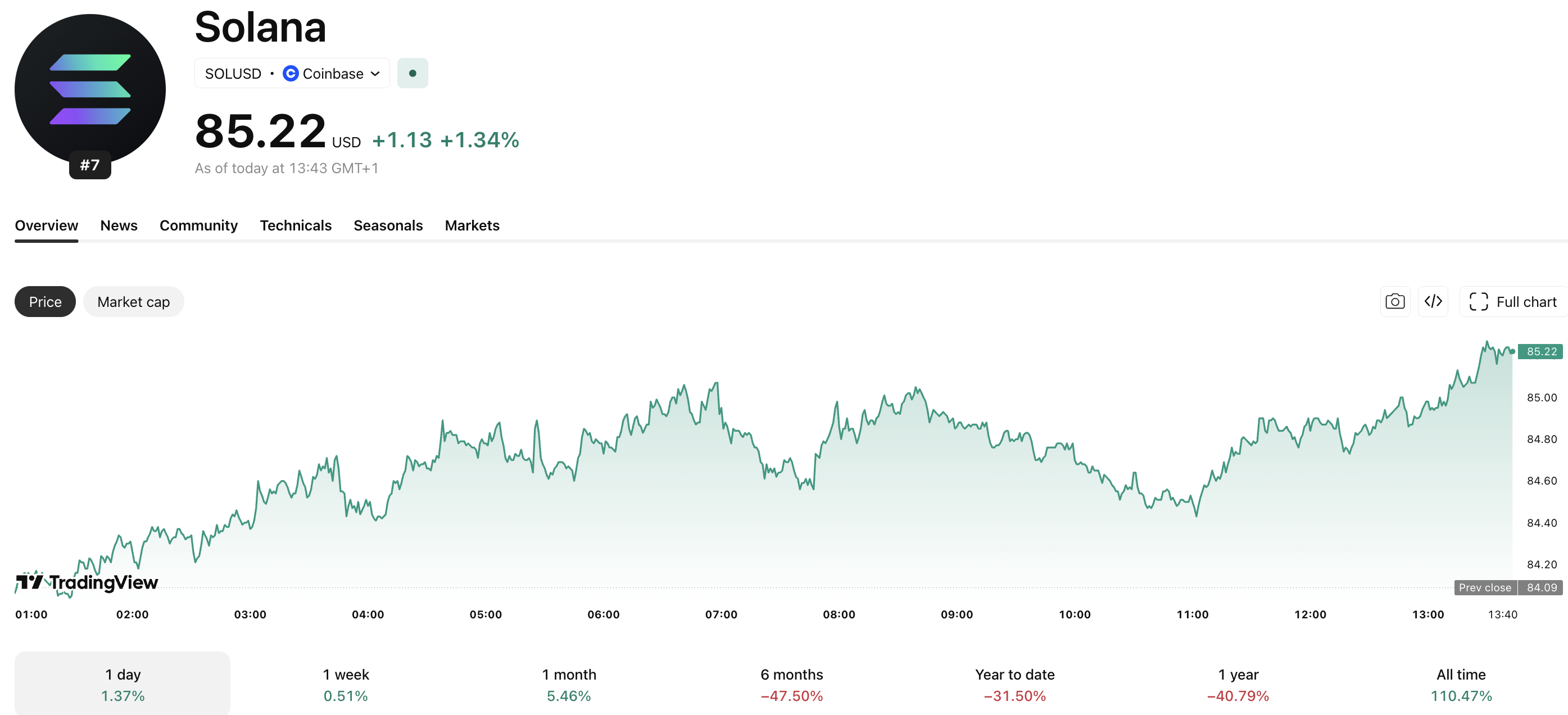
Solana News: Can SOL USD Break $90 on the Western Union USDPT Catalyst?
In other Solana news, SOL has been compressed between roughly $80 and $100 since late January, and at $85, it sits in the lower half of that band. The level to watch is $89–$90.
That zone has acted as a ceiling on every meaningful recovery attempt this year, and the USDPT launch is the first genuine institutional demand signal capable of providing sustained buy pressure behind a breakout.
Support is anchored near $80. A close below that level would flip the near-term structure bearish and open the door to a retest of the $72–$74 range.
On the upside, a confirmed close above $90 with expanding volume would be the first clean structural break since January, and the kind of move that draws momentum capital into the trade.
The technical setup matters less than the fundamental shift here. Solana’s selection by Western Union for USDPT deployment is a direct validation of the network’s throughput and fee structure at enterprise scale.
- Bull case: USDPT adoption accelerates across Western Union’s agent network, on-chain transaction volume on Solana climbs materially through Q2 2026, and institutional capital rotates into SOL as network utility becomes undeniable. SOL breaks $90 on volume, targets $100, and the prior-range highs above it. The Crossmint integration, enabling USDPT access at over 360,000 agent locations, becomes the distribution lever that turns theoretical volume into real volume.
- Base case: USDPT launches without friction, but adoption is gradual. Bolivia and Philippines corridors build slowly, exchange listings for USDPT arrive in mid-2026, and SOL grinds toward $90 without a decisive breakout. The network benefit is real but takes quarters to show up in price. SOL holds the $80 floor and consolidates in the $83–$92 range through summer.
- Bear case / Invalidation: Macro headwinds, rate policy, risk-off rotation, suppress the crypto market broadly before USDPT volume has time to build. A competing chain captures a parallel institutional remittance deal, diluting Solana’s narrative advantage. SOL loses $80 support, opens the $72–$74 range, and the USDPT catalyst becomes a ‘sell the news’ event in the short term.
The most probable near-term outcome sits between the base and bull cases. The structural pieces are in place, but real transaction volume from remittances takes quarters to accumulate; the price catalyst is real, but patient.
DISCOVER: Next Crypto to Explode in 2026
Why Western Union’s USDPT Makes Solana the Global Remittance Layer
BREAKING: Western Union is launching its own stablecoin, “USDPT,” on Solana.
Consumer spending in 40+ countries. Settlement layer for global exchanges.
Not a crypto startup. The world's oldest money transfer company.
Visa. Stripe. Meta. Now Western Union. Stablecoins are no… pic.twitter.com/3Q7h73JKHw
— IOPn Newsroom (@IOPn_newsroom) May 5, 2026
Correspondent banking, which USDPT aims to replace, is slow and costly, taking 2–5 business days and charging 5–7% in fees. In contrast, Solana news processes transactions in under 400 milliseconds for less than $0.01 each, showcasing the benefits of blockchain remittances.
USDPT, designed by Western Union on Solana’s Token Extensions framework, incorporates compliance features and identity verification, making it a tool for a regulated global payments network rather than just a stablecoin.
The landscape is shifting, with MoneyGram and Zelle exploring stablecoin remittances, and the stablecoin market could grow from $317.3Bn to over $2 trillion by 2030.
Institutional adoption of Solana has expanded beyond DeFi to traditional finance, with Western Union’s initiative validating this approach.
The crucial question is whether USDPT will create sustainable demand for SOL, essential for fee revenue and ecosystem liquidity. Upcoming earnings calls and corridor data will provide insights into adoption trends.