


 Some of the links on this site may be affiliate links. ICOBench may receive advertising commissions when users visit recommended platforms via our affiliate links, at no additional cost to you. All recommendations are based on a comprehensive review process.
The largest crypto presales are rarely built on technical novelty alone. They usually begin with a frustration that the market already understands. For Bitcoin, that frustration is simple: the network created peer-to-peer digital money, yet much of the activity around payments, applications, and decentralized finance moved elsewhere.
Bitcoin trades at $64,900 today, down 0.97% over 24 hours but still 3.02% higher across seven days. Ethereum trades at $1,800, having fallen 2.41% in the past day while retaining a 2.41% weekly gain. CoinMarketCap places the total cryptocurrency capitalization at approximately $2.21 trillion, of which BTC is 1.3 trillion of that.
While capital remains concentrated in BTC, the base chain itself still processes only a limited number of transactions per second – around 7 TPS – and cannot natively support the kind of programmable applications associated with Ethereum or Solana.
Investors have consequently helped Bitcoin Hyper (HYPER) raise $32.9 million – one of 2026’s largest presales – with its plan to bring fast payments back to Bitcoin, and give the original cryptocurrency back its original goals.
HYPER is currently priced at $0.01368, while buyers can join in on 36% staking APY through the project’s staking platform.
How Bitcoin Hyper Turns Bitcoin Into an Active Network
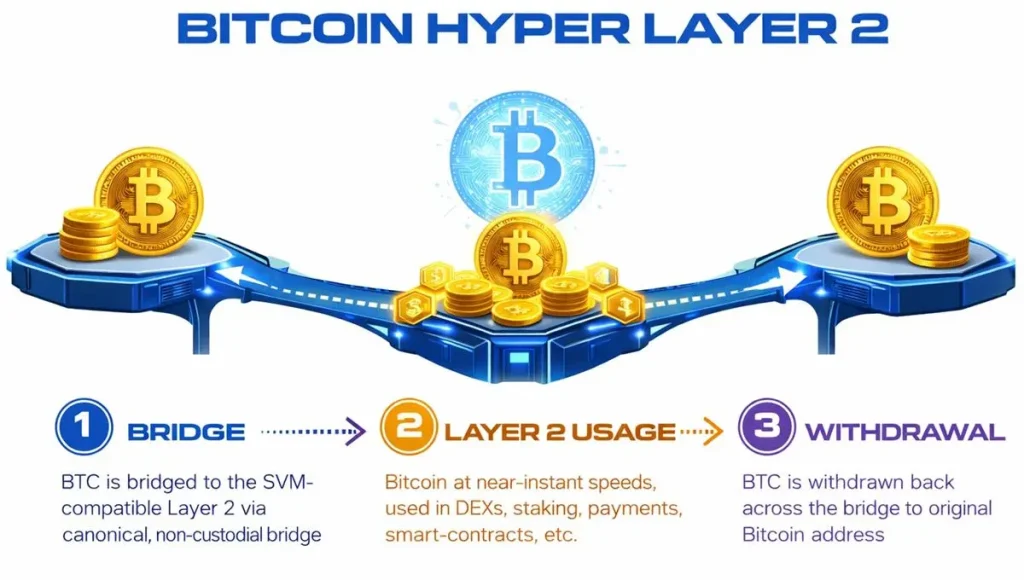
Bitcoin Hyper is designed as a Layer 2 execution environment built around Bitcoin. Its purpose is not to alter Bitcoin’s underlying rules, but move frequent activity away from the base chain, where it can be processed faster and at lower cost.
Bitcoin Hyper integrates the Solana Virtual Machine, or SVM, as an L2 above Bitcoin, giving developers an environment capable of supporting smart contracts, decentralized exchanges, payment applications, and other services without asking Bitcoin to perform every calculation.
Transactions can then take place with low latency before being bundled together and anchored back to Bitcoin using zero-knowledge proofs.
All roads lead to $HYPER. ⚡️https://t.co/VNG0P4GuDo pic.twitter.com/TifwNHMtOZ
— Bitcoin Hyper (@BTC_Hyper2) July 24, 2026
The protocol combines two qualities that have usually existed apart: Bitcoin’s monetary weight and Solana-style execution speed. Ethereum and Solana built powerful application economies partly because developers could operate with speed that made them useful in the real world. Bitcoin Hyper wants to give BTC similar freedom without weakening the base network that made the asset valuable.
HYPER is used to pay network fees, support staking, and participate in governance. Its utility therefore depends on activity rather than speculation, and more applications, transactions, and users mean more reasons to hold and use HYPER.
Could HYPER Be the Next Crypto to Explode?
HYPER‘s $32.9 million raise has already answered one question: there is substantial demand for a faster, programmable Bitcoin economy. Buyers are backing the idea that Bitcoin’s enormous capital base could support applications that currently live on other chains.
Bitcoin has a much larger market capitalization than Ethereum or Solana, yet its application layer remains comparatively small. That creates an unusual opportunity – Bitcoin Hyper does not need to displace the leading smart-contract networks, simply unlock some of the value already held in BTC.
The philosophical case is older than DeFi: Bitcoin began as electronic cash that could move directly between people. Over time, it became more commonly treated as digital gold – secure, scarce, and mostly held rather than spent.
Bitcoin Hyper asks whether Bitcoin can preserve that scarcity while recovering some of its original motion. A faster execution layer can make BTC useful inside payments, trading platforms, and decentralized applications, without rewriting the principles of the base chain.
Bitcoin’s Next Chapter May Be Built Above It
Bitcoin does not need to become Ethereum or Solana. Its advantage comes from being Bitcoin. But what it lacks is a practical layer where developers and users can move at modern blockchain speed.
Bitcoin Hyper has raised nearly $33 million because that proposition is easy to understand. The project is attempting to make the world’s largest cryptocurrency useful not only as something people protect, but as something they can put to work.