Some of the links on this site may be affiliate links. ICOBench may receive advertising commissions when users visit recommended platforms via our affiliate links, at no additional cost to you. All recommendations are based on a comprehensive review process.
Solana – today trading around $95.91 after gaining more than 27% over the past week- has built much of its reputation on speed, and remains the ultimate chain for speed and low costs.
Bitcoin Hyper (HYPER) is taking that idea in a different direction – bringing that speed and cost to Bitcoin as a Layer 2, aiming to give BTC access to much faster transactions – keeping Satoshi’s original dream of BTC for real-world payments alive.
Bitcoin with Solana? It’s a tasty proposition, which perhaps explains why the presale has already raised $33 million, with HYPER priced at $0.01368 today.
Why Bring Solana-Style Execution to Bitcoin?
Bitcoin and Solana are good at very different things – Bitcoin is built around security, resilience, and settlement, while Solana is designed for high-throughput execution, allowing applications to process large numbers of transactions without waiting for the base network to crawl through them one by one.
Bitcoin Hyper is effectively combining those strengths – allowing BTC to be bridged onto the Layer 2, where the Solana Virtual Machine-based environment provides a much faster environment for activity than Bitcoin Layer 1 can offer on its own.
It’s a protocol that opens the door to faster transfers and payments, with the bigger opportunity being the ability to enable financial services to work on BTC, which, historically, has been difficult because every interaction has to wait on Bitcoin’s base chain (which can process about 7 transactions per second).
Hyper speed. Maximum blast. 💥⚡️https://t.co/VNG0P4GuDo pic.twitter.com/R7BUhvLCZW
— Bitcoin Hyper (@BTC_Hyper2) August 24, 2026
A user trying to make a payment at a shop simply cannot wait through long confirmation times or pay disproportionately high fees whenever the network becomes busy. The same applies to lending, decentralized exchanges, and other DeFi products that depend on frequent interactions between users and smart contracts.
Bitcoin Hyper can give developers a place to build those services around BTC without requiring Bitcoin itself to become a high-speed application chain.
The SVM is also useful for another reason – developers already understand it. So Bitcoin Hyper borrows technology associated with one of crypto’s most active developer ecosystems. Teams familiar with Solana-style tooling can quickly scale up services around Bitcoin-linked capital.
For users, the technology is less important than the result: Bitcoin remains the secure asset underneath, while the Layer 2 handles the faster work above it.
HYPER serves as the token used for network fees, and staking is also available at 35% APY during the current presale stage. With Coinsult and SpyWolf having already audited project contracts, the project is moving along at speed.
Could HYPER Be the Next Crypto to Explode?
The $33 million already raised gives Bitcoin Hyper a substantial starting point before public trading begins. It does not guarantee adoption after launch, but it shows how quickly people have latched onto a project that offers Bitcoin a faster environment.
The potential audience is enormous – Bitcoin already has the capital, and Solana has shown how much activity can develop when execution becomes fast enough for payments, trading, and other on-chain financial products to feel routine.
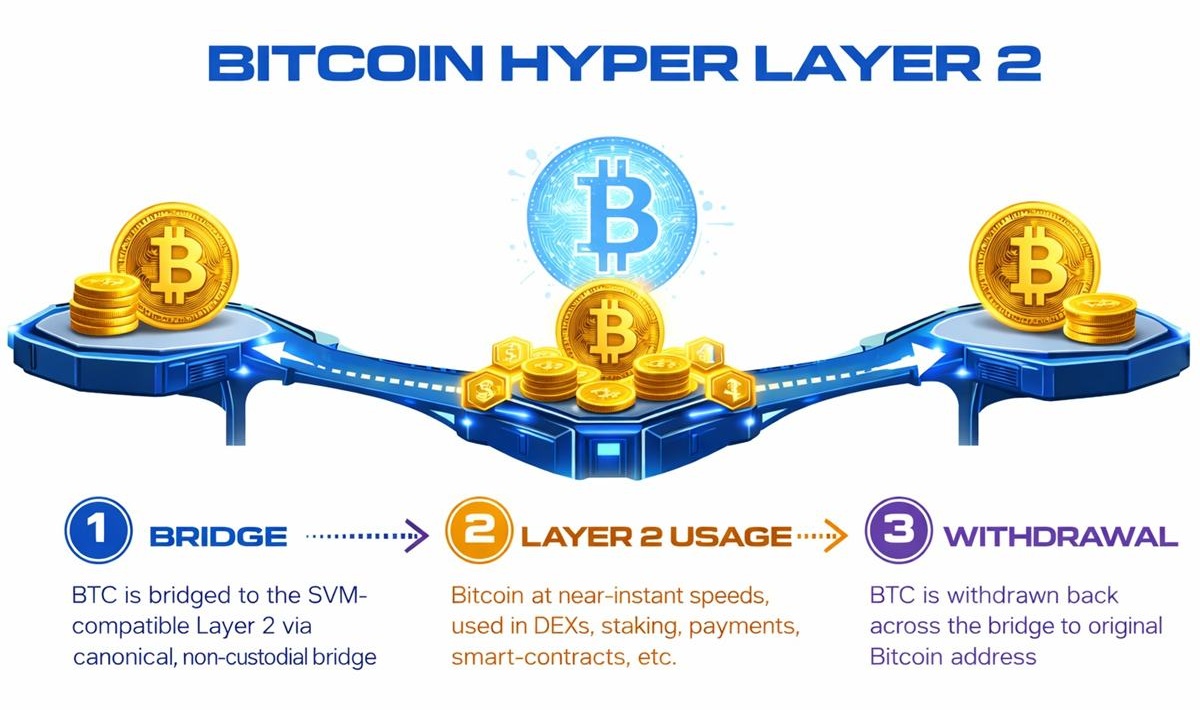
So the SVM choice is a great one – it is the mechanism that Bitcoin Hyper is using to argue that Bitcoin does not have to choose between remaining a secure settlement asset and becoming easier to use.
For investors looking for the next crypto to explode, HYPER’s proposition is unusually easy to understand: take the speed associated with Solana, put it above Bitcoin, and see what people build when BTC becomes easier to move.
The $33 million presale suggests plenty of buyers already want to find out.