Some of the links on this site may be affiliate links. ICOBench may receive advertising commissions when users visit recommended platforms via our affiliate links, at no additional cost to you. All recommendations are based on a comprehensive review process.
Wall Street had its strongest day of Bitcoin buying in almost eight months this week. U.S. spot Bitcoin ETFs attracted $730.9 million in net inflows on Thursday, the biggest daily haul since January 14.
BlackRock’s IBIT led the charge with roughly $454 million, followed by Ark Invest’s ARKB and Fidelity’s FBTC.
Bitcoin itself has since pulled back, trading now at $79,338.54 after briefly moving above $81,000. Stronger-than-expected U.S. employment data caused the reversal: the economy added 162,000 jobs in August against expectations for roughly 56,000, bringing a September Federal Reserve rate hike firmly back into the conversation.
The volatility does not erase Thursday’s ETF flows and, if anything, the contrast is interesting. Bitcoin can lose $2,000 in a few hours due to a jobs report, while regulated funds quietly accumulate hundreds of millions of dollars in BTC.
Buying Bitcoin has become easy – Bitcoin Hyper (HYPER) asks a different question: what happens when all that Bitcoin becomes easier to use?
Wall Street Has Solved the Bitcoin Access Problem
The ETF numbers illustrate how far Bitcoin has come as a financial asset: institutions no longer need to set up wallets, manage private keys, or build specialized crypto infrastructure just to hold BTC exposure. BlackRock alone can attract nearly half a billion dollars to its Bitcoin ETF in one trading session.
Thursday’s inflows were also broad rather than concentrated entirely in one fund – Ark Invest, Fidelity, Grayscale, and Bitwise all recorded fresh money alongside BlackRock.
That is an extraordinary transformation for an asset that spent much of its early history outside mainstream finance.
The next part of the story is less settled – Bitcoin has a huge pool of capital around it, but nowhere near the speed or utility found on chains designed from the beginning for smart contracts and high-speed transactions.
Bitcoin Hyper Gives Developers Somewhere to Build Around BTC
Bitcoin Hyper is developing a Layer 2 using the Solana Virtual Machine (SVM), the execution environment behind Solana applications.
Instead of inventing another proprietary programming environment, Bitcoin Hyper gives builders access to tooling based on a mature ecosystem. Applications that demand fast execution – like real-world payments – can operate away from Bitcoin’s base layer, while still remaining centered on BTC.
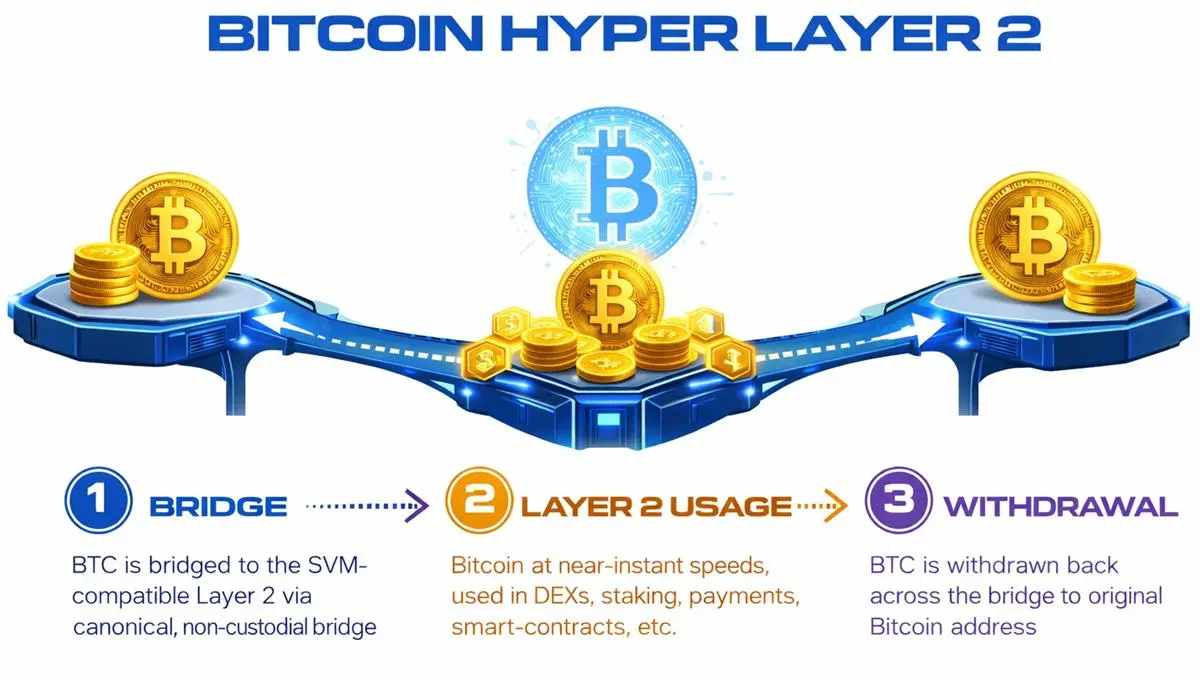
It means BTC can be used in trading applications, decentralized finance products, and payment systems where users expect an immediate response. Paying for something at a checkout is an obvious example: Bitcoin may work extremely well as scarce digital money, but waiting 10 minutes for the transaction to settle is not how people expect a modern payment to behave.
For years, Bitcoin scaling discussions have sometimes sounded as though Bitcoin needs to become something fundamentally different. Bitcoin Hyper takes the opposite approach: Bitcoin can keep being Bitcoin.
But it can now move at Solana speeds (thousands of transactions per second) rather than Bitcoin (10 transactions per second). Periodically, transactions are bundled up and then settled on Bitcoin’s base chain.
Is HYPER the Next Crypto to Explode?
Investors have already added $33 million to the Bitcoin Hyper raise ahead of launch, giving HYPER one of the largest presale totals of 2026.
The token is currently available at $0.01368, and after mainnet launch, HYPER will be used for transaction and application fees, as well as for staking and governance. Presale holders can currently stake their tokens for 35% APY. Coinsult and SpyWolf have audited the token contracts.
The fit is charged. The mission is clear. ⚡️🔥https://t.co/VNG0P4GuDo pic.twitter.com/BvWcrTMbWC
— Bitcoin Hyper (@BTC_Hyper2) September 4, 2026
The $33 million figure is important – it shows how holders are attracted to the potential of the protocol, and can see the simplicity of Bitcoin as the Layer 1 and Solana as the Layer 2.
Bitcoin’s latest move below $80,000 is a useful reminder that even an increasingly institutional asset remains volatile. The deeper story is what is being built around it.
Spot ETFs have made Bitcoin considerably easier for traditional investors to own – $731 million arriving in a single day shows how large that market has become, even before considering BTC held directly by companies, funds, and individual investors.
Bitcoin Hyper wants to take the next step and make that enormous asset base more useful – and return Bitcoin back to its “useful as currency” roots.
At $0.01368, HYPER gives presale investors early exposure.