


 Some of the links on this site may be affiliate links. ICOBench may receive advertising commissions when users visit recommended platforms via our affiliate links, at no additional cost to you. All recommendations are based on a comprehensive review process.
The arrival of the Morgan Stanley Bitcoin Trust (MSBT) on the NYSE Arca this Wednesday effectively ended the era of institutional hesitation. For years, the narrative of Bitcoin access was a dangling carrot for the wider financial market, but now this is another clean move towards TradFi acceptance of BTC.
Recording $30.6 million in inflows on its trading debut, the fund has comfortably moved through its first session, with total volume of $34 million, slightly beating the $30 million target set by Bloomberg ETF analyst Eric Balchunas.
Morgan Stanley’s entry is the first spot Bitcoin ETF offered by a major US bank, and it has recalibrated expectations for where capital will flow this quarter.
While TradFi settles into the ETF, a more interesting development is the new infrastructure that makes Bitcoin functional for the next decade. The primary bottleneck for Bitcoin has never been its value, but its use as a digital currency, which has driven a push for a real Layer 2 for Bitcoin (so far, a challenge that has not yet been met).
So a highlight of this week is seeing the extraordinary presale rise of Bitcoin Hyper (HYPER), tackling Bitcoin’s historical speed and cost limitations and raising $32.3 million, moving toward the $33 million milestone with surprising speed. Currently priced at $0.013678, the project also offers a 36% staking APY for early holders.
Building Speed on the Bitcoin Backbone
Bitcoin Hyper has a simple premise in theory – enabling Bitcoin transactions at the speed of modern commerce without compromising the security of the underlying chain.
In the current Layer 2 world, we have seen how networks like Arbitrum and Mantle transformed Ethereum from a slow, expensive settlement layer into a place for decentralized finance. HYPER is attempting a similar feat for Bitcoin.
HYPER bypasses the 10-minute block time and the prohibitive gas fees that have historically kept Bitcoin out of the payments narrative by processing transactions off the main chain using a Solana Virtual Machine layer, and then batching them back to Bitcoin for finality.
And just like that…
Everything starts moving ⚡️🔥https://t.co/VNG0P4GuDo pic.twitter.com/cQUY9Qh1KL
— Bitcoin Hyper (@BTC_Hyper2) April 9, 2026
In simple terms, HYPER effectively turns the world’s most secure network back into a usable currency – the original dream of Satoshi.
The technical design focuses heavily on interoperability and throughput. Unlike previous attempts at Bitcoin sidechains, HYPER is built to feel like an invisible extension of the core network. It targets the payments narrative, the idea that Bitcoin can finally fulfill its original promise as peer-to-peer electronic cash, while integrating the smart contract capabilities that users now expect from a modern blockchain.
The project’s whitepaper outlines a commitment to low-latency execution, which is the missing piece of the puzzle for institutional users entering the space via the Morgan Stanley ETF.
The credibility of this architecture is bolstered by the project’s focus on security audits conducted by Coinsult and SpyWolf. Completing audits also suggests the project’s full launch is near.
Why 2026 Is the Bullish Pivot for Layer 2 Solutions
The intersection of Morgan Stanley’s ETF launch and the surge in HYPER’s presale suggests we are in the middle of a move toward hard infrastructure. The bullish case for 2026 rests on the fact that we now have the two necessary ingredients for a sustained rally: massive institutional liquidity entering at the top and high-performance utility being built at the bottom.
When a bank the size of Morgan Stanley begins funneling millions into Bitcoin, it creates a floor of stability. That stability, in turn, gives investors the confidence to look for ways to improve the underlying tech and invest in ways to bring that future into reality.
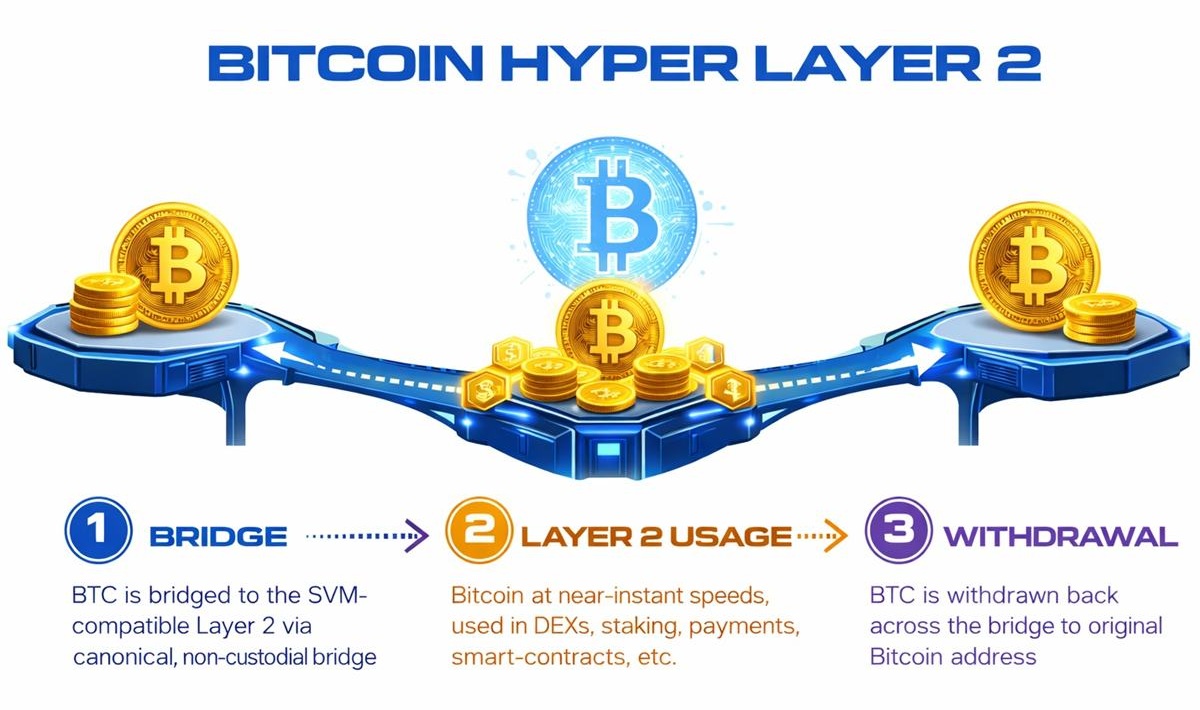
The comparison to networks like Mantle or Arbitrum is unavoidable. When Ethereum Layer 2s gained traction, they became the primary venues for activity, often outperforming the base layer in percentage gains during bullish cycles.
Bitcoin Hyper is following a similar trajectory but with the added benefit of the Bitcoin name and its significantly larger market cap over Ethereum. The $32.2 million already raised serves as a credible sign of trust in the project, and the proof will be in the full protocol launch and seeing how much of the trillion-dollar market cap – effectively idle capital – moves into a framework that offers effectively instant, low-cost payments and DeFi possibilities. Basically, moving Bitcoin from 2009 tech to 2026 tech in one action.
The Convergence of Institutional Liquidity and Layer 2 Utility
We are moving past the point where a crypto project’s success is measured solely by social media hype. The data coming from the Morgan Stanley debut and the Bitcoin Hyper presale indicate a market that is becoming more sophisticated and more demanding. Investors want projects with product-market fit before they even hit the public exchanges.
HYPER’s ability to raise over $32 million in a competitive environment suggests that it has tapped into a genuine need within the Bitcoin community.
As the world tracks the performance of the MSBT ETF, the secondary story – the rise of the Bitcoin Layer 2 – will likely become the primary driver for the remainder of the year. HYPER’s $0.013678 price and 36% APY are the entry points, but the real value lies in the infrastructure being built. The base layer is for the banks, but Layer 2s are where innovation and significant growth are likely to be found.