

 Some of the links on this site may be affiliate links. ICOBench may receive advertising commissions when users visit recommended platforms via our affiliate links, at no additional cost to you. All recommendations are based on a comprehensive review process.
Gnosis is back among crypto’s stronger performers, with GNO climbing 8.49% over the past 24 hours to $112.80.
The move comes as GnosisDAO considers a substantial change to the network itself – the GIP-153 proposal asks whether Gnosis Chain should transition from a standalone Layer 1 into the Ethereum Economic Zone, a proposed rollup framework designed to give Gnosis much closer access to Ethereum’s liquidity and applications.
The proposal argues that the biggest advantage would be synchronous composability with Ethereum, making assets and liquidity on mainnet far easier for Gnosis applications to reach.
Compatibility creates an interesting backdrop for investors searching for the best crypto to buy – it’s a reminder that crypto spent years asking which blockchain would win, when the question really should be about how several successful ecosystems can work together.
It’s another sign that LiquidChain (LIQUID) is pushing in the right direction – building a shared liquidity pool around Bitcoin, Ethereum, and Solana. LIQUID costs $0.0148, has raised $940,000 so far in presale, and offers 1,202% APY through staking.
Gnosis Looks to Ethereum for Deeper Liquidity
Gnosis Chain currently operates as an EVM-compatible Layer 1 with its own validator network. Under GIP-153, it would instead become an Ethereum-settled rollup while retaining GNO economics and xDAI for gas.
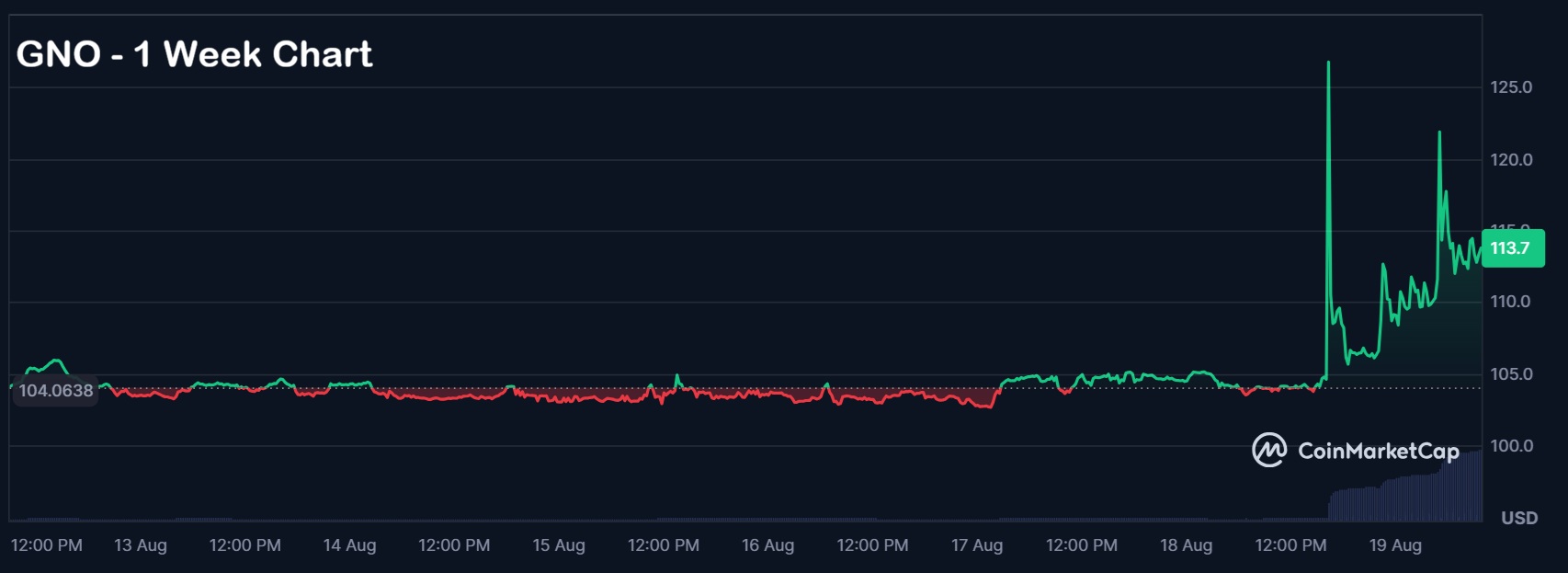
The motivation is strikingly economic – GIP-153 argues that operating as an independent chain has left Gnosis separated from much of Ethereum’s liquidity and asset ecosystem. The proposed EEZ structure is intended to make Ethereum liquidity, oracles, on-ramps, and applications much more directly accessible.
The vote is live through August 19, so the transition remains a proposal rather than a completed change, but GNO’s 8% rally reminds us that liquidity is far less useful when blockchain boundaries keep it divided.
LiquidChain Builds Around a Market With Several Winners
LiquidChain starts from a similar observation – but places it on a much bigger canvas.
Bitcoin, Ethereum, and Solana have all built substantial economies without becoming interchangeable. Bitcoin holds enormous pools of capital, Ethereum has deep decentralized finance markets, and Solana has developed a fast, active execution environment. Users increasingly have reasons to interact with more than one of them.
The problem is that capital does not automatically follow them across chains.
So LiquidChain is developing a Layer 3 that brings activity from those three ecosystems into a shared liquidity pool. Its architecture is designed to verify Bitcoin transactions, Ethereum state, and Solana accounts in real time, while unified liquidity pools allow applications to access capital wherever it originates. It does so without wrapping or bridging assets.
L1 laid the foundation. L2 scaled it.
Now L3 rises above them all. ⟁👁️ pic.twitter.com/X96p0CjhzH
— LiquidChain (@getliquidchain) August 19, 2026
In short, users can access liquidity across BTC, ETH, and SOL without having to think as much about where their money happens to sit, while developers can build products that access capital across those ecosystems without having to maintain three separate codebases.
It is an interesting comparison with Gnosis. The chain is considering much tighter integration with Ethereum because Ethereum contains the liquidity its ecosystem seeks. LiquidChain instead assumes that several major blockchain economies will continue to grow and builds around enabling their liquidity to be used together.
That leaves LIQUID with a sizeable target, given that crypto’s future is almost certainly multichain.
LIQUID Targets the Cost of Fragmented Capital
Fragmentation is easy to dismiss, but really it is a massive – and growing – problem. Economically, it can mean thinner markets, additional swaps, bridge transactions, and capital sitting somewhere other than where a user or application needs it.
The Gnosis proposal offers an unusually direct acknowledgment of that problem – its authors argue that being a technically capable standalone blockchain is no longer enough when applications need access to larger pools of capital.
LiquidChain‘s investment case rests on the same underlying pressure becoming broader.
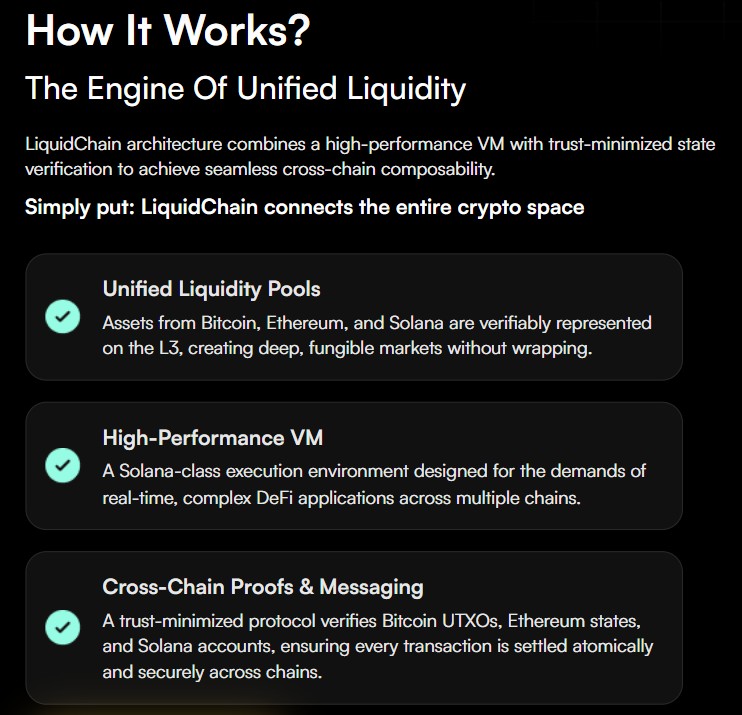
Rather than asking users to choose among Bitcoin, Ethereum, and Solana, the project argues that infrastructure can make those distinctions less intrusive. An application can benefit from Bitcoin-originating capital, Ethereum liquidity, and Solana-style execution without forcing its users to hop chains every few minutes.
LIQUID remains very early – the presale has raised $940,000 so far, with tokens priced at $0.0148. Staking offers a 1,202% APY right now (this is expected to drop as more holders become stakers), while SpyWolf and CertiK have reviewed the project contracts.
The more important test will be whether developers and users find value in treating capital across several chains as a shared resource. If they do, LiquidChain addresses a problem that becomes larger as blockchain ecosystems become more successful, not smaller.
Best Crypto to Buy? LIQUID Bets the Multichain Era Is Here to Stay
Gnosis, considering a fundamental redesign to get closer to Ethereum, says something important about where blockchain competition has reached.
Being faster or cheaper in isolation is no longer necessarily enough – GIP-153 says that the real prize is access to liquidity and applications that already exist elsewhere.
LiquidChain takes that logic into a market where there may never be a single center – built on the fair assumption that Bitcoin, Ethereum, and Solana will all remain important, while users become progressively less interested in changing chains all the time.
Crypto already has plenty of capital – LIQUID stops all the travel time between the different pools by turning it into an ocean.