

 Some of the links on this site may be affiliate links. ICOBench may receive advertising commissions when users visit recommended platforms via our affiliate links, at no additional cost to you. All recommendations are based on a comprehensive review process.
The U.S. could take an important step toward giving crypto a comprehensive rulebook on Tuesday, just as the technology itself is trying to solve another problem: how to make a market spread across multiple blockchains actually work like one.
The Senate’s first procedural vote on the CLARITY Act comes as LiquidChain (LIQUID) builds a new kind of Layer 3 around Bitcoin, Ethereum, and Solana. Rather than asking users to keep moving assets between separate chains, LiquidChain wants those three ecosystems to feel more like parts of the same financial system.
Crypto is already multichain – and it’s going to stay that way – but the infrastructure is still catching up. LiquidChain’s pitch is simple: make BTC, ETH, and SOL easier to use together without forcing users to use the usual bridges, network changes, or duplicate apps.
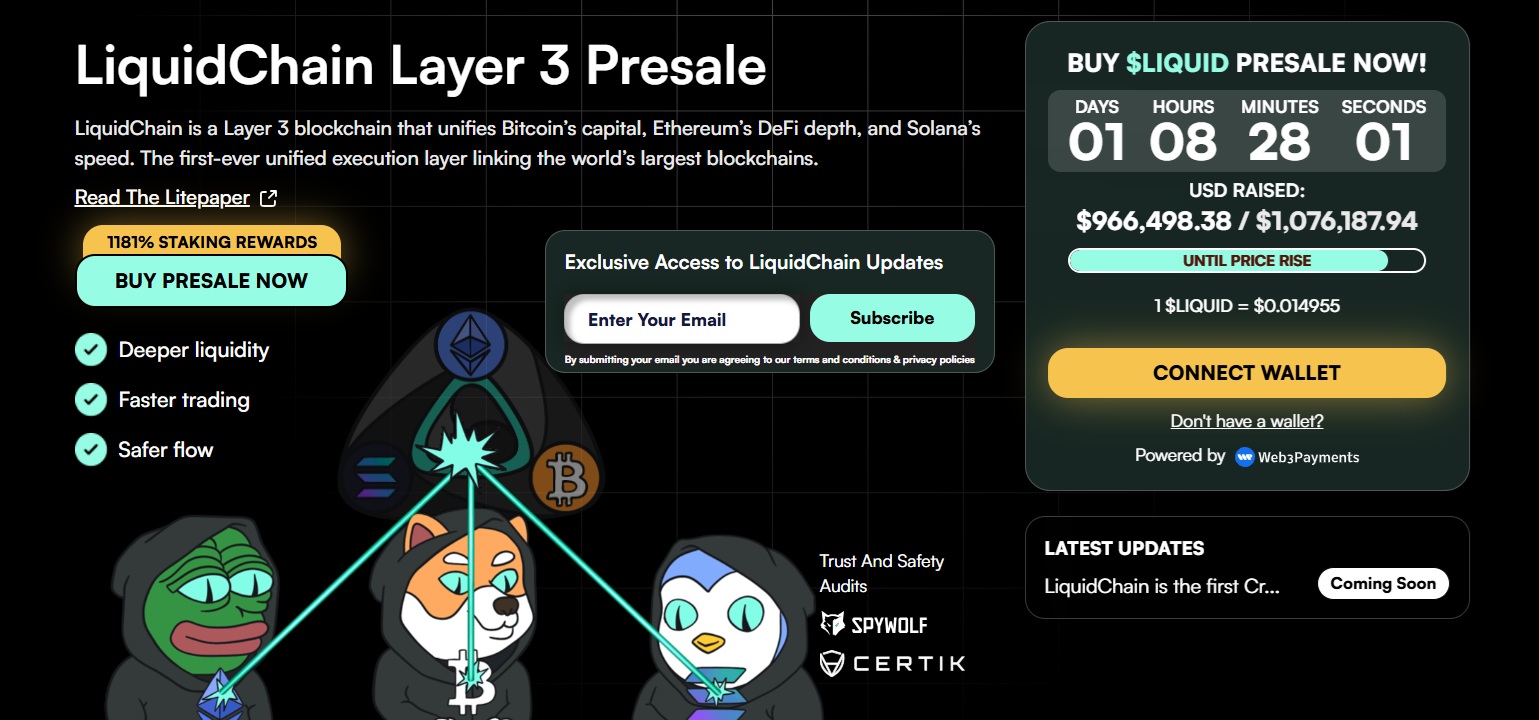
LIQUID has now raised $966,000, putting its first $1 million milestone just $34,000 away, with tokens priced at $0.0149, and could stop crypto being isolated pools of liquidity – and turn them into an ocean instead. That’s the idea behind one of the best crypto presales of the year.
LiquidChain Builds Above Bitcoin, Ethereum, and Solana
LiquidChain is developing a Layer 3 rather than another blockchain that competes directly with BTC, ETH, or SOL, with an environment that works to coordinate activity across the three networks, with a cross-chain virtual machine and proof system used to verify what is happening on each chain in real time.
There is plenty of engineering hidden inside that description, but the actual experience LiquidChain is aiming for is much less complicated.
Imagine a trader spots an opportunity that requires liquidity held across Ethereum and Solana while the user’s largest pool of capital remains in Bitcoin. Today, the first job can be moving everything into the right places, with a time and gas tax on top.
A little of this chain. A little of that chain.
Then things get interesting. 👁️ pic.twitter.com/ybu9a1L0o0
— LiquidChain (@getliquidchain) September 7, 2026
That fragmentation also affects liquidity itself: Deep markets on Bitcoin, Ethereum, and Solana do not automatically become one deep market when the capital is trapped behind different network boundaries.
LiquidChain is designed so that the application can handle more of those network boundaries itself, with atomic execution one of the key parts here – connected actions can be handled as a single coordinated operation, so users are less likely to complete the first half only to discover that the second half cannot go through.
That also removes some of the anxiety from cross-chain activity, with the current process being to ask a user to approve several transactions and keep trusting that every stage of a bridge or swap completes properly.
If those steps can be coordinated under the hood of the app, multichain finance starts to feel much more like using ordinary software, and that’s a help for trading, collateral management, and portfolio applications. Capital becomes more useful when it doesn’t need to be manually repositioned.
Developers get a similar advantage – supporting three ecosystems separately means three sets of integrations, liquidity considerations, testing, and user journeys. LiquidChain’s appeal is that a team can concentrate more on the product itself and less on rebuilding for every network – simply tap into LIQUID.
LIQUID Is Just $34K Away From Its First $1M
LiquidChain’s presale is now getting close to seven figures, with $966,000 raised at a current price of $0.0149, with just $34,000 separating the project from $1 million. Buyers can also stake LIQUID, with the current presale rate at 1,180% APY.
If LiquidChain can show what Layer 3s can bring to crypto – one ocean of liquidity rather than individual pools – it is a low market cap for a project with such a large total addressable market.
Washington aims to create rules that work across an increasingly complicated digital-asset market. LIQUID is building infrastructure for a market that has changed from the early days.
In the bull case, LiquidChain helps make Bitcoin, Ethereum, or Solana more valuable together than they are apart. At $966,000 raised, that idea is now within touching distance of its first $1 million.