


 Some of the links on this site may be affiliate links. ICOBench may receive advertising commissions when users visit recommended platforms via our affiliate links, at no additional cost to you. All recommendations are based on a comprehensive review process.
Bitcoin has spent most of its life proving that digital money can be valuable, but arguably the next race is about what holders can actually do with it.
That question became more concrete today when Stacks launched its Genesis Bond, bringing Bitcoin Staking into live institutional use. 21shares, HashKey Cloud, UTXO Management, and Sypher Capital have participated in the first bonding period, with roughly 250 BTC committed at launch. The first rewards are expected on September 17.
It comes as Bitcoin trades at $77,244.91, down 1.71% over 24 hours and 4.19% across the week. The price has cooled- but the technology being built around BTC is moving in the opposite direction.
Take Bitcoin Hyper (HYPER), which aims to make BTC easier to spend, trade, and use in decentralized finance. Its presale has already raised $33 million, with HYPER priced at $0.01368, putting it among the best crypto presales for investors following Bitcoin’s expanding use cases.
Stacks Turns Bitcoin Into Productive Capital
For years, earning a return on BTC usually meant moving it elsewhere or trusting somebody else with it.
The Stacks Genesis Bond changes that model- participating institutions lock BTC using standard Bitcoin scripts while the asset remains on Bitcoin Layer 1. Rewards are paid in BTC and come from Bitcoin committed by Stacks miners through the network’s Proof of Transfer system. It is an important shift in how Bitcoin is being treated.
The first chapter was accumulation – companies, funds, and individuals wanted exposure to BTC with the belief that the asset itself would become more valuable.
Stacks suggests Bitcoin can also become productive capital without abandoning the characteristics that made people want to hold it in the first place. Bitcoin Hyper takes that thought further.
Bitcoin Hyper Takes BTC Beyond Holding and Yield
Bitcoin Hyper is building a Layer 2 designed to give BTC the kind of speed and programmability that Bitcoin itself deliberately lacks.
The easiest way to understand HYPER is to imagine using Bitcoin without having to wait – no ten-minute block confirmation times.
That means a customer can pay in BTC at checkout and get an immediate response, and traders can use Bitcoin on decentralized exchanges and financial tools. Developers can also create more complicated services around BTC rather than treating it mainly as an asset moving between wallets.
The technical component is the Solana Virtual Machine (SVM), the execution environment for Solana smart contracts. Bitcoin Hyper incorporates SVM technology, giving developers access to familiar, high-speed tooling as they build around Bitcoin.
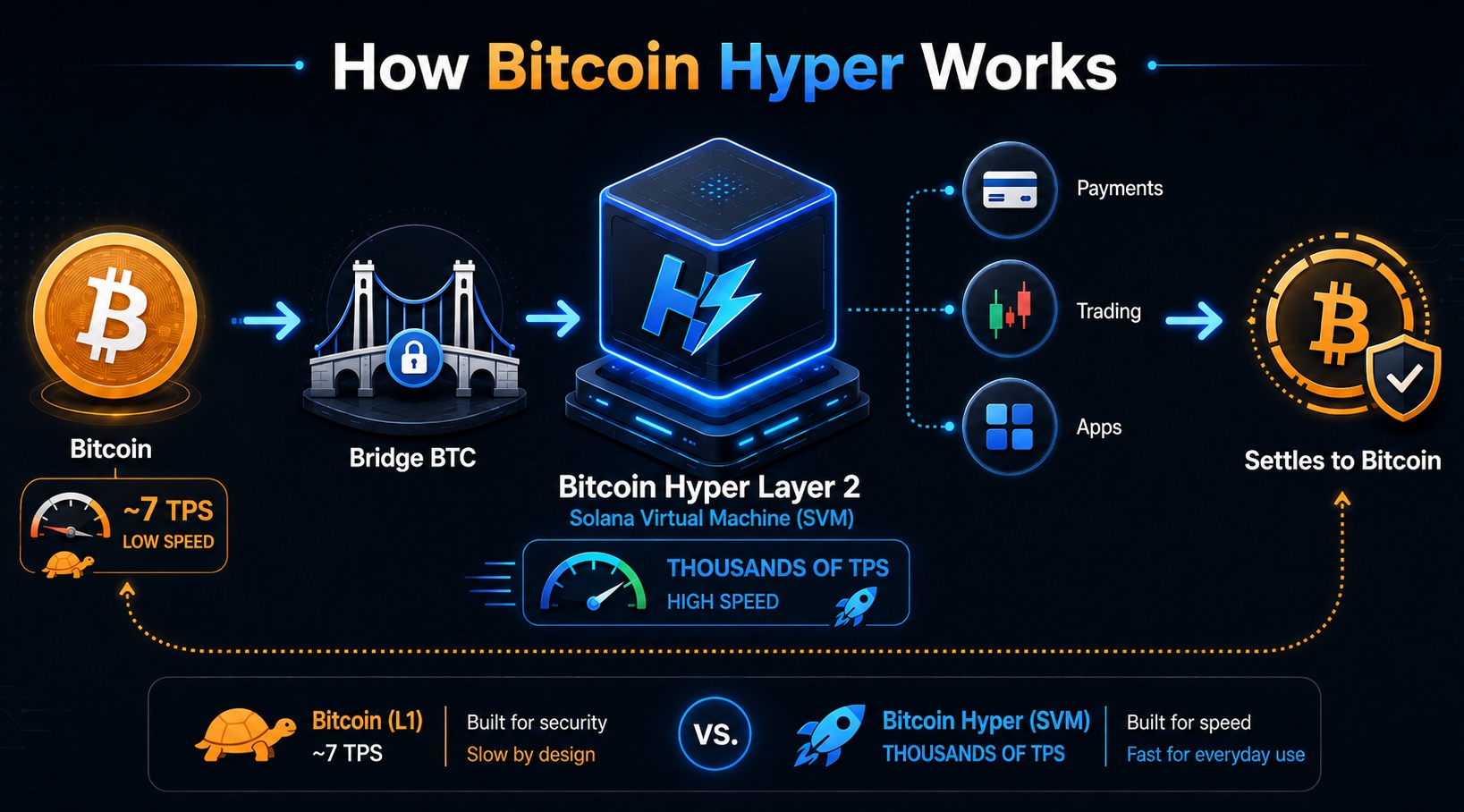
That design leaves Bitcoin free to keep doing the job it does exceptionally well: maintaining an extremely difficult-to-alter record of ownership. The computational work required by interactive apps runs at Solana speeds on the L2, where it can run at nearly instant speeds, making it better suited to payments and trading.
Bitcoin Hyper provides a canonical bridge that grants access to the network, allowing users to deposit BTC into a monitored Bitcoin address. The Layer 2 recognizes the confirmed deposit, so the value can be used within HYPER.
In practice, that means BTC stops being something users merely transfer or hold, and becomes currency – Satoshi’s original dream.
That is a different proposition from Stacks’ new Genesis Bond. Stacks gives holders another way to generate returns from BTC. HYPER is focused on widening the number of places where Bitcoin itself can be useful.
Could HYPER Be the Next Bitcoin Presale to Explode?
The $33 million already raised suggests that the argument has found a substantial early audience.
HYPER currently costs $0.01368 before public exchange trading begins, and the token itself will cover fees within Bitcoin Hyper, while holders can also use it for staking and governance. Presale staking currently offers 35% APY, and Coinsult and SpyWolf have audited the token contracts.
$HYPER has entered the building. ⚡️🔥https://t.co/VNG0P4GuDo pic.twitter.com/pFQHQpnTIY
— Bitcoin Hyper (@BTC_Hyper2) September 9, 2026
The more interesting phase starts once the presale finishes – Bitcoin Hyper then needs to turn its $33 million community into network activity: developers launching products, BTC moving through the Layer 2, liquidity forming around those products, and HYPER entering open market price discovery when exchange listings arrive.
Thursday’s Stacks launch shows that Bitcoin utility is no longer purely theoretical. Around 250 institutional BTC holders are already participating in the Genesis Bond, with Stacks expecting the program to expand through additional bonding periods.
Bitcoin spent more than a decade convincing the world to hold it – and it’s done its job. But the “using it as money” argument is still lacking. That’s why HYPER is beginning to look like a crucial part of the next bull run.