


 Some of the links on this site may be affiliate links. ICOBench may receive advertising commissions when users visit recommended platforms via our affiliate links, at no additional cost to you. All recommendations are based on a comprehensive review process.
The broader crypto market is recovering its footing this week. The global crypto market cap sits at $2.52T, with a total market volume at $15032B in the last 24 hours. Bitcoin dominance is at 59.09%, climbing 0.28% on the day, as the market’s largest asset continues to absorb capital that might otherwise rotate into riskier plays. Ethereum (ETH) is up 3% on the week, while Solana is holding its ground after a relatively bearish year.
Layer 2 tokens tell a more uncomfortable story: Arbitrum (ARB) trades at just $0.11, and Mantle (MNT) at $0.65, two reminders that building on a single chain has its limits. They have a ceiling while making crypto liquidity increasingly fragmented.
While Bitcoin holds the largest share of market value, Ethereum remains the dominant DeFi settlement, and Solana continues to attract high-speed activity, it means users need to move between these systems through bridges, wrapped assets, and separate execution environments.
L2s solved throughput at the cost of fragmentation, and the market is increasingly aware of the difference.
So while Layer 2 tokens dominated previous cycles by solving scalability, Layer 3 tokens may well dominate 2026 and 2027 by solving fragmentation. That’s the environment in which LiquidChain (LIQUID) is gaining serious attention. Currently priced at $0.01449 in its presale, the project has already raised $674,000, with early participants accessing a staking APY of 1607%.
How LiquidChain’s Layer 3 Architecture Actually Works
LiquidChain describes itself as the first Layer 3 network built on top of Bitcoin, Ethereum, and Solana, aiming to serve as a unified liquidity and execution layer rather than a traditional Layer 2 or a simple bridge.
Imagine connecting Bitcoin’s depth and security, Ethereum’s smart contracts, and Solana’s speed. Together, LiquidChain says, we could have cross-chain DeFi, deep liquidity, near-instant payments, and other high-performance applications within a single framework.
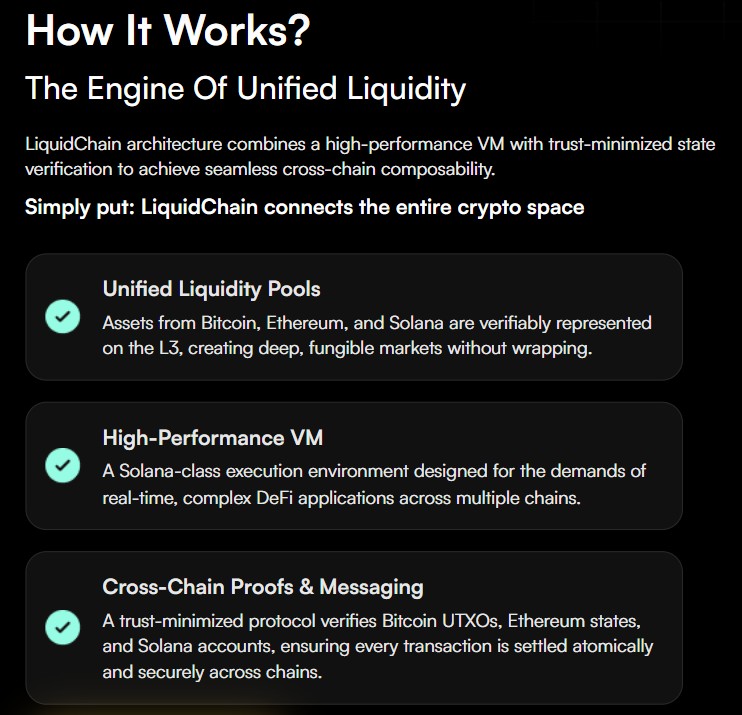
Technically, this runs through what the whitepaper calls a Proof-of-State Validation Layer, a consensus mechanism anchored to the underlying networks, where each transaction is verifiably settled across chains to ensure atomicity.
A Cross-Chain VM executes transactions referencing multiple blockchains simultaneously, while a Unified Proof Engine verifies Bitcoin, Ethereum, and Solana states in real time.
Effectively, the architecture reduces dependence on wrapped assets and limits reliance on centralized intermediaries, with transactions processed on the Layer 3. Finality can be anchored back to the underlying chains when required.
For developers, the model is a deploy-once framework – “build it once and reach users across all three chains”, rather than maintaining separate codebases per ecosystem.
On the security side, the protocol has been audited by both SpyWolf and CertiK.
Why LIQUID Could Be the Best Crypto to Buy in 2026
LiquidChain is launching at the exact moment the market recognizes the problem, as we become aware that isolated blockchains need to end.
What makes the timing sharper is that the L2 sector – Arbitrum, Mantle, and their peers – has already peaked in narrative terms without solving the underlying issue. Capital is siloed, users are fragmented, and a working solution will capture meaningful TVL from liquidity providers seeking chain-agnostic yield.
The presale numbers are already showing unusual conviction. Early participants are locking up their allocations to capture an extraordinary staking APY, effectively removing circulating supply before the token even hits the open market. That supply compression, combined with a relatively modest presale valuation, is what appears to have drawn larger players.
No entry. Only initiation. ⟁👁https://t.co/vqvBcdSQYC pic.twitter.com/aiOryR1ERN
— LiquidChain (@getliquidchain) April 15, 2026
Reaching a dominant position makes a large market cap likely – and as an example, a 100x from the current entry is only a $60 million market cap, when success in this arena is likely to give LIQUID a much larger valuation.
In the short term, forecasts suggest LIQUID could reach around $0.110 by 2027 if the token lists on major exchanges and early demand grows among DeFi users and developers. The team is planning to list LIQUID on exchanges in Q3 2026. The token carries gas, staking, and governance utility across the ecosystem, so it is not a speculative appendage, but the operational fuel of the network itself.
A Unifying Presale Worth Watching
LiquidChain isn’t trying to out-Ethereum Ethereum or out-Solana Solana, but operate as an overarching network that sits above existing Layer 1 and Layer 2 environments and aggregate liquidity from them.
The presale is live now at $0.01449, with $662,000 raised and staking live at 1,649% APY. The whitepaper is available on-site.