

 Some of the links on this site may be affiliate links. ICOBench may receive advertising commissions when users visit recommended platforms via our affiliate links, at no additional cost to you. All recommendations are based on a comprehensive review process.
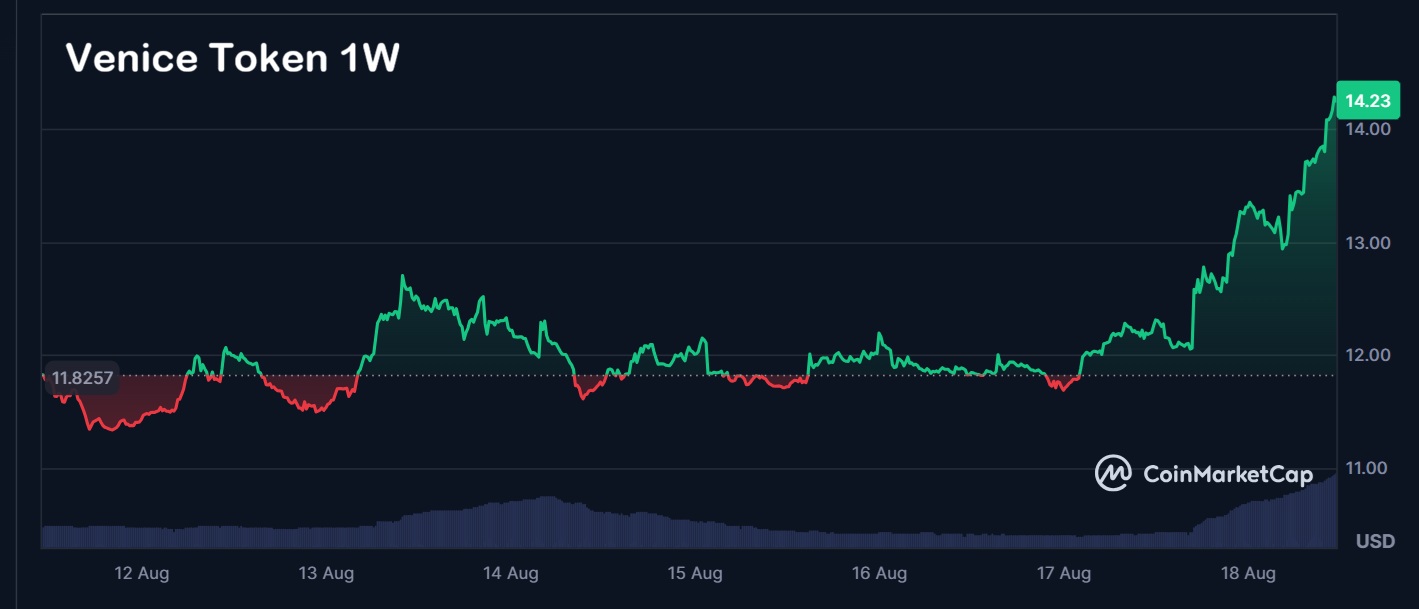
Venice Token (VVV) is showing that an altcoin can move in an otherwise quiet crypto market. VVV has jumped roughly 15% over the past 24 hours after Venice AI announced it had surpassed $100 million in annualized revenue and reached 4 million users.
VVV currently trades at $15.07, up 15.7% over the past day and 17.11% over the past week.
There is one of those rare direct connections between growth and the token – Venice already uses a portion of its subscription revenue to buy VVV on the open market and burn it, while $5 of every $100 spent on API credits now funds additional VVV buy-and-burn transactions.
Demand for Venice’s DIEM token can tighten supply further because new DIEM is created by locking staked VVV, while annual VVV emissions are also scheduled to fall from 3 million to 2 million by October. Revenue growth, token burns, and lower issuance are all moving in the same direction.
VVV’s breakout, therefore, looks much more like investors responding to a project-specific catalyst than a blanket altcoin rally. For investors looking for projects where similar adoption success can lead to strong ROI, Bitcoin Hyper, LiquidChain, and SUBBD each have presale products taking shape before their utility tokens reach exchanges.
Bitcoin Hyper Brings Faster Payments to BTC
Bitcoin Hyper starts with a familiar Bitcoin problem: BTC is valuable, but its base layer was deliberately built for security rather than fast, programmable everyday transactions. So Bitcoin Hyper adds a Layer 2 environment based on Solana where BTC can move faster and support DeFi use cases – without trying to redesign Bitcoin itself.
The mechanism is relatively straightforward but very innovative: Bitcoin Hyper’s L2, based on the Solana Virtual Machine (SVM), lets people actually use BTC without waiting around for Bitcoin’s base layer every time they want to send money, pay for something, or interact with an app.
Hard to miss $HYPER from up here. ⚡️🔥 pic.twitter.com/mIHy3xRInZ
— Bitcoin Hyper (@BTC_Hyper2) August 17, 2026
BTC moved onto Bitcoin Hyper can be transferred quickly, used across payment and DeFi applications, and then returned to the Bitcoin network when needed.
That turns Bitcoin from something largely held in a wallet into capital that can move at app speed – useful for everyday payments, trading, and other activity where ten-minute block times are simply too slow.
That gives HYPER a highly practical angle at a time when Bitcoin itself is still worth around $1.28 trillion. Bitcoin has succeeded spectacularly as an asset, but using BTC for frequent payments remains frustrating. Faster transfers can make more of that capital useful rather than simply held – and take us back to Satoshi’s original vision.
The presale has already raised an incredible $33 million, making HYPER comfortably the largest of the three projects here. HYPER costs $0.01368, while buyers who stake HYPER can earn 35% APY.
Development updates also show work extending beyond the concept stage, including a devnet, native SVM programs, and user-flow testing across the wallet, bridge, and explorer.
LiquidChain Targets Crypto’s Fragmented Liquidity
An early presale, LiquidChain tackles how crypto already has huge pools of capital and activity spread across Bitcoin, Ethereum, and Solana – but moving between them remains unnecessarily complicated.
Layer 3, currently being built and tested, serves as a common settlement layer above those ecosystems, enabling transactions that reference more than one underlying blockchain at once while continuously verifying the states of Bitcoin, Ethereum, and Solana.
The candles mark the circle. The L3 connects what sits outside it. 👁️https://t.co/vqvBcdSQYC pic.twitter.com/ub4TiCnHdz
— LiquidChain (@getliquidchain) August 17, 2026
In plain English, it leads to unified liquidity pools where assets from the three networks are verifiably represented – that means a DeFi application can reach capital from several chains without making its users repeatedly bridge assets, swap into wrapped versions, or move between separate applications.
Instead, LiquidChain plans to make all of that feel more like using one connected market. A trader or DeFi user could tap liquidity from Bitcoin, Ethereum, and Solana without manually shuffling assets between separate ecosystems, making cross-chain activity faster, cleaner, and much less fiddly.
Crypto is likely to remain a multi-chain market – Ethereum still dominates large parts of DeFi, Solana has fast trading, and Bitcoin holds by far the largest pool of crypto capital.
So in a sense, LiquidChain’s opportunity is to make the boundaries between them less important.
LIQUID is priced at $0.0148, with the presale having raised about $940,000, and presale staking offers 1,202% APY.
As demand for cross-chain infrastructure grows, there is considerable room for the protocol to establish itself before exchange trading begins.
SUBBD Takes the AI Story Into the Creator Economy
Of the three presales, SUBBD has the closest thematic connection to Venice – it is also building around AI, but its target is creators rather than general-purpose private inference.
SUBBD combines an Ethereum-based token with a creator platform and AI tools. Creators can use AI personal assistants to handle interactions and custom requests, while the platform is developing AI-generated personas, image tools, and other automated content features.

SUBBD, as a token, then supplies the payment and access layer around that product – fans can use it for subscriptions and premium content, while holding or staking it can unlock livestreams, behind-the-scenes material, discounts, and higher XP multipliers.
The product makes SUBBD part of how fans pay, gain access, and participate, while AI is intended to reduce the amount of repetitive work creators have to do themselves. The roadmap includes a personal AI assistant, AI influencer creation, image generation, a beta platform, and a dedicated creator app.
SUBBD has raised $1.57 million at a presale price of $0.05756, and its staking program offers 20% APY during the first year. Venice’s $100 million revenue milestone is a useful reminder of why this category is attracting capital: AI services can become real businesses when their products find repeat users.
VVV Shows Why Specific Catalysts Matter Again
VVV’s rally is more useful as a signal than as evidence of a broad altseason. Bitcoin, ETH, and SOL are making comparatively modest moves, and the overall market has gained less than 1% in 24 hours.
Yet VVV has jumped by about 15% because Venice delivered something investors could measure: more users, more revenue, and token mechanics that link much of that activity back to VVV.
The three presales here are earlier examples of the same basic principle: Bitcoin Hyper is trying to make BTC easier to use, LiquidChain wants capital to move more freely between major chains, and SUBBD is giving AI a defined role within a creator platform.
None of them need a market-wide altcoin surge to make a case – their strongest catalyst is much simpler: getting the products into users’ hands.