


 Some of the links on this site may be affiliate links. ICOBench may receive advertising commissions when users visit recommended platforms via our affiliate links, at no additional cost to you. All recommendations are based on a comprehensive review process.
Selective strength in Solana-linked tokens is cutting through the broader caution that has settled over crypto after further Middle East hostilities and weekend profit-taking. Jito has surged 13.3% today to trade near $0.67, with volume almost doubling as buyers step in while Bitcoin holds just above $63,000 and the total market cap sits at $2.17 trillion after a mild 24-hour dip. Ethereum has mostly stayed flat near $1,780, while the Fear and Greed Index’s “Fear” reading reflects a generally subdued sentiment, and most large caps are still range-bound.
These factors make the search for long-term value more pronounced than usual, and the best altcoins to buy right now are the ones offering either proven infrastructure upside or early-stage entry points. Crypto presales have also continued to attract capital despite the chop, giving participants discounted prices and staking yields that listed tokens cannot match.
Three top projects are standing out from the crowd today. Bitcoin Hyper (HYPER) is speeding through a hugely successful Bitcoin Layer 2 presale campaign; Pyth Network (PYTH) is an established oracle expanding its institutional data reach; and LiquidChain (LIQUID) is combining liquidity across Bitcoin, Ethereum, and Solana in a single Layer 3 design. Each carries a clear bullish case tied to the market’s need for both speed and deeper capital efficiency.
Bitcoin Hyper (HYPER)
Bitcoin Hyper (HYPER) is building the fastest Bitcoin Layer 2 network that runs on the high-throughput Solana Virtual Machine while settling security back to Bitcoin itself. The design lets users move BTC quickly and cheaply, open DeFi positions, stake, and launch dApps without waiting for the main chain’s slower confirmation times or paying elevated fees. The native HYPER token powers gas, governance, and rewards inside the L2 ecosystem.
Some people shop for aesthetics.
Hyper shops for utility. 🔥⚡️https://t.co/VNG0P4GuDo pic.twitter.com/OquMN39bBK
— Bitcoin Hyper (@BTC_Hyper2) July 13, 2026
HYPER’s live presale price is now $0.013683, while fundraising has already reached $32.96 million of a $33.38 million near-term target. Participants who buy and stake can earn a 36% APY on their tokens. HYPER’s tokenomics allocation covers development (30%), treasury (25%), marketing (20%), rewards (15%), and listings (10%).
With Bitcoin still consolidating in a multi-month range and users hunting for yield-bearing ways to put idle BTC to work, the Bitcoin Hyper project’s mix of near-instant settlement, Bitcoin-grade security, and attractive staking APYs has kept demand firm even as broader markets cooled. Once mainnet activity begins, HYPER’s setup leaves room for meaningful appreciation if the Bitcoin DeFi niche continues its gradual expansion.
Pyth Network (PYTH)
Pyth Network (PYTH) is a first-party oracle that pulls live market prices straight from more than 125 institutional publishers (such as exchanges, market makers, and trading firms), rather than relying on secondary aggregates. It currently delivers more than 3,000 low-latency price feeds spanning crypto, equities, FX, commodities, and ETFs, and those feeds already power applications across more than 100 blockchains. The PYTH token underpins network incentives, publisher rewards, and governance.
At present, PYTH trades near $0.049, up 5.6% in the last 24 hours on roughly $20 million in volume and a market capitalization of about $391 million. The token has recovered more than 60% from its June low, and community sentiment remains heavily bullish. Recent protocol upgrades have added paid subscription tiers and expanded asset coverage, giving the network clearer revenue paths beyond pure data provision.
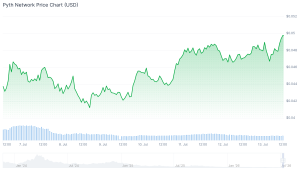
As traditional finance and DeFi continue to blur, the need for accurate, high-speed price feeds only grows. Projects building derivatives, RWAs, or cross-chain lending keep integrating Pyth because the first-party model reduces manipulation risk and latency. That structural demand, paired with a still-modest valuation relative to earlier peaks, gives PYTH a credible path to re-rate higher once risk appetite returns more broadly.
LiquidChain (LIQUID)
LiquidChain (LIQUID) is constructing a Layer 3 execution environment that natively unifies Bitcoin’s capital, Ethereum’s impressive DeFi depth, and Solana’s widely respected speed. Developers can deploy once and reach combined liquidity pools without traditional wrapping or multi-hop bridges; the architecture uses a high-performance virtual machine plus trust-minimized cross-chain proofs to settle transactions atomically across the three ecosystems. The LIQUID token serves as the gas, staking, and incentive asset inside that unified network.
The path doesn't end at L1.
It doesn't stop at L2 either. 👁⟁https://t.co/vqvBcdSQYC pic.twitter.com/UsmCfGdk3x
— LiquidChain (@getliquidchain) July 13, 2026
The LiquidChain presale is live at a current price of $0.01479 per LIQUID. Fundraising has already climbed to $903,000 of a $1 million stage target, placing the raise well into its later phases (currently Stage 84). Total supply is fixed at 11.8 billion LIQUID tokens, with allocations toward development (35%), marketing (32.5%), community rewards and staking (10%), business development (15%), and listings (7.5%). Staking is available at a 1,249% APY rewards rate during the presale window.
In a market where liquidity fragmentation still frustrates traders and builders, LiquidChain’s single layer that lets capital move freely among the three largest ecosystems addresses a clear pain point. Early participants who secure LIQUID tokens and stake them capture both the discounted entry and the elevated yield before exchange listings. With the stage hard cap approaching and Bitcoin, Ethereum, and Solana all showing selective strength, LiquidChain’s timing and technical focus give it a constructive setup as one of the best altcoins to buy.