


 Some of the links on this site may be affiliate links. ICOBench may receive advertising commissions when users visit recommended platforms via our affiliate links, at no additional cost to you. All recommendations are based on a comprehensive review process.
One Senate vote in September could decide the next twelve months. That is the framing behind the latest Grok AI price prediction, in which the model predicts Ripple (XRP) will reach $2.50 to $4.00 by the end of 2026, with a base-case target of $3.20.
The date to watch is September 15. A Senate cloture vote on the CLARITY Act would classify XRP as a CFTC commodity.
That reclassification is the unlock. It could bring sustained institutional inflows after the recent White House summit, where Ripple’s CEO and President Trump advanced the bill.
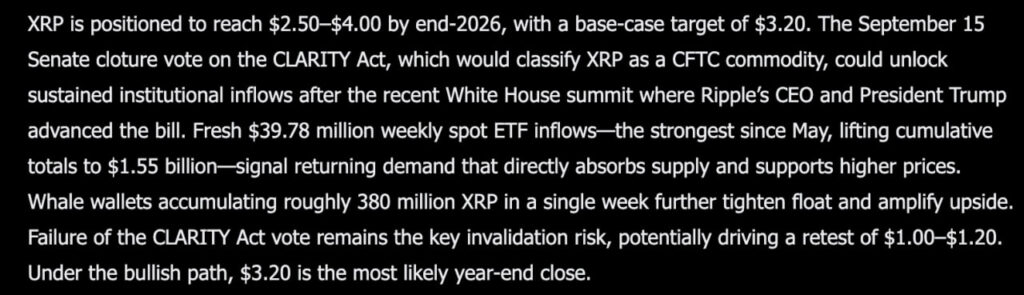
Money is already returning ahead of the vote. Weekly spot ETF inflows reached $39.78 million, the strongest reading since May. Cumulative totals now sit at $1.55 billion. That demand directly absorbs supply and supports higher prices, rather than just sentiment.
Large holders are moving in parallel. Whale wallets accumulated roughly 380 million XRP in a single week, tightening the float further.
A thinner float amplifies any upside move. It also amplifies the downside if the catalyst fails. That failure is the key invalidation. If the CLARITY Act vote fails to pass, XRP’s price could retest $1.00 to $1.20.
Under the bullish path, $3.20 remains the most likely year-end close.
XRP Price Prediction: Grok AI Predicts September Rewrites the Range
The chart explains why this vote carries so much weight. XRP traded above $3.60 last July and spent the following year giving it all back.
October cracked $2.40 violently. February 2026 saw the price flush to $1.13, and the following months delivered a flat, uninspiring range between roughly $1.30 and $1.55.
June broke that, too. XRP price settled at $1.00 and stayed there through July and most of August, moving almost nothing for weeks. Last week broke the deadlock with a vertical candle to $1.68. Sellers arrived immediately afterward.
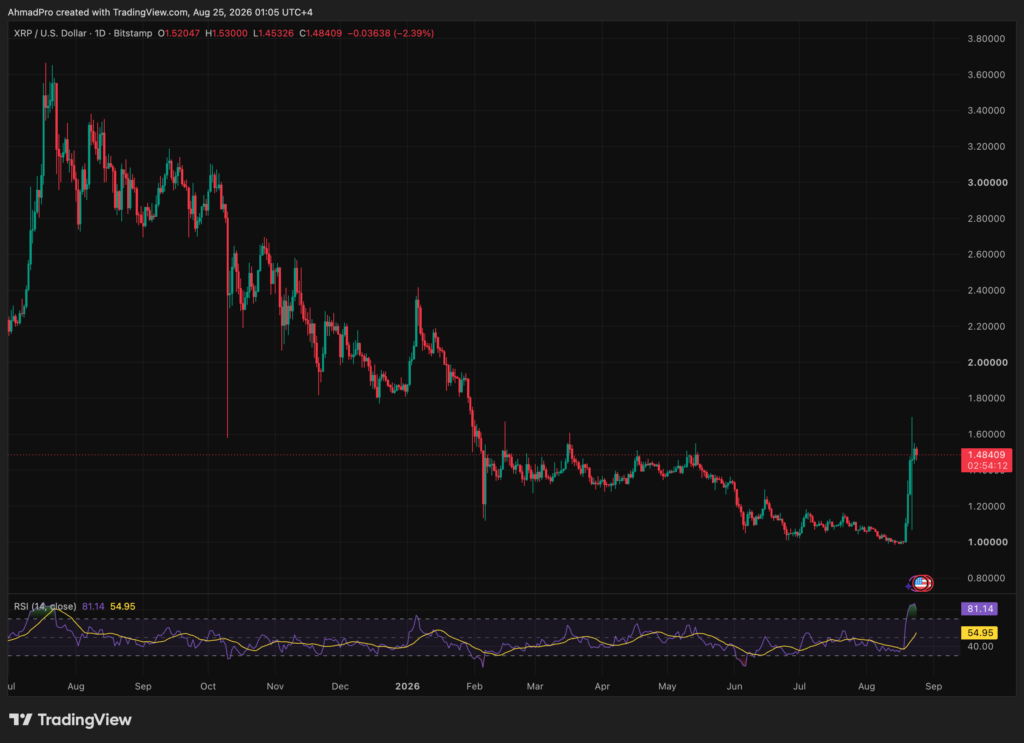
XRP closed at $1.48409, down $0.03638 for a loss of 2.39%, with a session range from $1.45326 to $1.53000. Resistance sits at $1.53000, then the $1.68 spike high, then $1.80.
Support runs through $1.45326 and $1.30, with $1.00 the structural floor. RSI reads 81.14 against a signal line at 54.95. That 26-point gap confirms the momentum that arrived suddenly rather than being built.
Two red sessions have not meaningfully dented it. The indicator is cooling from an extreme while price holds most of its gains, which is the healthier version of a pullback.
Everything now hinges on one calendar date. Pass the vote, and $3.20 becomes the working assumption.
XRP Is Waiting on Washington: Bitcoin Hyper Is Building Without Waiting for Bitcoin to Change
XRP’s next major move may depend on a Senate vote. Bitcoin Hyper is taking a different route, building its growth case around infrastructure it can control.
The project is developing a Bitcoin Layer 2 powered by the Solana Virtual Machine, designed to give BTC something its base layer was never built for: fast execution, low-cost transactions, and full smart contract functionality.

Its Canonical Bridge brings BTC into that environment, while HYPER powers gas, staking, and governance across the ecosystem. That turns the thesis from simply owning Bitcoin into making Bitcoin capital usable across DeFi and programmable applications.
The timing matters as investors increasingly look beyond large caps whose next repricing depends on regulatory decisions or institutional flows.
Bitcoin Hyper has already raised more than $33 million in presale funding, with buyers currently able to stake HYPER for yields of up to 36% APY ahead of its planned 2026 rollout.
Don’t Miss: ICOBench Experts Call the Next 1000x Crypto Coins for 2027