




 Some of the links on this site may be affiliate links. ICOBench may receive advertising commissions when users visit recommended platforms via our affiliate links, at no additional cost to you. All recommendations are based on a comprehensive review process.
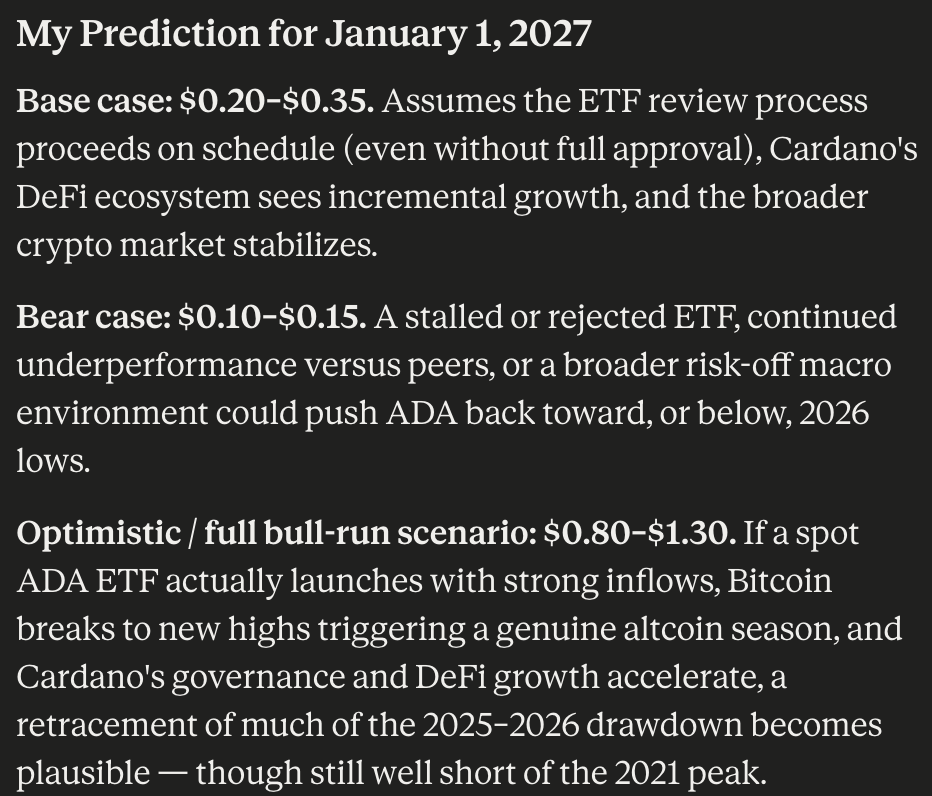
Token holders just voted to spend $21.3M of their own treasury on fixing Cardano’s liquidity problem. The Elon Musk-backed Grok AI predicts that the decision matters, and the base-case price prediction points to $0.20 to $0.35 by year-end 2026, with $0.80+ highlighted as a bull-case scenario.
The vote came in mid-August, and Cardano’s DReps have since approved allocating 120 million ADA from the treasury directly into DeFi applications.
Grok AI describes it as a governance-driven liquidity injection. The purpose is to meaningfully deepen on-chain activity rather than fund overhead.
Today, ADA is trading at just over $0.20, up +4.6% over the past 24 hours, making it one of the top performers in recent days, with daily trading volume over $392M.
Grok AI Predicts That Major Catalysts Are Behind the Cardano Price Spike
Two days earlier, another piece landed. The regulated USDM stablecoin went live on Cardano’s Midnight privacy chain.
That expands confidential-finance use cases on a chain built for exactly that. Regulated stablecoins and privacy rails are an unusual combination.
Institutional access forms the third thread. ADA hit its six-month spot-ETF eligibility milestone on August 9 under the SEC’s streamlined review framework.
CME’s regulated ADA futures launch in February set that up. This institutional adoption for Charles Hoskinson’s token has been crucial in the recent bullish price action.
EXPLORE: Best Memecoins Presales to Watch in 2026
Cardano Price Prediction: Claude AI Predicts Token Holders Fund Their Own Recovery
$ADA confirmed a buy signal on the 4-hour chart.
RSI buy signal -> Price broke out -> Candle close above trending dots
Higher we go. https://t.co/tU372GLXy2 pic.twitter.com/OQXSnuhxXW
— Jesse Olson (@JesseOlson) September 3, 2026
The weekly chart is in a long decline with two failed rallies. ADA traded near $1.25 in 2022 before falling to $0.24 by that autumn.
A 2024 recovery reached $0.80 and faded. Late 2024 saw a spike to $1.30, which also gave way.
Mid-2025 offered one more attempt near $1.00. Everything since has been a controlled slide.
Early 2026 broke $0.30 and continued lower. Price bottomed near $0.14 before a shallow stabilization.
With ADA sitting at just over $0.20, support sits at $0.17, then $0.15 and $0.138 as the floor Grok AI flags. Resistance appears at $0.22, then $0.25 and $0.30.
RSI reads 37.65 with its signal line below at 34.28. The oscillator leads by more than 3 points, indicating easing selling pressure at low levels.
Both lines remain well under the midline. Momentum is weak, though the downward slope has flattened.
The Grok AI predicts that the ADA base case needs a near-70% move from here. Seeing that treasury money translates into visible DeFi volume is what would start closing the gap.
Cardano Is Spending Its Treasury to Create Liquidity. LiquidChain Is Building for Liquidity That Already Exists
Cardano’s vote highlights the problem clearly: capital can exist on-chain and still fail to produce meaningful activity if the surrounding infrastructure is too fragmented.
LiquidChain is attacking that problem at the network level. Instead of trying to deepen liquidity within a single ecosystem, it is building a single execution layer across Bitcoin, Ethereum, and Solana.
One deployment can reach all 3 networks, reducing the need for separate apps, repeated bridges, and the fees and slippage that come with moving capital between isolated chains.
That changes the bet. LiquidChain does not need to manufacture a new pool of crypto liquidity. It needs to make the trillions already sitting across major ecosystems easier to use together.
The presale is currently priced at $0.014951 with just over $960,000 raised. At that valuation, even modest adoption can matter far more than it would for established large caps.