




 Some of the links on this site may be affiliate links. ICOBench may receive advertising commissions when users visit recommended platforms via our affiliate links, at no additional cost to you. All recommendations are based on a comprehensive review process.
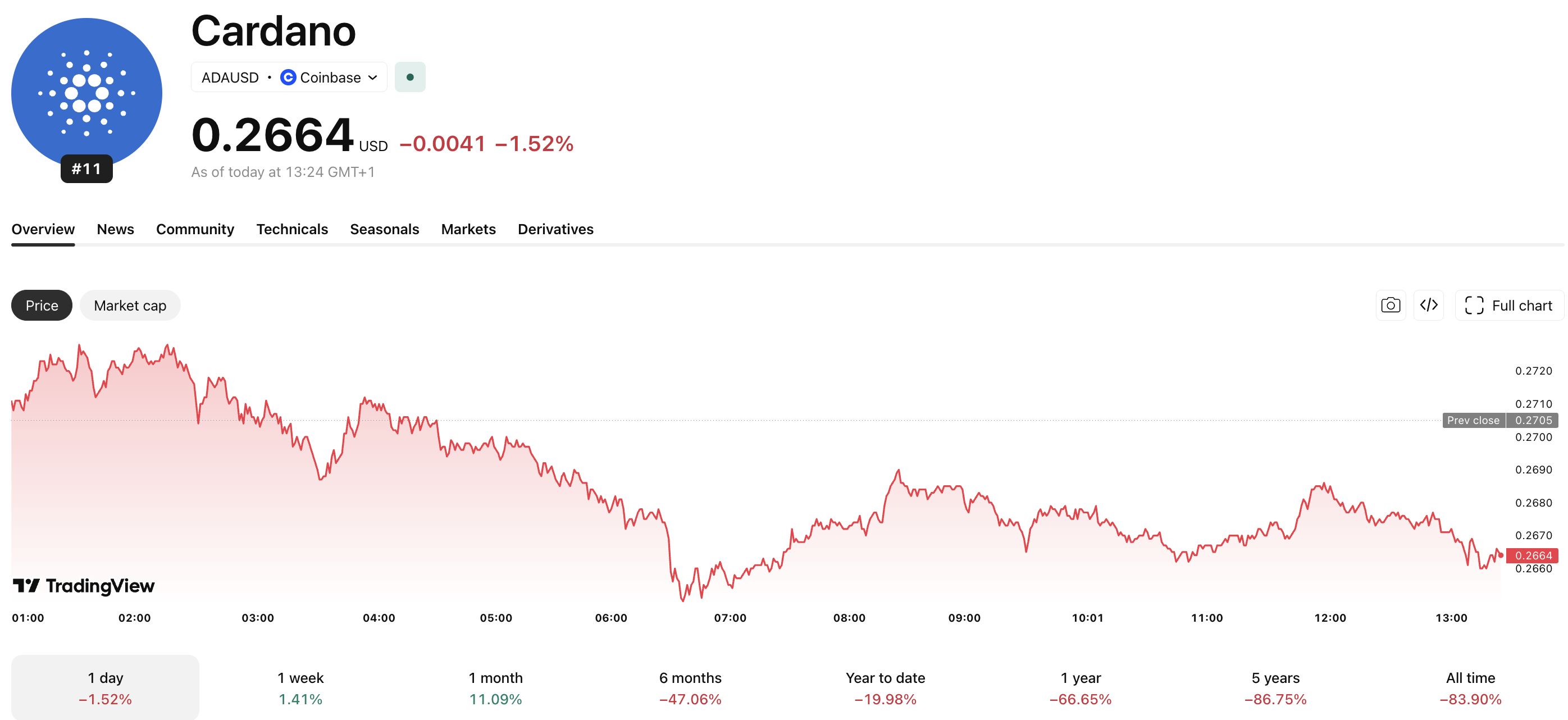
In Cardano news today, on-chain data from Santiment confirms that wallets holding at least one million ADA now control 25.09 billion tokens, 67.47% of Cardano’s circulating supply, the highest whale concentration recorded since July 2020. ADA was trading at $0.27 during Asian hours Friday, roughly 89% below its all-time high, with a market cap of $9.96Bn.
This isn’t routine portfolio rebalancing or custodial wallet consolidation that would produce an incidental headline number. It is a structural shift in who owns Cardano’s liquid supply, executed over 17 months amid sustained price declines.
🤑 Cardano’s key stakeholders have slowly but surely accumulated, consistently adding more and more of the existing supply to their bags, dating back to December, 2023.
🐳 Wallets with at least 1M tokens now hold 25.09B $ADA, which translates to 67.47% of the current existing… pic.twitter.com/knuSbfYtaE
— Santiment Intelligence (@SantimentData) May 13, 2026
The open question the market now has to answer is whether that structural shift resolves as a supply squeeze, concentrated ownership compressing available sell-side liquidity until even modest demand produces outsized price movement.
On the other hand, it could deepen liquidity and centralization risks, leaving ADA exposed to asymmetric downside if even a fraction of those whale positions reverse. Both readings are internally consistent with the same dataset.
Cardano News: ADA Whale Concentration – What the 67% Figure Actually Reveals
The 67.47% figure is meaningful only when broken down by wallet cohort. The one-million-ADA threshold includes a range of holders, but the more significant signal lies with those holding at least 10 million ADA, which increased by 5.2% over nine weeks, indicating acceleration in top ownership consolidation.
Exchange flow data further supports this view, showing a transfer of 67.9 million ADA from Coinbase to a whale wallet, indicating active accumulation into cold storage rather than custodial pools. This outflow reduces the liquid supply available for trading.
Additionally, 819 million ADA was added to whale wallets over three weeks, marking the largest accumulation spike since January.
In contrast, retail addresses holding 100–10,000 ADA have been net sellers, illustrating a transfer of supply from smaller to larger holders. Santiment noted this trend reflects larger holders’ continued accumulation amid volatility and uncertainty.
DISCOVER: Next Crypto to Explode in 2026
ADA Price: Where Current Levels Sit Against the Accumulation Thesis
#Cardano Chart Looks “Incredibly Clean,” Financial Analyst Celal Kucuker Predicts $4 $ADA Target.
Cardano may break the $1 resistance first, with upside projection extending toward $4.21 if momentum builds.
Whales now hold record ADA supply share, signaling strong long-term… pic.twitter.com/2jW3Xtbjtx
— TheCryptoBasic (@thecryptobasic) May 15, 2026
ADA is currently trading at $0.266, approximately 89% below its all-time high, and within a price range that has repeatedly failed to sustain closes above $0.27–$0.31, a band where prior buyers are likely to sell near breakeven, creating a structurally thick overhead resistance layer.
The Market Value to Realized Value ratio sits below 1.0, indicating that a significant portion of the circulating supply is held at an unrealized loss; historically, that configuration during whale accumulation phases has marked local bottoms rather than distribution tops.
The accumulation thesis requires ADA to hold the $0.25 level as a structural floor; a breach of that level would signal that whale-buying programs are insufficient to absorb market sell pressure at scale.
On the upside, a sustained close above $0.35 would represent the first meaningful break above overhead resistance and the first price confirmation that supply compression is beginning to translate into order book dynamics.
Until that level clears on volume, the accumulation thesis remains an on-chain signal without a price confirmation.