

 Some of the links on this site may be affiliate links. ICOBench may receive advertising commissions when users visit recommended platforms via our affiliate links, at no additional cost to you. All recommendations are based on a comprehensive review process.
US spot Bitcoin ETF products have now recorded 10 consecutive trading days of net redemptions, the longest outflow streak since these products launched in January 2024, surpassing the prior record of nine days and accumulating approximately $2.97Bn in total net outflows from May 15 through May 29, per CoinGlass data.
That figure carries particular weight because it arrives directly on the heels of a 10-day inflow streak that had pulled in over $4.26Bn, a sentiment reversal of striking speed. The central question the market must now resolve is whether this institutional de-risking signals broader risk-off pressure or the early rotation signal that historically precedes an altcoin season.
LATEST: 📊 Bitcoin social sentiment has hit its most bullish ratio of 2026 at 2.23 to 1, even as spot ETF outflows have topped $2.97B since May 15, according to Santiment. pic.twitter.com/aULudltIiT
— CoinMarketCap (@CoinMarketCap) June 1, 2026
The mechanism matters here. When ETF redemptions accelerate, authorized participants are required to sell underlying Bitcoin to meet those redemptions, adding direct spot supply without a corresponding demand offset.
That transmission from the institutional trading desk to the spot order book is not theoretical; it is the structural reason a sustained outflow streak carries more weight than a single large redemption day.
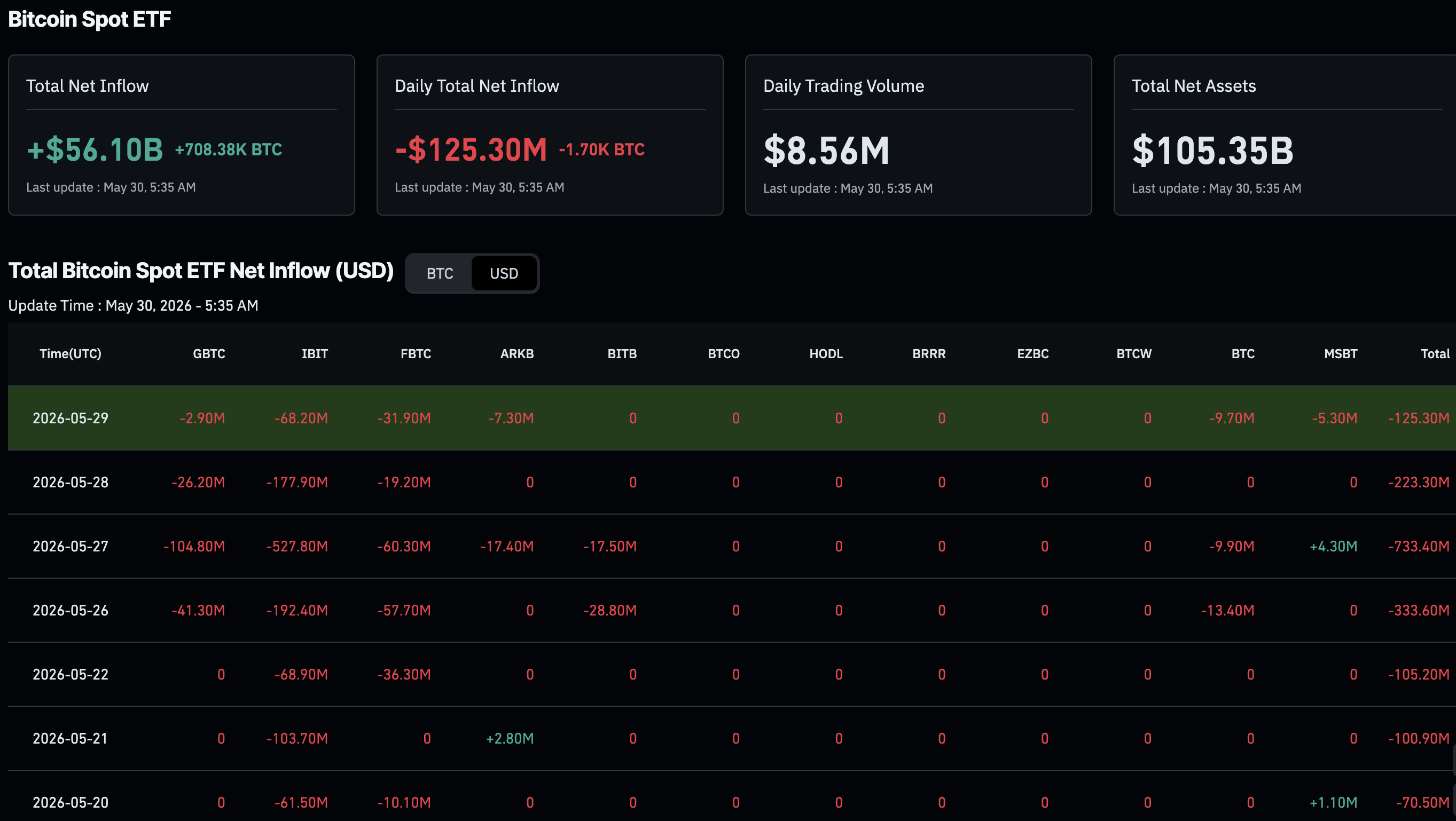
Bitcoin ETF Outflows: What the 10-Day Streak Actually Reveals About Institutional Positioning
Context significantly enhances the importance of the recent outflow trends. The previous record streak lasted nine days, but the current episode, as noted by Bloomberg, exceeds both in duration and dollar scale for the US spot Bitcoin ETF complex.
Notably, BlackRock’s IBIT experienced a single-day outflow of $448.4M on May 18, its largest since launch. Fidelity’s FBTC also contributed to the total decline.
Binance Research highlighted that around $10Bn in total spot BTC ETF holdings have been lost during this drawdown, indicating systematic de-risking rather than a simple tactical adjustment.
What distinguishes this situation is the simultaneous outflows from large-cap crypto products, with Ether investment products seeing 14 consecutive days of outflows alongside Bitcoin ETFs.
This points to a broader risk reduction across major assets, reflecting macroeconomic uncertainty rather than a reaction to a specific event. Meanwhile, some non-BTC, non-ETH crypto ETPs have recorded net inflows, suggesting a potential rotation in investment strategies.
DISCOVER: Best Meme Coins to Buy Right Now
Bitcoin Price Structure: The Levels That Define What Happens Next
$BTC failed to hold above $74,500.
And now, Bitcoin has dropped below $73,000.
This is a sign of weakness, but all key levels aren't lost yet.
As long as Bitcoin holds above the $71,000-$72,000 zone, there's still a chance of rally.
Below that, things could get ugly for… pic.twitter.com/tg12JNmlwI
— Ted (@TedPillows) June 1, 2026
A separate flows snapshot recorded $229M in net outflows on May 28 alone, with derivatives markets assigning 0% probability to BTC reaching $84,000 by the end of May, a data point that encapsulates the prevailing short-term risk-off stance.
K33 Research has identified $83,000 as the approximate breakeven level for many spot Bitcoin ETF holders, a threshold that now sits roughly 15% above the current price, depending on the entry tranche. That level functions as both a technical resistance and a sentiment anchor; a sustained move above it would represent relief for the institutional cohort currently sitting underwater and could flip the ETF flow dynamic back to net inflows.
- Bull case: BTC reclaims and holds above $74,500 on elevated volume, ETF flows stabilize with at least two consecutive net-positive days, and BTC.D begins declining – this combination would confirm rotation rather than retreat and open a path toward the $83,000 breakeven zone.
- Base case: BTC consolidates between $69,000 and $74,000 while ETF flows remain mildly negative or flat, BTC dominance plateaus, and capital gradually shifts into high-beta altcoins and early-stage presales, without a decisive macro catalyst.
- Bear case: A daily close below $68,000 on elevated volume with continued ETF net outflows extending the streak beyond 12–13 days would confirm a structural breakdown, likely pulling altcoins lower in sympathy before any rotation thesis can play out.
Is This an Altcoin Rotation? Reading the Capital Flow Divergence
what if?
ALT SZN happens right when everyone discards it and stocks/equities start consolidating pic.twitter.com/BjDcSgKIWi
— Toshi (@cryptoshi47) May 30, 2026
On-chain watchdogs and community hubs are noticing a classic crypto market rotation pattern: BTC dominance stalling near cycle highs, ETF redemptions accelerating, and selective altcoin products quietly attracting inflows.
Some non-BTC, non-ETH crypto ETPs, including products tied to Solana, XRP, and cross-chain infrastructure narratives, have logged net inflows during the same fortnight that the flagship Bitcoin ETF complex bled nearly $3Bn.
K33 Research senior analyst Vetle Lunde framed the 10-day outflow run as a potential contrarian indicator, arguing that prolonged redemptions following a strong rally can precede renewed upside as weaker hands exit and fresh capital repositions.
The street-smart consensus, forming on trading desks and community channels, is that the money is not leaving crypto; it is moving down the risk curve toward fresher, higher-momentum targets.
AI tokens, RWA infrastructure projects, and new gaming ecosystems launching in the primary market are dominating the rotation conversation right now.
EXPLORE: Next Crypto to Explode in 2026