Some of the links on this site may be affiliate links. ICOBench may receive advertising commissions when users visit recommended platforms via our affiliate links, at no additional cost to you. All recommendations are based on a comprehensive review process.
Most “no-KYC” exchanges have a quiet threshold, even if it is buried in the small print and you don’t know it until you are mid-swap. Today we explore Godex, which is built around no limits.
Our Godex review explores the platform in full, whether the no-KYC promise holds up under scrutiny, platform fees, and ease of use.
Key Takeaways
- Godex requires no registration, no email, and no KYC verification – at any transaction size, with no hidden thresholds.
- The platform supports 936+ cryptocurrencies, including native Monero (XMR) pairs – not wrapped assets.
- Fixed-rate swaps are locked for 30 minutes to protect against volatility during execution.
- Order data is automatically deleted after two weeks.
- Godex is non-custodial: funds move wallet-to-wallet, with no balance held on-platform. US users are not supported.
- Note there is no fiat on/off ramp.
What is Godex?
Godex launched in 2018 and has continued operating with the same core philosophy throughout: a non-custodial service requiring zero registration, zero KYC, and zero personal data for every swap.
The platform is not a trading terminal – you won’t find charts, order books, or portfolio dashboards here. Godex focuses on doing one thing well, and that’s swapping one crypto to another anonymously.
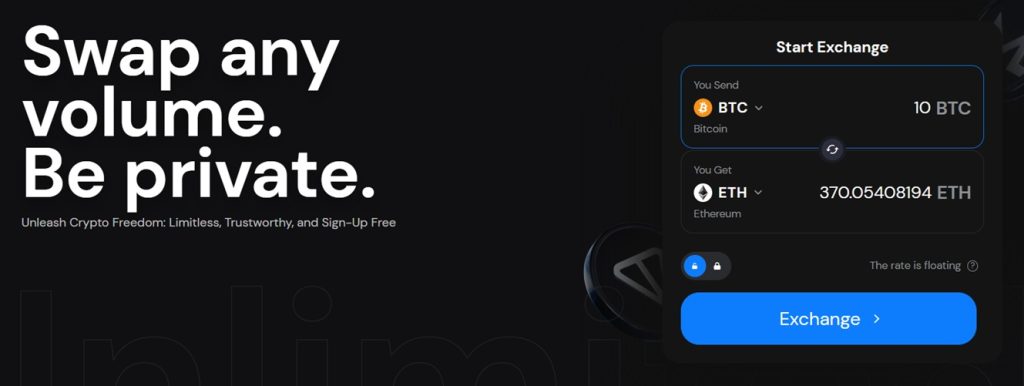
What that means is you choose a coin pair, Godex shows you a rate, you send from your wallet, and the exchanged coins go directly to your receiving wallet. That helps explain why no KYC is collected – there’s no account to inspect.
It’s 930+ coin support (including XMR pairs), fixed-rate option, zero-data-collection model, and two-week order deletion are services that we find unmatched in the instant swap category among platforms.
Available Coins and Trading Pairs
Godex provides access to (at the time of writing) 936+ tradable cryptocurrencies, including major assets (BTC, ETH, XRP, LTC) as well as privacy coins. Native Monero (XMR) support provides actual on-chain XMR swaps, not wrapped tokens.
There are no upper limits for cryptocurrency exchanges on Godex. In order to transfer coins from one address to another, gas fees and miner fees can apply, so Godex does have minimal transaction fees to cover them, which vary by pair and network conditions, but are noted at quote time, and we found them competitive with centralized exchanges.
The No-KYC Policy: Where Godex Differs From Competitors
Genuine, uncapped no-KYC policies are rare. We note that other services often rely on partner exchanges with their own compliance systems, which can lead to freezes when KYC is subsequently requested. Other “no-KYC” exchanges bring in checks above €10,000 or similar thresholds. So that no-KYC promise often comes up with caveats or wrinkles.
Based on user reports and independent testing through 2025 and early 2026, Godex has not imposed KYC for any swap size, including large transactions over $100,000.
And then, after the swap completes, Godex deletes all order information after two weeks.
The practical consequence for high-volume traders is that there are no hidden thresholds to discover mid-transaction.
Extra Features on Godex Worth Mentioning
Swapping in and out of coins is the superpower of Godex – but here are some extra features or options we appreciated:
Fixed Rates & Floating Rates
Every swap on Godex offers a choice between two rate types. The fixed rate is locked for 30 minutes, while the floating rate tracks the market.
Most instant swap platforms default to floating rates, and some charge an additional fee for price locks. Godex offers the 30-minute fixed window as a standard feature, relevant for anyone moving a position large enough that 2–3% price movement during the swap window would make a difference.
The floating rate may yield a slightly better outcome if the pair moves in your favor during execution. For large or time-sensitive swaps, the fixed rate removes that variable.
Trezor and Edge Wallet Hardware Integration
Godex has official integrations with Trezor hardware wallets and Edge Wallet. For Trezor users, this means initiating the swap directly in Trezor Suite, with private keys never leaving the device.
Edge Wallet’s inclusion is relevant as Edge Wallet holds privacy as a non-negotiable product requirement, and its vetted partner list reflects that. Being included on both lists adds a layer of third-party validation that on-chain swaps benefit from.
Native Monero (XMR) Support
The wallet-to-wallet flow supports BTC to XMR and other similar pairs, allowing users to select a fixed or floating rate, enter their destination Monero address, send funds to the one-time deposit address, and receive native assets automatically once confirmed.
XMR support on most instant swap platforms is either limited to specific pairs or routes through a wrapped or synthetic version of Monero. Godex processes actual on-chain XMR.
How to Use Godex: Step-by-Step
No account is created at any stage. The entire process runs from wallet to wallet.
Step 1: Select Your Trading Pair
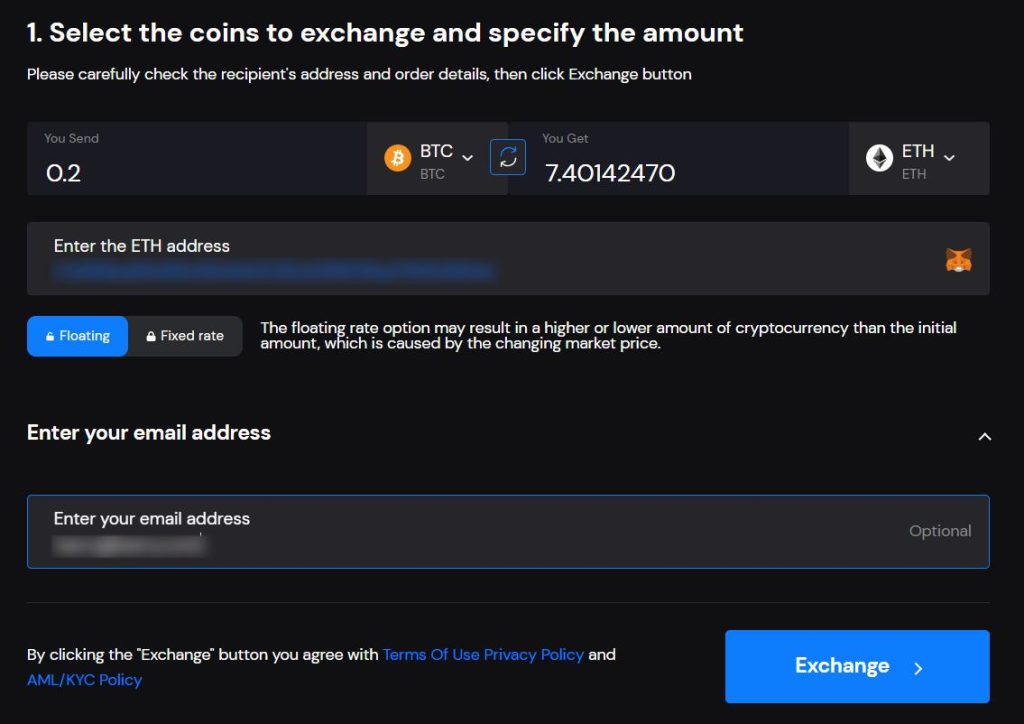
Go to godex.io (or use the Android app). On the main page, select the cryptocurrency you are sending in the left field and the cryptocurrency you want to receive in the right field. Enter the amount. The platform will calculate the estimated output and display the quoted rate.
Step 2: Choose Your Rate Type
Select fixed rate (locked for 30 minutes, recommended for larger swaps or volatile pairs) or floating rate (tracks market price, may yield a marginally better result if the pair moves in your favor). The fixed rate includes a small premium. (You will see an email field below, but it is entirely optional.)
Step 3: Enter Your Receiving Wallet Address
Enter a destination address – a valid wallet address for the currency you want to receive. This is the only piece of information Godex handles.
For some currencies, including Monero, Ripple, and Stellar, an additional ID field will appear. Sending without the correct additional ID on applicable pairs can result in lost funds.
Step 4: Send Funds to the Deposit Address
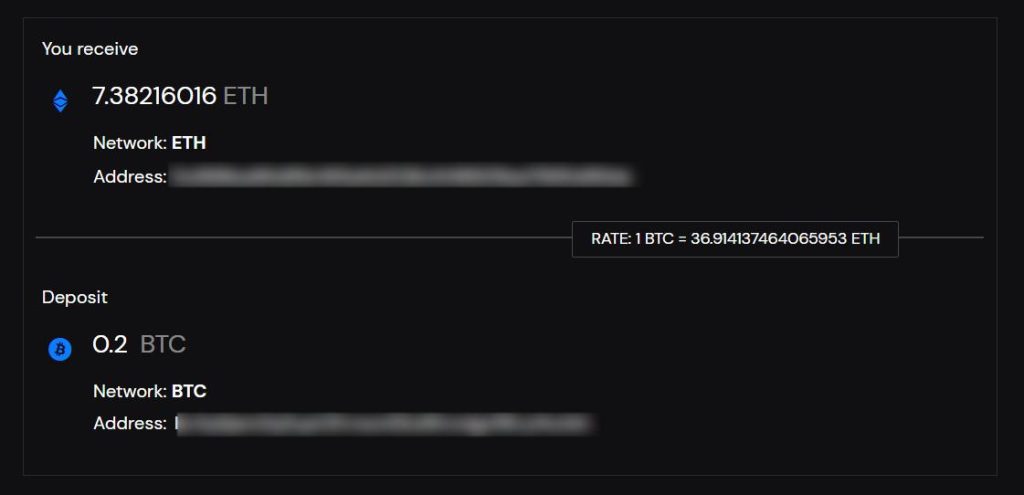
Send the exact input amount to Godex’s one-time deposit address. The address is generated for that transaction only. Send within the rate window.
Step 5: Wait for Completion
The platform routes the swap through liquidity sources and sends the output to your wallet — usually within 5–30 minutes. Completion time varies depending on the confirmation speed of the sending and receiving networks. After the swap completes, Godex deletes all order information after two weeks.
Fees and Limits
Fees stay competitive at approximately 0.5% all-in, embedded in the quoted rate with zero hidden costs. There is no separate fee line to subtract (the spread markup is visible only by comparing the quoted rate to the live mid-market price). Most instant swap platforms use this model, and Godex’s ~0.5% sits at the lower end of the non-custodial swap category.
Godex does not charge withdrawal fees – the only fee is any network fees.
There are no upper limits on transaction size. The only minimum is the network miner fee requirement, which varies by blockchain.
Our Experience Using Godex
The interface is intentionally minimal – very much just a purchase interface. Everything you need to swap crypto and then get on with your day, and, in case it needs emphasizing again, no sign-ups or logins.
Very simply:
- You go to godex.io
- Select the coin you’re sending and the coin you want to receive
- Choose fixed rate or floating rate
- Enter your receiving wallet address for the output coin
- Send the exact input amount to Godex’s one-time deposit address.
The platform routes the swap through liquidity sources and sends the output to your wallet, usually within 5–30 minutes (which will be dictated by the chain you are on, e.g. Ethereum usually takes a few minutes, Bitcoin might take 10 minutes.
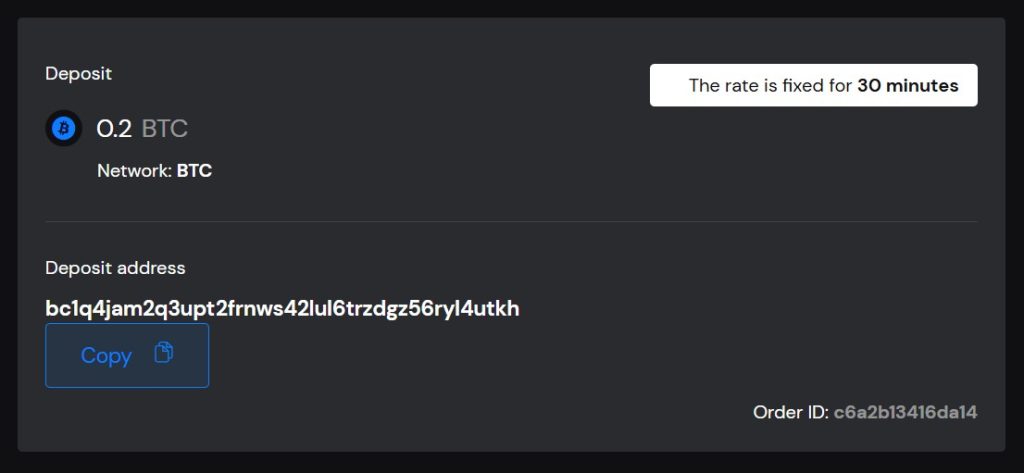
To provide the best “in-and-out” exchange experience, Godex’s system tracks rates in real time across platforms, including Bitfinex, HitBTC, Binance, and other partners.
One practical caution is that after a transaction is included in a block, it cannot be recalled or changed by anyone – that immutability is one of the main features of blockchain. So do check all data (such as amounts and wallet addresses) carefully before executing the exchange. A test swap on an unfamiliar pair before moving a significant position is worth the cost.
All in all, it is the quickest way to swap between coins – no fuss, no unnecessary clicks.
Pros and Cons of Using Godex
| ✅ No KYC at any transaction size – no hidden thresholds confirmed through 2026 | ❌ US users are not supported |
| ✅ 936+ cryptocurrencies including native XMR support |
❌ No fiat on/off ramp – crypto-to-crypto only
|
| ✅ No account, no email, no registration required |
❌ No proof-of-reserves or third-party financial audit
|
| ✅ ~0.5% all-in fee – competitive versus the non-custodial swap market |
❌ No major-jurisdiction regulatory license (MiCAR, FinCEN, etc.)
|
| ✅ Official Trezor integration – requires independent security review to list |
❌ No advanced order types, charting, or margin trading
|
| ✅ Automatic order deletion after two weeks | |
| ✅ Fixed rate locked for 30 minutes – no extra charge | |
|
✅ No security breaches since 2018 launch
|
What “Non-Custodial” Means in Practice
Godex never holds your account balance and only temporarily custodies your coins during the actual exchange execution. The FTX collapse in November 2022 illustrated what custodial risk looks like at scale: over seven million users had funds frozen because the platform had been holding assets in accounts it controlled.
Non-custodial architecture eliminates that specific failure mode – there is no account to freeze, and you always hold your own assets.
| Feature | Custodial Exchange |
Non-Custodial Exchange
|
| Holds your funds | Yes – in exchange wallets |
No – wallet-to-wallet routing only
|
| Requires account/login | Yes | No |
| KYC required | Almost always |
No (by architecture)
|
| Freeze risk | Platform can lock funds |
No account to freeze
|
| Data collected | Extensive |
None permanently stored
|
Godex holds an official integration with Trezor, the hardware wallet manufacturer, with Trezor including Godex in its vetted list of exchange partners that requires passing an independent security review before listing.
For instance, you can exchange ETH to BTC directly through Trezor Suite’s interface, and private keys remain on the hardware device throughout.
Godex servers use SSL certificates to prevent information interception and are protected against DDoS attacks. There have been no recorded security breaches since launch. Note, Godex is not available to United States residents.
Conclusion
Godex continues to deliver a true no-KYC operation, unlimited transaction volumes, competitive ~0.5% fees, 30-minute fixed-rate protection, and fast 5–20-minute settlements across 936+ assets.
With eight years of operation under its belt, without a verified security breach and without reversing its no-KYC policy under regulatory pressure, it has an excellent track record in a category where most competitors have buckled over time.
The platform is not for everyone – Godex.io does not allow US users, there is no fiat gateway, nor advanced charting or margin trading. But they aren’t Godex’s purpose. The service does one thing at the highest quality.
For the specific use case it’s built for – genuine privacy without verification triggers, regardless of swap size – Godex delivers what it promises consistently.