Some of the links on this site may be affiliate links. ICOBench may receive advertising commissions when users visit recommended platforms via our affiliate links, at no additional cost to you. All recommendations are based on a comprehensive review process.
Bitcoin is having another very good week – although using it to buy something is still one of the biggest challenges in crypto.
BTC is trading at $86,202.45, up 13.86% over seven days, with the rally spreading well beyond Bitcoin – take NEAR, which is up 88.18% over the same period. But after all the progress crypto has made in trading, DeFi, and tokenized assets, Bitcoin itself remains focused on the job it had at launch: securely moving BTC from one address to another.
Spending it in the real world is still a tough task, largely limited by the number of transactions Bitcoin can process per second. Bitcoin Hyper (HYPER) has a neat solution to a problem that has been nearly two years in the making.
Its Layer 2 is designed to let Bitcoin move at speeds better suited to real-world payments, while opening BTC to trading and financial apps that are difficult to run directly on the original network.
It is an idea that has swept across crypto, with HYPER already raising $33.1 million, with tokens currently priced at $0.01368.
For investors looking for the best crypto to buy now, the appeal is easy to understand: HYPER aims to make all that locked BTC value considerably easier to spend.
Bitcoin Wasn’t Built for the Checkout
Bitcoin’s slowness isn’t an engineering accident – the network deliberately prioritizes decentralization, security, and a simple monetary ledger over raw throughput. A new Bitcoin block arrives roughly every 10 minutes, and the base-layer speed is only about 7 transactions per second (depending on transaction size and network conditions).
Bitcoin’s own developer documentation notes that a transaction paying an adequate fee still takes about 10 minutes on average to receive its first confirmation.
That can be perfectly acceptable when someone is moving savings between wallets, but far less attractive when someone is standing at a checkout. Nobody wants to order lunch, broadcast a BTC transaction, and then spend the next ten minutes discussing blockchain security with the cashier.
Online commerce has the same problem: modern payment systems and customers expect a settlement answer almost immediately – maybe with a second’s grace.
Bitcoin Hyper’s answer is not to start rewriting Bitcoin, but a separate Layer 2 where transactions happen near-instantly, using the Solana Virtual Machine (SVM) – the execution environment used by Solana applications and smart contracts. BTC brought into the network can then be sent, received, and used on the Layer 2 with the speeds needed in 2026.
The speed difference between the two underlying designs is enormous. Solana’s own research materials cite 55,000 TPS in theoretical throughput, while its live explorer was recently processing more than 5,500 transactions per second.
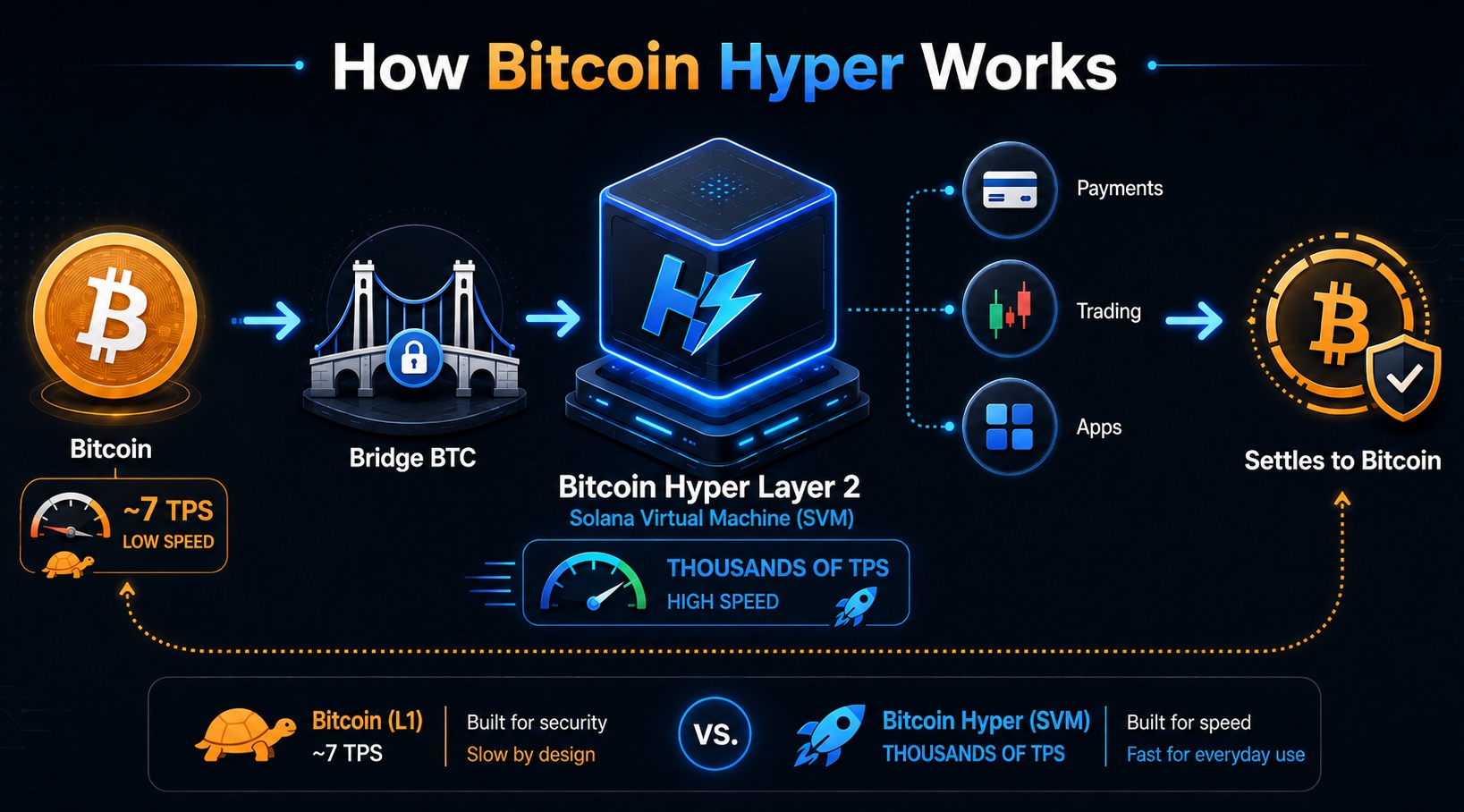
That means a payment app that adopts Bitcoin Hyper can let somebody bring BTC onto the Layer 2, spend it at a speed suitable for payments, then withdraw back to native Bitcoin when needed.
The project’s canonical bridge handles that journey: BTC is deposited to a Bitcoin address, verified by the bridge infrastructure, and represented on the Layer 2 for use inside the HYPER ecosystem.
Bitcoin remains Bitcoin – but the checkout doesn’t have to feel like Bitcoin. That checkout could be an online store, a physical payment terminal, or a financial app where users need to complete several actions quickly.
HYPER also supports smart contracts, meaning the same BTC that becomes easier to send can potentially move through decentralized exchanges, lending products, and other services.
The payment angle may be the most important, though, because it goes back to Bitcoin’s original ambition.
HYPER Has $33.1M Behind the Payments Push
The plan has already attracted a sizeable presale audience. Bitcoin Hyper has raised $33.1 million before public exchange trading begins, with HYPER available at $0.01368.
The token itself is used inside the network and can also be staked, with the current staking rate at 35% APY. Coinsult and SpyWolf have audited the token contracts.
The city sleeps. $HYPER stays charged. ⚡️ pic.twitter.com/LKBUzZLH39
— Bitcoin Hyper (@BTC_Hyper2) September 22, 2026
The timing is interesting because Bitcoin utility is becoming a much broader theme – Circle this week launched a service allowing eligible institutional customers to deposit BTC, mint cirBTC, and use it as collateral to borrow USDC without selling the underlying Bitcoin.
Circle describes the product as a route for BTC to participate in lending and other on-chain financial activity rather than simply remaining in treasury custody.
That’s a very different product from Bitcoin Hyper, but the direction is similar – holders increasingly want to keep their Bitcoin exposure while doing something useful with the capital.
Payments could become another major part of that shift, and Solana provides a useful glimpse of what happens when a blockchain is built around fast interaction.
Its network is already used for payments and stablecoin settlement, while the Solana Foundation is experimenting with payment infrastructure capable of handling large volumes of off-chain payment updates before settling them back into the network.
HYPER’s proposition is to bring some of that high-speed thinking to Bitcoin without asking BTC holders to abandon the asset that brought them there.
The $33.1 million presale shows an unusually large audience for a Bitcoin Layer 2 that is preparing its payments and app ecosystem. If it can unlock the effectively idle capital sitting in crypto’s largest market cap, HYPER could become a household name, at least within crypto circles, with surprising speed.