Some of the links on this site may be affiliate links. ICOBench may receive advertising commissions when users visit recommended platforms via our affiliate links, at no additional cost to you. All recommendations are based on a comprehensive review process.
Bitcoin payments are becoming less theoretical – Square now lets eligible U.S. merchants accept Bitcoin directly at checkout through the Lightning Network, with payments settling in seconds and sellers able to receive either BTC or automatically converted dollars. Bitcoin payments are also being auto-enabled for eligible Square locations, while a June update added tap-to-pay support on newer Square Register hardware.
So the demand side of Bitcoin is becoming clearer, and while Lightning is highly specialized around sending Bitcoin efficiently, Bitcoin still lacks the programmable, high-speed environment that made Ethereum and Solana useful for trading, financial products, and DeFi. There’s a hunger to make BTC an asset that can move easily through a much wider range of everyday financial activity.
Bitcoin Hyper (HYPER) is the first credible attempt to bring BTC into 2026, without changing the base layer. Its Layer 2 uses the Solana Virtual Machine to combine faster Bitcoin transfers with programmable execution, making payments the starting point rather than the full extent of Bitcoin’s utility. HYPER costs $0.01368, has raised $33 million in presale, and offers a 35% staking APY.
How Bitcoin Hyper Moves Payments Off the Base Chain
Bitcoin Hyper starts with a practical constraint: Bitcoin Layer 1 can process only a limited number of transactions at once (7 transactions per second).
So the project moves frequent activity into a faster execution environment powered by the Solana Virtual Machine. Bitcoin remains underneath as the monetary and settlement layer, while the Layer 2 handles rapid transfers and other activity that would be cumbersome if every interaction had to compete for Bitcoin block space.
Transactions carried out on Bitcoin Hyper are bundled together and verified with zero-knowledge proofs before the Layer 2 state is committed back to Bitcoin.
Hard to miss $HYPER from up here. ⚡️🔥 pic.twitter.com/mIHy3xRInZ
— Bitcoin Hyper (@BTC_Hyper2) August 17, 2026
That method is particularly relevant to payments because checkout experiences are unforgiving. A user buying coffee or paying a merchant does not want to think about block intervals, transaction queues, or network architecture – they certainly can’t wait at the checkout for 10 minutes.
Square’s rollout is useful evidence of that demand, and while Bitcoin Hyper is not trying to replace Lightning, it is testing another route toward the same underlying goal: making BTC useful when speed matters.
Where HYPER goes further is programmability – the same execution environment based on Solana that supports fast transfers can also bring smart contract functions to Bitcoin – trading tools, financial products, yield platforms, lending, and more. HYPER itself is used within the Layer 2 for network activity, while holders can stake it and are intended to participate in governance as the system develops.
Coinsult and SpyWolf are listed as auditors of project contracts.
Could HYPER Be the Next Crypto to Explode?
The $33 million presale raise makes Bitcoin Hyper one of the more heavily backed presales of the year, but fundraising alone is not the interesting part – it is more the size of the market. If Bitcoin can become easier to spend without changing Bitcoin Layer 1 itself, the total addressable market is Bitcoin’s market cap – more than a trillion dollars.
BTC already has the users, liquidity, and global recognition – what it doesn’t have is much utility other than buy and hold.
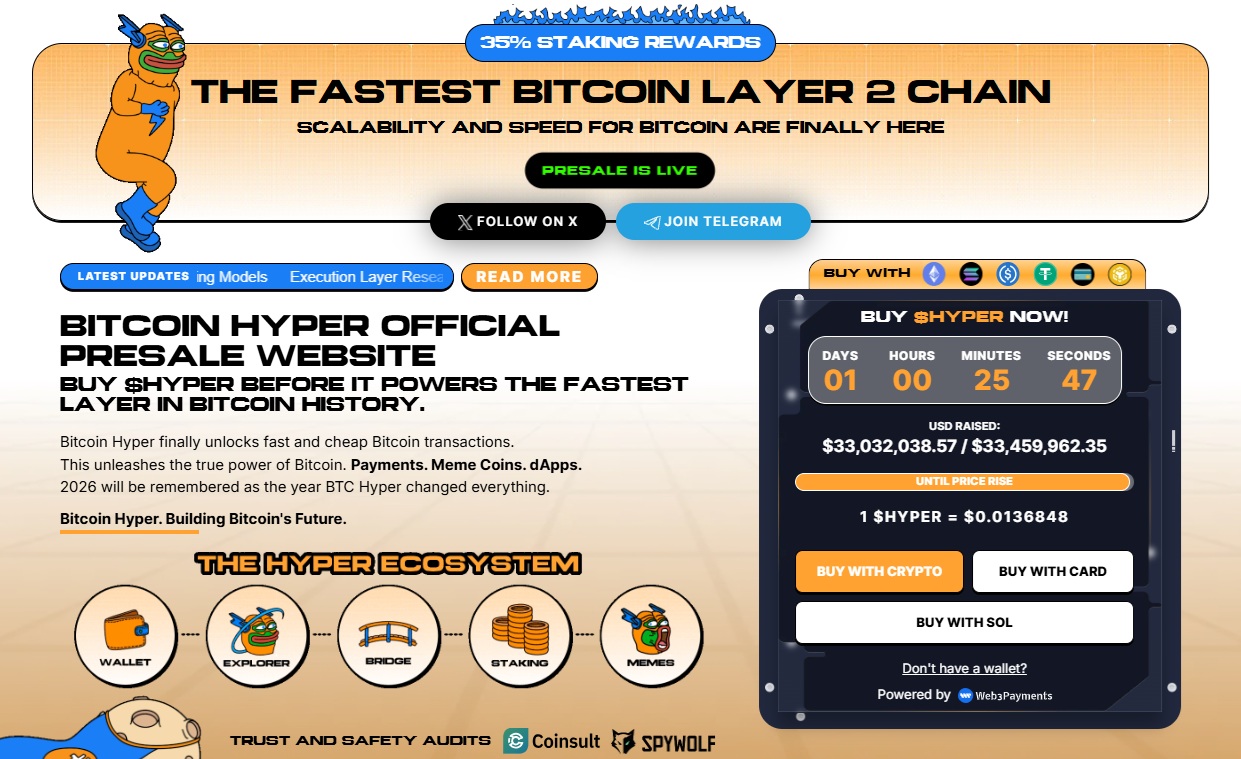
What HYPER needs is developers willing to build around the SVM environment and users who find its payment and financial tools useful. But if successful, HYPER could be the first Bitcoin Layer 2 to succeed at scale. Merging Bitcoin’s L1 with a Solana-based L2 is a novel and, perhaps in hindsight, an obvious move.
For investors searching for the next crypto to explode, HYPER arrives as real businesses demonstrate that faster Bitcoin payments are in demand.
Bitcoin Payments Are Becoming Ordinary
Bitcoin spent years becoming extraordinary – the first digital currency that was scarce, decentralized, and valuable enough to attract institutions.
Payments require something almost opposite – they need Bitcoin to become boring, where a transaction at a café should not feel like a blockchain event. Instead, it should take a second, settle reliably, and let both sides get on with their day.
Payments will likely get the attention, but programmability goes even further. Bitcoin itself doesn’t need to pick up the powers of, say, Ethereum, but having those smart contract options gives BTC its third strength – digital gold, spendable currency, and programmable money.
The projects that make that experience genuinely ordinary may end up doing some of Bitcoin’s most important work since the early 2010s.