


 Some of the links on this site may be affiliate links. ICOBench may receive advertising commissions when users visit recommended platforms via our affiliate links, at no additional cost to you. All recommendations are based on a comprehensive review process.
Goldman Sachs has issued one of its most consequential Asia FX calls of 2026, backing the South Korean won, Taiwan dollar, and Malaysian ringgit as the primary beneficiaries of a structural shift driven by the global AI investment boom, and separating those chip-exporting economies sharply from energy importers like the Thai baht and Indonesian rupiah, which the bank expects to continue lagging.
South Korea’s current account surplus is forecast to nearly double to roughly $300 billion this year, equal to 13.9% of GDP, while Taiwan’s surplus is projected at 25% of GDP, the widest in Asia, underpinned by surging semiconductor exports and substantial USD deposit holdings.
The macro split Goldman identifies, AI capital spending versus energy supply shock exposure, does not stay contained to FX desks. Stronger local currency liquidity in Korea and Taiwan translates directly into more dry powder on regional crypto exchanges, more aggressive positioning in AI tokens, and a broader EM liquidity expansion that sets up the classic conditions for altcoin rotation.
Goldman Sachs lists Asian currencies riding the AI boom https://t.co/ymHOUFpi2X
— CNBC (@CNBC) July 27, 2026
The open question the market must now resolve is whether the AI investment cycle sustains long enough to convert this FX outperformance into a durable crypto liquidity tailwind – or whether a reversal in AI sentiment compresses both simultaneously.
Goldman Sachs Asia FX Split: What the Chip-Exporter Surplus Actually Reveals About AI’s Macro Footprint
Context significantly enhances the raw figure. Goldman identifies two forces reshaping Asian macro markets in 2026: a global energy supply shock that weighs on oil-importing economies, and an AI capital spending boom that generates sustained export revenue and FDI inflows for semiconductor hubs.
That divergence is now the dominant driver of intra-Asia exchange rate dispersion, according to the bank’s analysis.
For the South Korean won, Goldman’s bullish case rests on a current account surplus expanding faster than outbound equity flows can offset. The bank noted that reduced foreign equity outflows have lessened the drag on the surging current account surplus, paving the way for a won rally.
For the Taiwan dollar, the mechanism is similar: semiconductor exports running at record levels and a current account surplus at 25% of GDP provide structural currency support even with interest rates held steady.
The Malaysian ringgit rounds out Goldman’s bullish trio, supported by resilient AI-led economic growth, strong export performance, and sustained foreign direct investment.
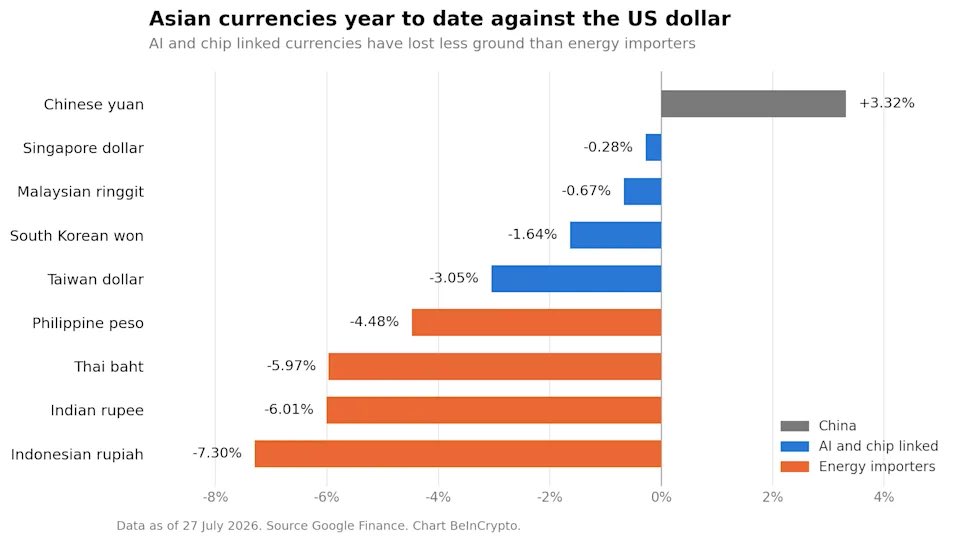
The bank is more cautious elsewhere: falling gold prices and lower real rates weigh on the Thai baht; Indonesia faces governance questions; and the Philippine peso remains sensitive to elevated oil costs. China is the outlier: the yuan has gained +3.32% year-to-date, the only Asian currency higher against the greenback, with Goldman maintaining a 12-month USD/CNY forecast of 6.50 on undervaluation and yuan internationalization.
Critically, outperformance here is relative. The dollar index is up nearly +3% in 2026, meaning every AI-linked Asian currency Goldman favors has still lost ground in absolute terms: the won is down -1.64%, the ringgit -0.67%, and the Taiwan dollar -3.05%.
Energy importers fared far worse: the Indonesian rupiah dropped by 7.30%, the baht by 5.97%, and the peso by 4.48%. Goldman’s call is that the divergence holds – and widens, as long as AI investment stays intact.